
利用微分熵和网络推理揭示小鼠早期胚胎分化过程中的候选Nanog辅助基因。
Uncovering candidate Nanog-Helper genes in early mouse embryo differentiation using differential entropy and network inference.
作者信息
Prista von Bonhorst Francisco, Gandrillon Olivier, Herbach Ulysse, Robert Corentin, Chazaud Claire, De Decker Yannick, Gonze Didier, Dupont Geneviève
机构信息
Unit of Theoretical Chronobiology, Université libre de Bruxelles (ULB), 1050, Brussels, Belgium.
Univ Lyon, CNRS, ENS de Lyon, INSERM, UMR5239, LBMC, U1210, 69364, Lyon, France.
出版信息
Sci Rep. 2025 Jun 6;15(1):19975. doi: 10.1038/s41598-025-03956-y.
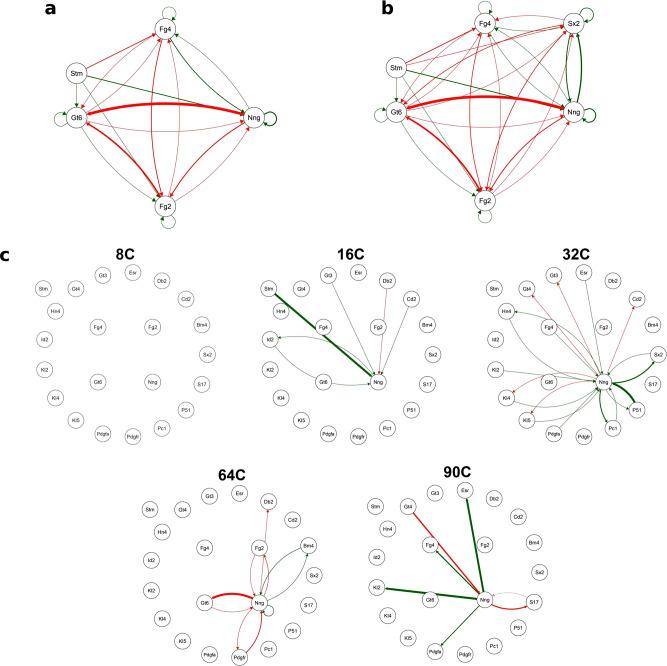
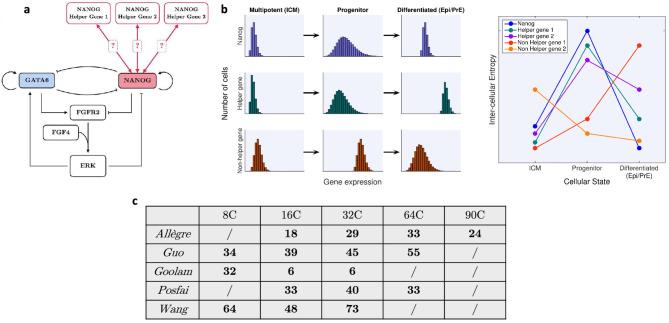
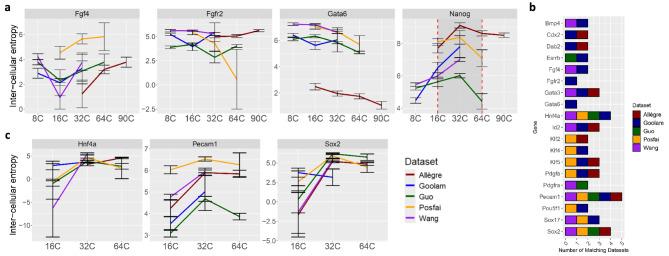
In the preimplantation mammalian embryo, stochastic cell-to-cell expression heterogeneity is followed by signal reinforcement to initiate the specification of Inner Cell Mass (ICM) cells into Epiblast (Epi). The expression of NANOG, the key transcription factor for the Epi fate, is necessary but not sufficient: coincident expression of other factors is required. To identify possible Nanog-helper genes, we analyzed gene expression variability in five time-stamped single-cell transcriptomic datasets using differential entropy, a quantitative measure of cell-to-cell heterogeneity. The entropy of Nanog displays a peak-shaped temporal pattern from the 16-cell to the 64-cell stage, consistent with its key role in Epi specification. By estimating the entropy profiles of the 21 genes common to all five datasets, we identified three genes - Pecam1, Sox2, and Hnf4a - whose variability in expression patterns mirrors that of Nanog. We further performed gene regulatory network inference using CARDAMOM, an algorithm that exploits temporal dynamics and transcriptional bursting. The results revealed that these three genes exhibit reciprocal activation with Nanog at the 32-cell stage. This regulatory motif reinforces fate-switching decisions and co-expression states. Our innovative analysis of single-cell transcriptomic data thus uncovers a likely role for Pecam1, Sox2, and Hnf4a as key genes that, when coincidentally expressed with Nanog, initiate ICM differentiation.
在植入前的哺乳动物胚胎中,细胞间随机的表达异质性之后是信号增强,以启动将内细胞团(ICM)细胞分化为上胚层(Epi)的过程。NANOG是决定Epi命运的关键转录因子,其表达是必要的,但并不充分:还需要其他因子的协同表达。为了确定可能的Nanog辅助基因,我们使用微分熵(一种衡量细胞间异质性的定量指标)分析了五个带有时间戳的单细胞转录组数据集的基因表达变异性。Nanog的熵在16细胞期到64细胞期呈现出峰状的时间模式,与其在Epi分化中的关键作用一致。通过估计所有五个数据集共有的21个基因的熵谱,我们确定了三个基因——Pecam1、Sox2和Hnf4a——它们的表达模式变异性与Nanog相似。我们进一步使用CARDAMOM进行基因调控网络推断,这是一种利用时间动态和转录爆发的算法。结果显示,这三个基因在32细胞期与Nanog呈现相互激活。这种调控基序强化了命运转换决定和共表达状态。因此,我们对单细胞转录组数据的创新性分析揭示了Pecam1、Sox2和Hnf4a作为关键基因的可能作用,当它们与Nanog同时表达时,可启动ICM分化。


 Zotero 插件