
溶酶体离子通道与疼痛。
Lysosomal ion channels and pain.
作者信息
Liu Wanxue, Li Yiming, Bao Yuhan, Tan Zhi-Yong
机构信息
School of Basic Medicine, Hebei University, Baoding, Hebei, China.
Stark Neurosciences Research Institute, Indiana University School of Medicine, Indianapolis, IN, USA.
出版信息
Pain Rep. 2025 Jun 5;10(4):e1282. doi: 10.1097/PR9.0000000000001282. eCollection 2025 Aug.
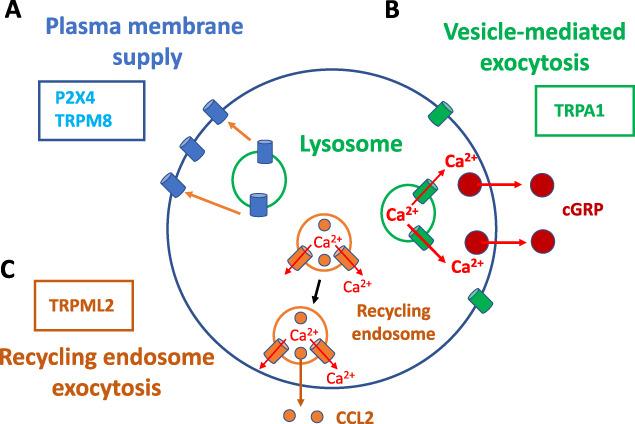
Lysosomes are recycling centers of nearly all types of eukaryotic cells. Lysosomal ion channels maintain ion homeostasis of lysosomes and exchange ions with neighboring cytoplasm and subcellular structures. In these ways, lysosomal ion channels contribute to major function of lysosomes such as autophagy and lysosomal exocytosis. Deficiency in some lysosomal ion channels results in lysosome storage disorders such as mucolipidosis IV that is associated with early-onset neurodegeneration. Moreover, lysosomal ion channels are involved in a variety of conditions such as cancer, infectious diseases, respiratory diseases, cardiovascular and kidney diseases. This narrative review aims to summarize current evidence that supports the potential role of lysosomal ion channels in pain. Lysosomal P2X4 may contribute to pain through trafficking to plasma membrane as well as lysosomal exocytosis. In dorsal root ganglion neurons, lysosomal TRPM8 functions as a constitutive supply from lysosomal to plasma membrane, whereas lysosomal TRPA1 may mediate vehicle exocytosis of neurotransmitters. Moreover, recent studies suggest that Tmem63A forms a mechanosensory ion channel in lysosomal membrane and that Tmem63A of dorsal root ganglion neurons contributes to mechanical hypersensitivity in chronic pain models. Furthermore, evidences indicating a potential role of TRPMLs in pain include ROS sensitivity of TRPML1, chemokine release mediated by TRPML2, and re-expression of TRPML3 upon nerve injury. However, despite the current supporting evidence, the role of lysosomal ion channels in pain is just being explored, and future studies are needed to address the significance, mechanism, and potential translation of lysosomal ion channels in pain.
溶酶体是几乎所有类型真核细胞的回收中心。溶酶体离子通道维持溶酶体的离子稳态,并与相邻的细胞质和亚细胞结构进行离子交换。通过这些方式,溶酶体离子通道有助于溶酶体的主要功能,如自噬和溶酶体胞吐作用。某些溶酶体离子通道的缺陷会导致溶酶体贮积症,如与早发性神经退行性变相关的黏脂贮积症IV型。此外,溶酶体离子通道还涉及多种病症,如癌症、传染病、呼吸系统疾病、心血管疾病和肾脏疾病。这篇叙述性综述旨在总结当前支持溶酶体离子通道在疼痛中潜在作用的证据。溶酶体P2X4可能通过转运到质膜以及溶酶体胞吐作用导致疼痛。在背根神经节神经元中,溶酶体TRPM8作为从溶酶体到质膜的组成性供应发挥作用,而溶酶体TRPA1可能介导神经递质的囊泡胞吐作用。此外,最近的研究表明,Tmem63A在溶酶体膜中形成机械敏感离子通道,背根神经节神经元的Tmem63A在慢性疼痛模型中导致机械性超敏反应。此外,表明TRPMLs在疼痛中潜在作用的证据包括TRPML1对活性氧的敏感性、TRPML2介导的趋化因子释放以及神经损伤后TRPML3的重新表达。然而,尽管有目前的支持证据,但溶酶体离子通道在疼痛中的作用才刚刚开始探索,未来还需要研究来阐明溶酶体离子通道在疼痛中的意义、机制和潜在的转化应用。


 Zotero 插件