
上海猩红热的持续流行及A群M1型菌株的出现:一项跨越新冠疫情时期的14年监测研究
Ongoing epidemic of scarlet fever in Shanghai and the emergence of M1 lineage group A : a 14-year surveillance study across the COVID-19 pandemic period.
作者信息
Cai Jiehao, Zhou Xingyu, Zhang Chi, Jiang Yue, Lv Panpan, Zhou Yibin, Chen Mingliang, Zeng Mei
机构信息
Department of Infectious Diseases, Children's Hospital of Fudan University, Shanghai, China.
Department of Microbiology, Minhang Center for Disease Prevention and Control, Shanghai, China.
出版信息
Lancet Reg Health West Pac. 2025 May 13;58:101576. doi: 10.1016/j.lanwpc.2025.101576. eCollection 2025 May.
BACKGROUND
The surge of group A (GAS) infections in regional countries warranted attention in the post-COVID-19 era. The resurgence of notifiable scarlet fever in China has been a public health issue since 2011. We conducted a consecutive 14-year surveillance study to analyse dynamic epidemiological profiles of scarlet fever from the perspective of epidemic trend and molecular evolution of GAS strains.
METHODS
From 2011 to 2024, epidemiological data on notifiable cases of scarlet fever and 3370 GAS isolates from children with scarlet fever were analysed. Incidence rates were calculated as the mean rate per 100,000 population with 95% CIs. Whole genome sequencing was performed on 332 12 and 248 1 isolates.
FINDINGS
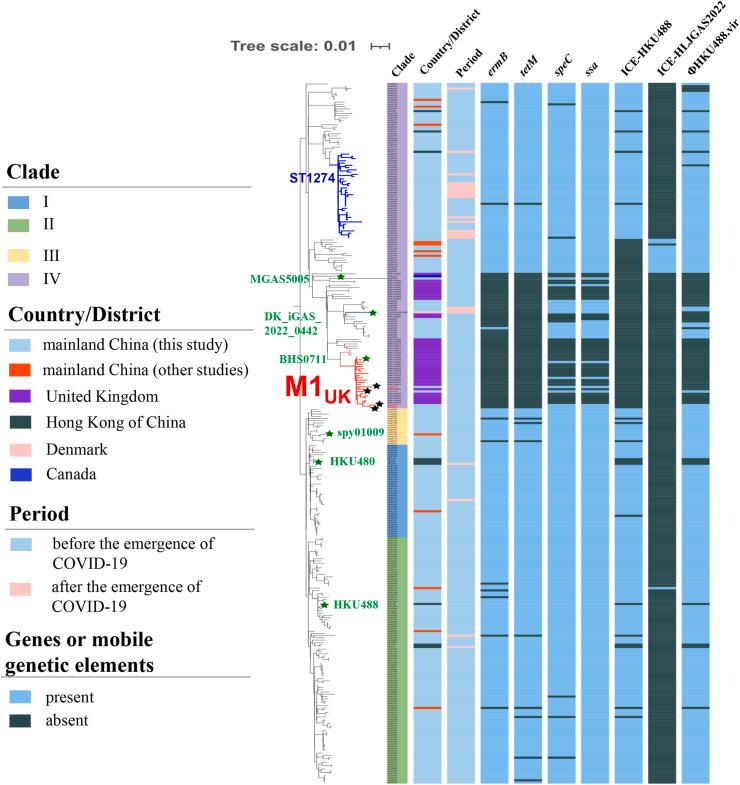
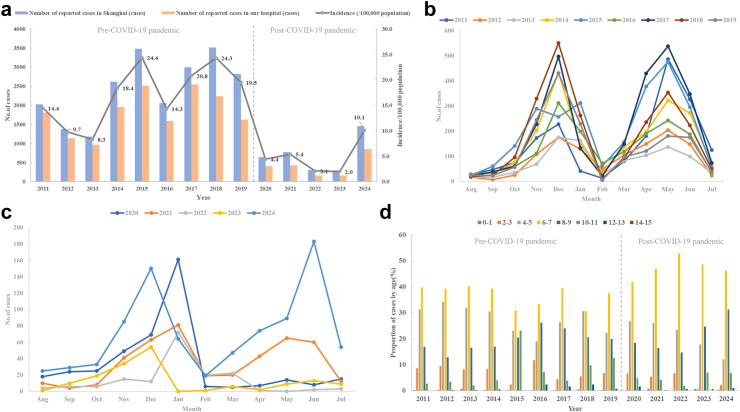
From 2011 to 2024, a total of 25,539 cases of scarlet fever were reported in Shanghai. The mean incidence declined from 17.1/100,000 population (95%CI 9.7-24.3, pre-COVID-19 period) to 4.8/100,000 population (2.0-10.1, post-COVID-19 period). Children aged 4-9 years represented 85.6% of cases. Sixteen types were identified with predominance of 12 (66.4%) and 1 (29.8%). The annual proportions of 12 and 1 alternatively fluctuated with a cycle of six years. GAS isolates displayed >90% resistance rate to erythromycin, clindamycin, and tetracycline. The distribution of types, antimicrobial resistance rates and profiles, and differences in superantigen genes carried by the 12 and 1 isolates were similar in the pre- and post-COVID-19 periods. Phylogenetic analysis indicated 96.7% of 12 isolates belonged to Clade II, harbouring ICE-12 and ΦHKU.vir. Among the 1 isolates, the proportions of the ST1274 isolates increased from 10.5% (pre-COVID-19 period) to 73.7% (post-COVID-19 period). Four novel M1 isolates were found in Shanghai, with distinctive characteristics of presence of and .
INTERPRETATION
Persistent and periodic predominance of 12 and 1 types was responsible for the annual epidemic of scarlet fever in Shanghai. A marked decline in the incidence of scarlet fever in the last 5 years in Shanghai may be associated with enhanced type-specific immunity among the susceptible population and enhanced infection control measures, awareness, and actions in child institutions in the post-COVID-19 era. The emergence of the M1 isolates with some distinctive characteristics and ST1274 lineage warrants further attention and continuous surveillance in China.
FUNDING
Shanghai municipal three-year action plan for strengthening the construction of the public health system 2023-2025 (GWVI-2.1.2); Research project of Shanghai Minhang District Health Commission (2024MW45).
背景
在新冠疫情后时代,部分地区A群链球菌(GAS)感染激增,值得关注。自2011年以来,中国法定报告猩红热病例的再度流行一直是一个公共卫生问题。我们开展了一项为期14年的连续监测研究,从GAS菌株的流行趋势和分子进化角度分析猩红热的动态流行病学特征。
方法
分析2011年至2024年法定报告猩红热病例的流行病学数据以及3370株来自猩红热患儿的GAS分离株。发病率计算为每10万人的平均发病率,并给出95%置信区间。对332株1型和248株1型分离株进行全基因组测序。
研究结果
2011年至2024年,上海共报告25539例猩红热病例。平均发病率从17.1/10万人口(95%置信区间9.7 - 24.3,新冠疫情前时期)降至4.8/10万人口(2.0 - 10.1,新冠疫情后时期)。4至9岁儿童占病例的85.6%。共鉴定出16种类型,其中12型占主导(66.4%),1型次之(29.8%)。12型和1型的年度占比交替波动,周期为6年。GAS分离株对红霉素、克林霉素和四环素的耐药率>90%。新冠疫情前后时期,1型和1型的类型分布、抗菌药物耐药率及谱型,以及12型和1型分离株携带的超抗原基因差异相似。系统发育分析表明,96.7%的12型分离株属于进化枝II,携带ICE-12和ΦHKU.vir。在1型分离株中,ST1274分离株的比例从10.5%(新冠疫情前时期)增至73.7%(新冠疫情后时期)。在上海发现了4株新型M1分离株,具有独特的特征,即存在和。
解读
12型和1型的持续周期性优势导致了上海猩红热的年度流行。上海过去5年猩红热发病率显著下降,可能与易感人群中针对特定类型的免疫力增强以及新冠疫情后时代儿童机构中感染控制措施、意识和行动的加强有关。具有一些独特特征的M1分离株和ST1274谱系的出现值得中国进一步关注并持续监测。
资助
上海市2023 - 2025年加强公共卫生体系建设三年行动计划(GWVI-2.1.2);上海市闵行区卫生健康委员会科研项目(2024MW45)


 Zotero 插件