
肾周脂肪作为代谢综合征的潜在标志物和治疗靶点:一项多中心随机对照试验的见解
Perirenal fat as a potential marker and therapeutic target for metabolic syndrome: insights from a multicenter randomized controlled trial.
作者信息
Hua Yang, Li Meng-Huan, Lou Yu-Xuan, Zhang Ke-Rui, Yang Jia-Ming, Sheng Yan-Hui, Zhang Yu-Qing, Cheng Chuan-Li, Zou Chao, Wu Ting-Ting, Kong Xiang-Qing, Sun Wei
机构信息
Department of Cardiology, The First Affiliated Hospital with Nanjing Medical University, Nanjing, China.
Department of Cardiology, The First Affiliated Hospital with Nanchang Medical University, Nanchang, China.
出版信息
Front Endocrinol (Lausanne). 2025 May 23;16:1557701. doi: 10.3389/fendo.2025.1557701. eCollection 2025.
BACKGROUND
Metabolic syndrome (MetS) represents a constellation of metabolic abnormalities. Perirenal fat is a type of visceral fat surrounding the kidneys and possesses distinct anatomical and physiological features. This study aims to investigate the association between perirenal fat volume (PrFV) and MetS in Chinese adults.
METHODS
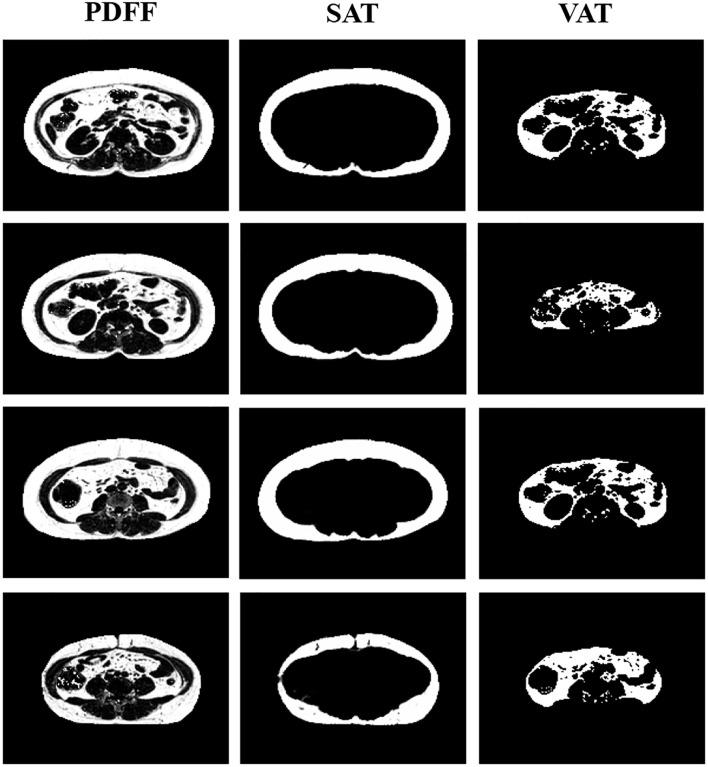
We conducted a cross-sectional analysis within a multicenter, randomized clinical trial. Demographic information, anthropometric data and laboratory tests were obtained from the electronic data capture system. PrFV was assessed and measured by ultrasonography. Subcutaneous and visceral fat volume were quantified by abdominal MRI. Individuals were categorized according to PrFV tertiles, and Spearman correlation analysis was performed to investigate the correlation between PrFV and metabolic profiles. Adjusted multivariable regression models were employed to investigate the relationship of PrFV with MetS. The receiver operating characteristic curve was used to identify the value of PrFV for predicting MetS.
RESULTS
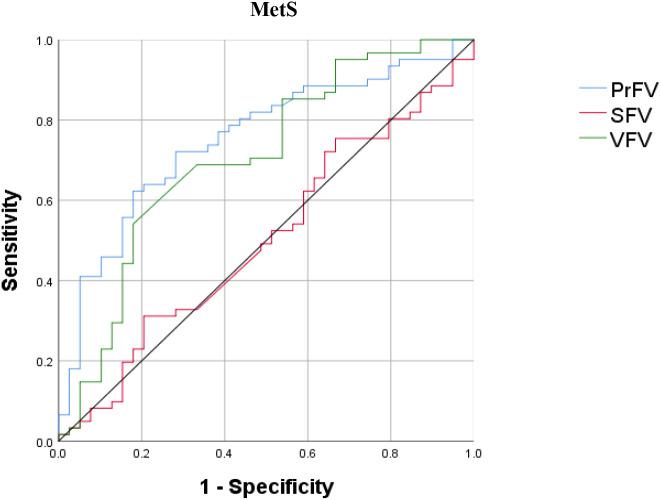
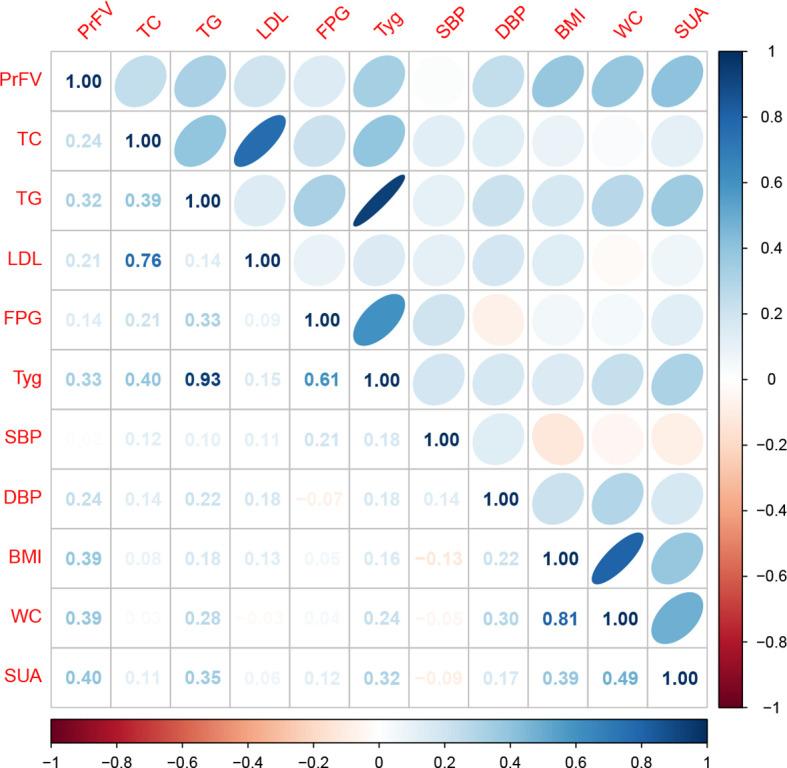
Among 100 enrolled subjects, the median age was 50.0 (40.0-60.0) years, and 75% were male. Spearman correlation analysis revealed significant positive correlations between PrFV and total cholesterol (r = 0.24, = 0.02), triglycerides (r = 0.32, = 0.001), LDL-C (r = 0.21, = 0.04), diastolic blood pressure (r = 0.24, = 0.02), BMI (r = 0.39, < 0.001), waist circumference (r = 0.39, < 0.001), and uric acid (r = 0.40, < 0.001). In the fully-adjusted multivariable regression model, individuals in the highest tertile of PrFV exhibited a higher risk of MetS (Odds ratio = 4.48, 95% Confidence interval: 1.25-17.6). The area under the curve (AUC) of PrFV for predicting MetS was higher than subcutaneous and visceral fat volume.
CONCLUSION
Increased PrFV was positively associated with a higher risk of MetS in Chinese adults. Perirenal fat may serve as a surrogate marker and potential therapeutic target for MetS.
CLINICAL TRIAL REGISTRATION
https://clinicaltrials.gov/, identifier NCT05049096.
背景
代谢综合征(MetS)代表一系列代谢异常。肾周脂肪是一种围绕肾脏的内脏脂肪,具有独特的解剖和生理特征。本研究旨在调查中国成年人肾周脂肪体积(PrFV)与MetS之间的关联。
方法
我们在一项多中心随机临床试验中进行了横断面分析。从电子数据采集系统中获取人口统计学信息、人体测量数据和实验室检查结果。通过超声评估和测量PrFV。通过腹部MRI对皮下和内脏脂肪体积进行量化。根据PrFV三分位数对个体进行分类,并进行Spearman相关性分析以研究PrFV与代谢指标之间的相关性。采用调整后的多变量回归模型研究PrFV与MetS的关系。使用受试者工作特征曲线确定PrFV预测MetS的值。
结果
在100名纳入的受试者中,年龄中位数为50.0(40.0 - 60.0)岁,75%为男性。Spearman相关性分析显示,PrFV与总胆固醇(r = 0.24,P = 0.02)、甘油三酯(r = 0.32,P = 0.001)、低密度脂蛋白胆固醇(r = 0.21,P = 0.04)、舒张压(r = 0.24,P = 0.02)、体重指数(r = 0.39,P < 0.001)、腰围(r = 0.39,P < 0.001)和尿酸(r = 0.40,P < 0.001)之间存在显著正相关。在完全调整的多变量回归模型中,PrFV最高三分位数的个体患MetS的风险更高(优势比 = 4.48,95%置信区间:1.25 - 17.6)。PrFV预测MetS的曲线下面积(AUC)高于皮下和内脏脂肪体积。
结论
中国成年人中PrFV增加与MetS风险升高呈正相关。肾周脂肪可能作为MetS的替代标志物和潜在治疗靶点。
临床试验注册

 Zotero 插件