
种植体周围疾病的患病率、发病率、全身、行为及患者相关危险因素和指标:一项AO/AAP系统评价与Meta分析
Prevalence, incidence, systemic, behavioral, and patient-related risk factors and indicators for peri-implant diseases: An AO/AAP systematic review and meta-analysis.
作者信息
Galarraga-Vinueza Maria Elisa, Pagni Sarah, Finkelman Matthew, Schoenbaum Todd, Chambrone Leandro
机构信息
Department of Oral Medicine, Infection, and Immunity, Division of Periodontology, Harvard School of Dental Medicine, Boston, USA.
School of Dentistry, Universidad de las Americas, Quito, Ecuador.
出版信息
J Periodontol. 2025 Jun;96(6):587-633. doi: 10.1002/JPER.24-0154. Epub 2025 Jun 9.
BACKGROUND
A profound understanding of the epidemiology of peri-implant diseases (PIDs) is essential for the development of preventive approaches to mitigate the occurrence and progression of peri-implant biological complications. The present systematic review and meta-analysis aimed to assess the incidence, prevalence, systemic, behavioral, and patient-related risk indicators and factors for PIDs in adult patients with dental implants.
METHODS
Clinical studies assessing the prevalence, incidence, systemic risk indicators, and risk factors for PIDs were considered eligible for inclusion. MEDLINE-PubMed, EMBASE, Cochrane Central Library, and ClinicalTrials.gov electronic databases were searched for published articles. Pooled data analyses were performed using random-effects models to identify risk indicators and factors for PIDs.
RESULTS
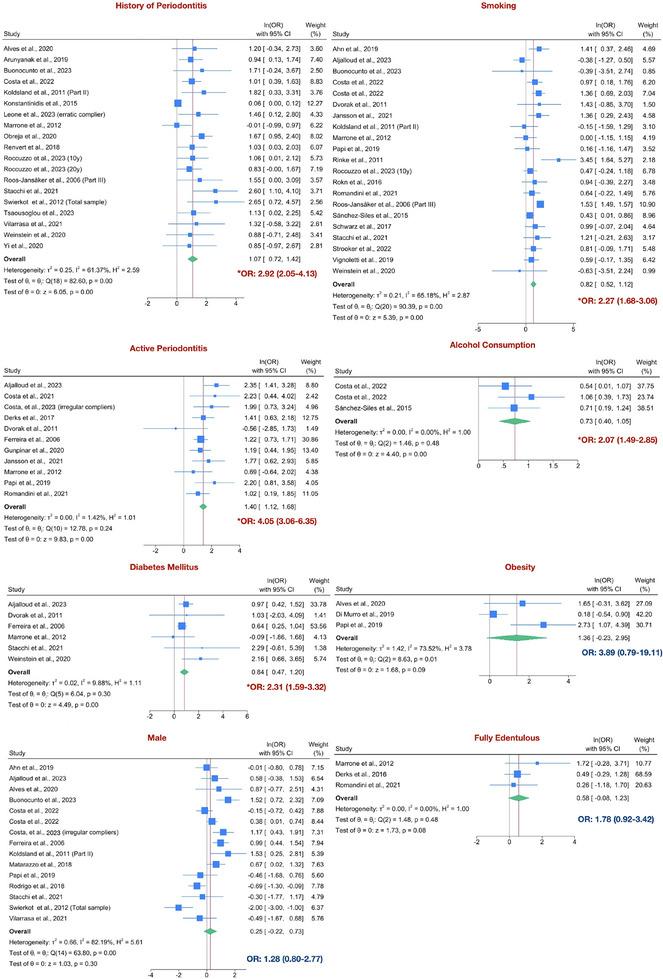
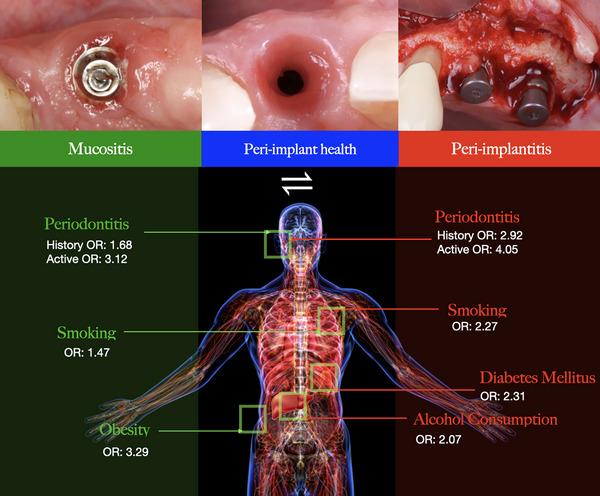
Of 1120 potentially eligible records, 102 studies met the eligibility criteria and were included in this systematic review. Prevalence rates at the patient level for peri-implant mucositis and peri-implantitis were 46% (95% confidence interval [CI], 41-51) and 21% (95% CI, 17-24), respectively. Weighted mean incidence rates at the patient level for peri-implant mucositis and peri-implantitis were 53% and 22%, respectively, within 20 years of function. Pooled estimates identified periodontitis, obesity, and smoking habits as significant systemic risk indicators for mucositis. For peri-implantitis, the significant risk indicators were periodontitis, diabetes mellitus, smoking habits, and alcohol consumption. Only risk indicators could be identified in the selected evidence.
CONCLUSION
More than half of the patients treated with dental implants were affected by PIDs over a 10-year follow-up period, with peri-implant mucositis being the most prevalent condition. Periodontitis and smoking were identified as risk indicators for the development of both PIDs. Obesity was identified as a potential risk indicator for mucositis, while diabetes mellitus and alcohol consumption were recognized as potential risk indicators for peri-implantitis.
PLAIN LANGUAGE SUMMARY
This systematic review looked at the causes and frequency of problems around dental implants, known as PIDs, which include conditions like peri-implant mucositis (inflammation around the implant) and peri-implantitis (more serious infection around the implant). Understanding these conditions and their etiology is important for finding ways to prevent them. This research reviewed 102 studies (including 13,030 patients) to gather data on how often these problems occur and what factors might increase the risk of developing them. The meta-analyses revealed that nearly half of people with dental implants had peri-implant mucositis, and about one in five had peri-implantitis. Over a period of 20 years, the incidence rates for developing these conditions were about 53% for mucositis and 22% for peri-implantitis. The study identified certain health and lifestyle factors that could increase the risk of these conditions. For mucositis, risk factors included having gum disease (periodontitis), obesity, and smoking. For peri-implantitis, the risks were similar, with periodontitis, smoking, and diabetes and alcohol use being important factors.
背景
深入了解种植体周围疾病(PID)的流行病学对于制定预防措施以减轻种植体周围生物并发症的发生和发展至关重要。本系统评价和荟萃分析旨在评估成年牙种植患者中PID的发病率、患病率、全身、行为及患者相关风险指标和因素。
方法
评估PID患病率、发病率、全身风险指标和危险因素的临床研究被认为符合纳入标准。检索MEDLINE-PubMed、EMBASE、Cochrane中心图书馆和ClinicalTrials.gov电子数据库中的已发表文章。使用随机效应模型进行汇总数据分析,以确定PID的风险指标和因素。
结果
在1120条潜在符合条件的记录中,102项研究符合纳入标准并被纳入本系统评价。种植体周围黏膜炎和种植体周围炎在患者层面的患病率分别为46%(95%置信区间[CI],41-51)和21%(95%CI,17-24)。在功能20年内,种植体周围黏膜炎和种植体周围炎在患者层面的加权平均发病率分别为53%和22%。汇总估计确定牙周炎、肥胖和吸烟习惯是黏膜炎的重要全身风险指标。对于种植体周围炎,重要的风险指标是牙周炎、糖尿病、吸烟习惯和饮酒。在所选证据中仅能确定风险指标。
结论
在10年随访期内,超过一半的牙种植患者受PID影响,种植体周围黏膜炎是最常见的情况。牙周炎和吸烟被确定为两种PID发生的风险指标。肥胖被确定为黏膜炎的潜在风险指标,而糖尿病和饮酒被认为是种植体周围炎的潜在风险指标。
通俗易懂的总结
本系统评价研究了牙种植体周围问题(称为PID)的原因和频率,这些问题包括种植体周围黏膜炎(种植体周围炎症)和种植体周围炎(种植体周围更严重的感染)等情况。了解这些情况及其病因对于找到预防方法很重要。本研究回顾了102项研究(包括13030名患者),以收集这些问题的发生频率以及哪些因素可能增加其发生风险的数据。荟萃分析显示,近一半的牙种植患者患有种植体周围黏膜炎,约五分之一患有种植体周围炎。在20年期间,发生这些情况的发病率黏膜炎约为53%,种植体周围炎约为22%。该研究确定了某些健康和生活方式因素可能增加这些情况的风险。对于黏膜炎,风险因素包括患有牙龈疾病(牙周炎)、肥胖和吸烟。对于种植体周围炎,风险类似,牙周炎、吸烟、糖尿病和饮酒是重要因素。



 Zotero 插件