
肌少症与认知障碍风险:队列研究和孟德尔随机化分析
Sarcopenia and Risk of Cognitive Impairment: Cohort Study and Mendelian Randomization Analysis.
作者信息
Sha Tingting, Zhang Yuqing, Wei Jie, Li Changjun, Zeng Chao, Lei Guanghua, Wang Yilun
机构信息
Department of Orthopaedics, Xiangya Hospital, Central South University, 87 Xiangya Road, Changsha, 410008, China, 86 84327326.
Hunan Key Laboratory of Joint Degeneration and Injury, Changsha, China.
出版信息
JMIR Aging. 2025 Jun 11;8:e66031. doi: 10.2196/66031.
BACKGROUND
Over half the people over 60 years of age experience cognitive impairment, with limited treatment options, making it crucial to identify risk factors. Studies have examined the association between sarcopenia and cognitive impairment; however, the evidence is inconclusive and cannot be used to make causal inferences.
OBJECTIVE
This study aims to appraise the causal association of sarcopenia with cognitive impairment by triangulating the data from a cohort study and Mendelian randomization (MR) analysis.
METHODS
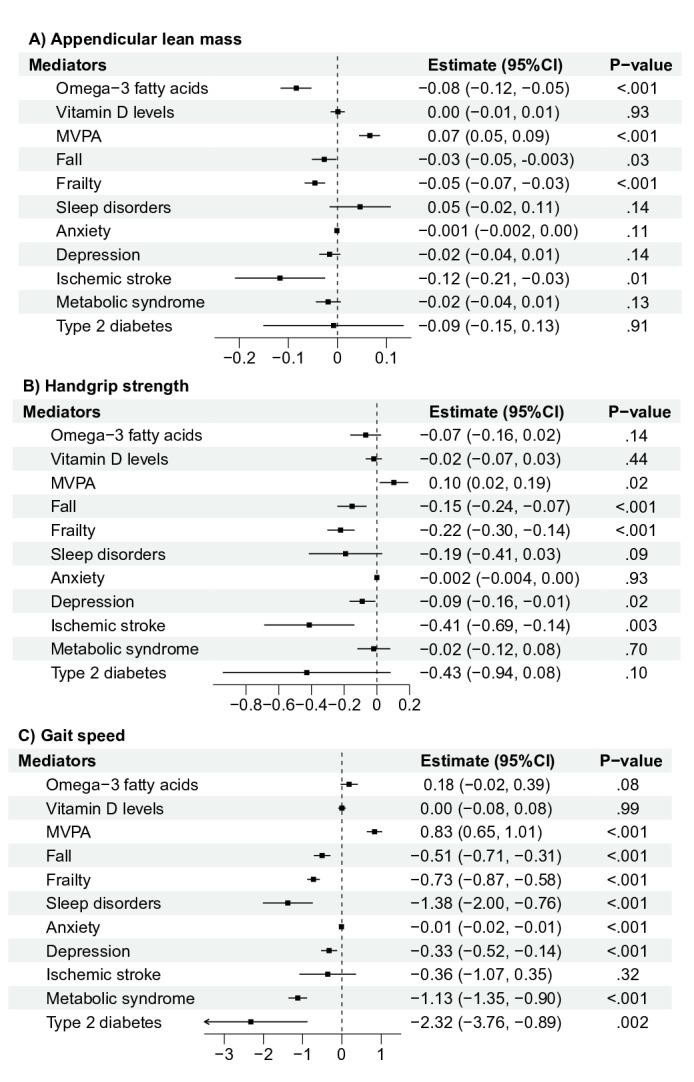
Using UK Biobank data, we first examined the associations of sarcopenia and its indices (appendicular lean mass [ALM], handgrip strength, and gait speed) with cognitive function (fluid intelligence and prospective memory) by using mixed-effects regression models. Then, we explored the causal associations of genetically predicted sarcopenic indices with cognitive function through a 2-sample MR, and examined potential mediation by omega-3 fatty acids, vitamin D levels, physical inactivity, falls, frailty, sleep disorders, anxiety, depression, stroke, metabolic syndrome, and type 2 diabetes.
RESULTS
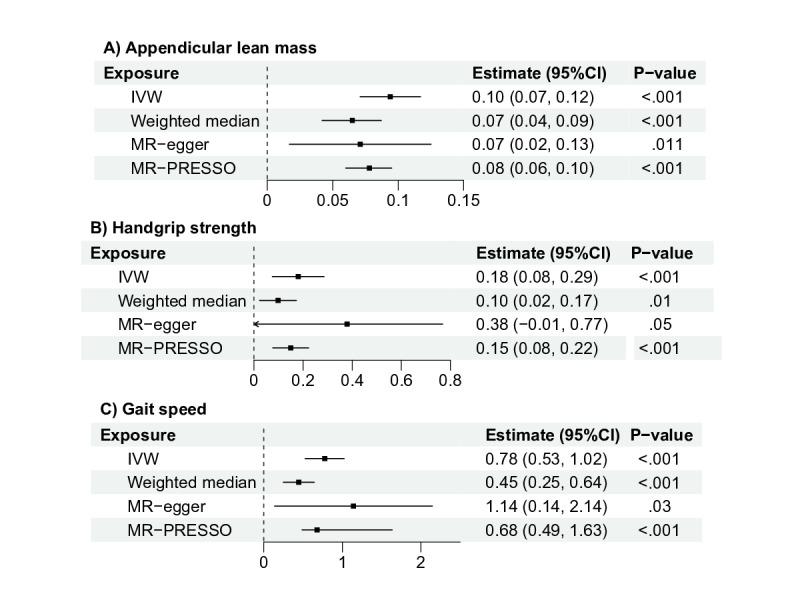
A total of 34,457 participants, with a mean age of 56.4 (SD 7.6) years, 51.1% (n=17,620) of which were female, completed baseline cognitive tests between 2006 and 2010 and attended at least 1 follow-up visit in 2012, 2014, or 2019, and were included in the observational analysis. The cohort study revealed that sarcopenia was significantly associated with cognitive impairment, which was evidenced by reduced fluid intelligence scores (β=-0.91, 95% CI -1.68 to -0.15; P=.02). Each of the sarcopenic indices also exhibited significant associations with either fluid intelligence or prospective memory (all P<.05). MR analyses yielded compelling evidence of positive associations between the genetically predicted increases in ALM (β=0.09, 95% CI 0.07-0.12; P<.001), handgrip strength (β=0.18, 95% CI 0.08-0.29; P<.001) and gait speed (β=0.78, 95% CI 0.53-0.29; P<.001) and improved cognitive function. The effects of ALM and handgrip strength on cognitive function were partially mediated by genetically predicted physical activity, with indirect effects of 0.01 (95% CI 0.00-0.02) for ALM and 0.02 (95% CI 0.00-0.05) for handgrip strength.
CONCLUSIONS
Our study suggests that sarcopenia is a potential causal risk factor for cognitive impairment, with physical activity acting as a modifiable mediator in this relationship.
背景
超过半数的60岁以上人群存在认知障碍,而治疗选择有限,因此识别风险因素至关重要。已有研究探讨了肌肉减少症与认知障碍之间的关联;然而,证据并不确凿,无法用于进行因果推断。
目的
本研究旨在通过对队列研究和孟德尔随机化(MR)分析的数据进行三角测量,评估肌肉减少症与认知障碍之间的因果关联。
方法
利用英国生物银行的数据,我们首先使用混合效应回归模型,研究了肌肉减少症及其指标(四肢瘦体重[ALM]、握力和步速)与认知功能(流体智力和前瞻性记忆)之间的关联。然后,我们通过两样本MR探索了基因预测的肌肉减少症指标与认知功能之间的因果关联,并研究了ω-3脂肪酸、维生素D水平、缺乏身体活动、跌倒、虚弱、睡眠障碍、焦虑、抑郁、中风、代谢综合征和2型糖尿病的潜在中介作用。
结果
共有34457名参与者,平均年龄为56.4(标准差7.6)岁,其中51.1%(n=17620)为女性,他们在2006年至2010年期间完成了基线认知测试,并在2012年、2014年或2019年至少参加了1次随访,被纳入观察性分析。队列研究表明,肌肉减少症与认知障碍显著相关,流体智力得分降低证明了这一点(β=-0.91,95%置信区间-1.68至-0.15;P=.02)。每个肌肉减少症指标也与流体智力或前瞻性记忆表现出显著关联(所有P<.05)。MR分析产生了令人信服的证据,表明基因预测的ALM增加(β=0.09,95%置信区间0.07-0.12;P<.001)、握力增加(β=0.18,95%置信区间0.08-0.29;P<.001)和步速增加(β=0.78,95%置信区间0.53-0.29;P<.001)与认知功能改善之间存在正相关。ALM和握力对认知功能的影响部分由基因预测的身体活动介导,ALM的间接效应为0.01(95%置信区间0.00-0.02),握力的间接效应为0.02(95%置信区间0.00-0.05)。
结论
我们的研究表明,肌肉减少症是认知障碍的一个潜在因果风险因素,身体活动在这种关系中作为一个可改变的中介因素。

 Zotero 插件