
非小细胞肺癌中的表皮生长因子受体(EGFR)突变:分类、特征及对第三代EGFR酪氨酸激酶抑制剂的耐药性(综述)
EGFR mutations in non-small cell lung cancer: Classification, characteristics and resistance to third-generation EGFR-tyrosine kinase inhibitors (Review).
作者信息
Tian Zhe, Cen Lilan, Wei Feng, Dong Jue, Huang Yulan, Han Yi, Wang Zhibo, Deng Junhua, Jiang Yujie
机构信息
Department of Pulmonary and Critical Care Medicine, Life Science and Clinical Medicine Research Center, Affiliated Hospital of Youjiang Medical University for Nationalities, Baise, Guangxi Zhuang Autonomous Region 533000, P.R. China.
Department of Infectious Disease, Guangxi Academy of Medical Sciences, The People's Hospital of Guangxi Zhuang Autonomous Region, Nanning, Guangxi Zhuang Autonomous Region 530021, P.R. China.
出版信息
Oncol Lett. 2025 Jun 2;30(2):375. doi: 10.3892/ol.2025.15121. eCollection 2025 Aug.
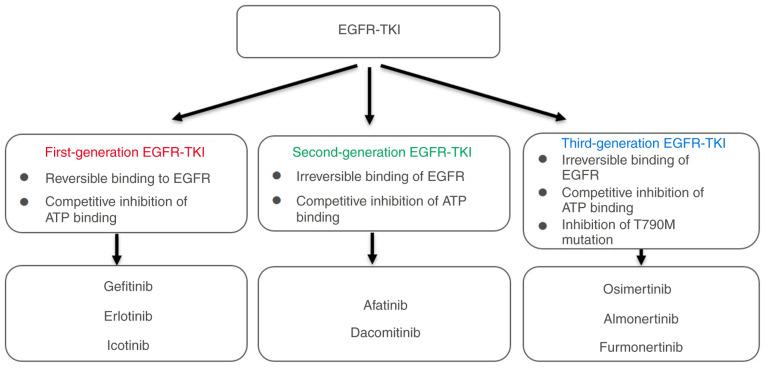
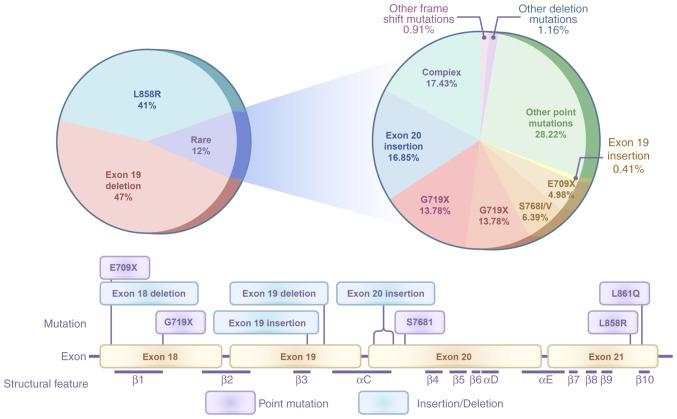
Mutations in EGFR (mEGFRs) in non-small cell lung cancer (NSCLC) are key factors driving tumor development and treatment response. The present article aimed to review the classification, characteristics and molecular mechanisms of resistance to third-generation EGFR-tyrosine kinase inhibitors (EGFR-TKIs) associated with mEGFRs. Activating mutations (such as L858R and exon 19 deletions) are the primary markers of sensitivity to EGFR-TKIs, while rare mutations (such as G719X and S768I) require individualized treatment strategies. Resistance mechanisms are categorized into EGFR-dependent (such as T790M and C797S mutations) and -independent (bypassing signaling activation, epithelial-mesenchymal transition, tumor microenvironment remodeling and epigenetic regulation). Third-generation EGFR-TKIs (such as osimertinib) markedly improve patient survival by selectively targeting the T790M mutation, but novel resistance mutations, such as C797S, limit their long-term efficacy. Combination therapies (such as MET proto-oncogene, receptor tyrosine kinase/EGFR dual-target inhibitors) and fourth-generation TKIs (such as BLU-945) offer novel directions to overcome resistance. Future research should focus on precise subtyping, dynamic monitoring of resistance mechanisms and regulation of the immune microenvironment to advance personalized treatment for NSCLC.
非小细胞肺癌(NSCLC)中表皮生长因子受体(EGFR)突变(mEGFRs)是驱动肿瘤发展和治疗反应的关键因素。本文旨在综述与mEGFRs相关的第三代EGFR酪氨酸激酶抑制剂(EGFR-TKIs)耐药的分类、特征及分子机制。激活突变(如L858R和19外显子缺失)是对EGFR-TKIs敏感的主要标志物,而罕见突变(如G719X和S768I)则需要个体化治疗策略。耐药机制分为EGFR依赖型(如T790M和C797S突变)和非依赖型(绕过信号激活、上皮-间质转化、肿瘤微环境重塑和表观遗传调控)。第三代EGFR-TKIs(如奥希替尼)通过选择性靶向T790M突变显著提高了患者生存率,但新型耐药突变(如C797S)限制了其长期疗效。联合治疗(如MET原癌基因、受体酪氨酸激酶/EGFR双靶点抑制剂)和第四代TKIs(如BLU-945)为克服耐药性提供了新方向。未来研究应聚焦于精准亚型分类、耐药机制的动态监测以及免疫微环境的调控,以推进NSCLC的个体化治疗。
 Zotero 插件