
表观遗传时钟作为中老年健康行为和死亡率的调节因子
Epigenetic clocks as mediators of health behaviors and mortality in middle-aged and older adults.
作者信息
Chen Xing-Ling, Zhao Qiang-Qiang, Lin Sheng-Rong, He Xing-Ling, Zhang Xiao-Jiao, Li Si-Jing, Li Zi-Ru, Chen Jia-Hui, Zhang Hua, Li Xiao-Fang, Zhou Yue-Hui, Liao Hui-Li, Sun Shu-Ning, Yang Zhong-Qi, Ni Shi-Hao, Lu Lu
机构信息
The First Affiliated Hospital, Guangzhou University of Chinese Medicine, Guangzhou 510407, China; Lingnan Medical Research Center, Guangzhou University of Chinese Medicine, Guangzhou 510407, China; Guangdong Clinical Research Institute of Chinese Medicine, Guangzhou 510407, China.
The First Affiliated Hospital, Guangzhou University of Chinese Medicine, Guangzhou 510407, China; Lingnan Medical Research Center, Guangzhou University of Chinese Medicine, Guangzhou 510407, China.
出版信息
J Nutr Health Aging. 2025 Jul;29(7):100602. doi: 10.1016/j.jnha.2025.100602. Epub 2025 Jun 11.
BACKGROUND
The impact of healthy lifestyles on epigenetic age acceleration (EAA) and mortality in middle-aged/ senior populations remains unclear. This study investigates associations between lifestyle factors, EAA biomarkers, and mortality risk.
METHOD
The 2532 adults of 50 years or older that registered in NHANES between 1999-2002.This study evaluated compares first- to third-generation epigenetic clocks (HannumAge, HorvathAge, PhenoAge, GrimAge2, DunedinPoAm) in predicting mortality risk associations between five lifestyle domains (diet, abdominal adiposity, physical activity, smoking, alcohol) and EAA were analyzed via multivariable regression, with mediation models testing EAA's role in lifestyle-mortality relationships.
RESULTS
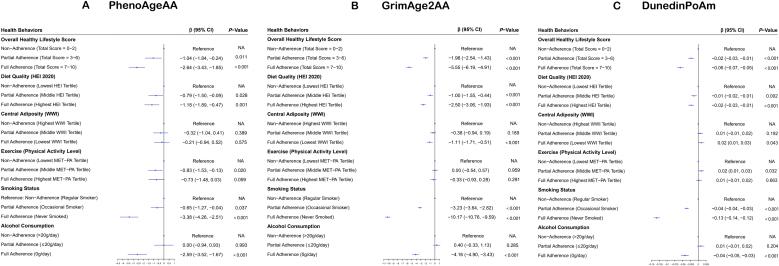
Survival curves results identified DunedinPoAm, GrimAge2AA, and PhenoAgeAA as robust biomarkers of accelerated biological aging, independent of chronological age. In multivariable linear regression models, full adherence to healthy behaviors reduced GrimAge2AA by β = -5.55 years, PhenoAgeAA by β = -2.64 years, and DunedinPoAm by β = -0.06 SD, with smoking cessation demonstrating the strongest GrimAge2AA attenuation (10.17 years). Stratified analyses revealed pronounced benefits: cancer patients adhering to healthy diets (β = -0.04 SD, P for interaction = 0.01) and hypertensive individuals reducing smoking (β = -0.05 SD, P for interaction = 0.04) showed significant EAA mitigation. The sensitivity analysis is consistent with the original results. Mediation analyses indicated GrimAge2AA accounted for 63.58% of lifestyle-survival associations, DunedinPoAm (44.63%) and PhenoAgeAA (28.45%).
CONCLUSIONS
These findings suggest that comprehensive adherence to healthy lifestyle behaviors is associated with reduced epigenetic aging, supporting their potential utility as targets for mortality risk mitigation. And emphasize the utility of epigenetic clocks in precision gerontology.
背景
健康生活方式对中年/老年人群表观遗传年龄加速(EAA)和死亡率的影响尚不清楚。本研究调查生活方式因素、EAA生物标志物与死亡风险之间的关联。
方法
对1999 - 2002年间在美国国家健康与营养检查调查(NHANES)中登记的2532名50岁及以上成年人进行研究。本研究评估并比较了第一代至第三代表观遗传时钟(汉纳姆年龄、霍瓦斯年龄、表型年龄、格里姆年龄2、达尼丁多组学衰老时钟)在预测死亡风险方面的作用。通过多变量回归分析五个生活方式领域(饮食、腹部肥胖、身体活动、吸烟、饮酒)与EAA之间的关联,并使用中介模型测试EAA在生活方式与死亡率关系中的作用。
结果
生存曲线结果表明,达尼丁多组学衰老时钟、格里姆年龄2加速年龄和表型年龄加速是生物衰老加速的可靠生物标志物,与实际年龄无关。在多变量线性回归模型中,完全坚持健康行为可使格里姆年龄2加速年龄降低β = -5.55岁,表型年龄加速降低β = -2.64岁,达尼丁多组学衰老时钟降低β = -0.06标准差,戒烟对格里姆年龄2加速年龄的衰减作用最强(10.17岁)。分层分析显示出显著益处:坚持健康饮食的癌症患者(β = -0.04标准差,交互作用P值 = 0.01)和减少吸烟的高血压患者(β = -0.05标准差,交互作用P值 = 0.04)的EAA显著减轻。敏感性分析与原始结果一致。中介分析表明,格里姆年龄2加速年龄占生活方式与生存关联的63.58%,达尼丁多组学衰老时钟占44.63%,表型年龄加速占28.45%。
结论
这些发现表明,全面坚持健康生活方式行为与表观遗传衰老的减轻有关,支持将其作为降低死亡风险目标的潜在效用。并强调了表观遗传时钟在精准老年医学中的效用。


 Zotero 插件