
重新审视膜联蛋白在膜运输中的作用。
Revisiting the role of Annexins in membrane trafficking.
作者信息
Grewal Thomas, Gerke Volker, Nylandsted Jesper, Rentero Carles, Enrich Carlos
机构信息
School of Pharmacy, Faculty of Medicine and Health, University of Sydney, Sydney, NSW, Australia.
Institute of Medical Biochemistry, Center for Molecular Biology of Inflammation (ZMBE), University of Münster, Röntgenstrasse 16, Münster, Germany.
出版信息
Cell Mol Life Sci. 2025 Jun 13;82(1):230. doi: 10.1007/s00018-025-05780-z.
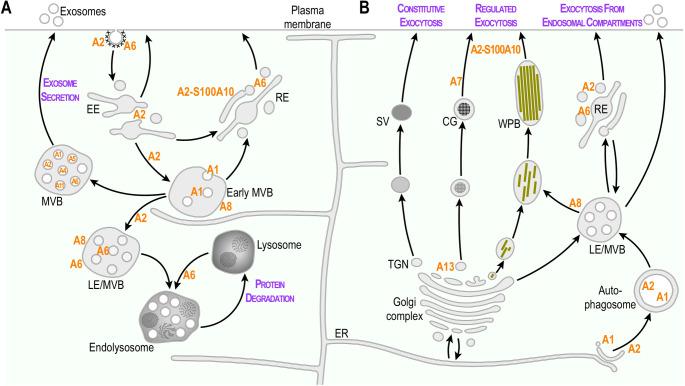
Ever since their discovery five decades ago, annexins have been implicated in membrane-related events along endo- and exocytic pathways. Over the years, structural, biochemical and cell imaging studies have revealed that annexins facilitate the organization of membrane domains to allow the formation of tight interactions between membranes destined to fuse. Yet, a comprehensive understanding that would elucidate the molecular characteristics, specific pathways and modes of action in relation to membrane trafficking events for all 12 human annexins is still lacking. By and large, annexins are considered cytosolic proteins that bind to acidic membrane phospholipids upon Ca²⁺ elevation. However, as extended Ca²⁺ stores in the ER, mitochondria and lysosomes continuously exchange Ca²⁺ with the cytosol, significant amounts of annexins remain in contact with membranes for the majority of their intracellular lifespan. Hence, how annexins sense and respond to subcellular Ca fluctuations in a dynamic manner and how this influences their localized lipid-binding preferences and functions still needs further clarification. This review examines earlier and recent observations that highlight the involvement of annexins in membrane traffic at the crossroads of endo- and exocytic pathways. The role of annexins in those less known facets such as membrane contact site formation, membrane repair, exosome biology and membrane-less compartments including annexins as RNA-binding proteins will also be discussed. Together, these new avenues strongly imply that annexins serve as important regulators of membrane trafficking.
自五十年前被发现以来,膜联蛋白就与内吞和外排途径中与膜相关的事件有关。多年来,结构、生化和细胞成像研究表明,膜联蛋白有助于膜结构域的组织,从而使注定要融合的膜之间形成紧密相互作用。然而,对于所有12种人类膜联蛋白在膜运输事件中的分子特征、特定途径和作用模式,仍缺乏全面的了解。总体而言,膜联蛋白被认为是胞质蛋白,在Ca²⁺浓度升高时与酸性膜磷脂结合。然而,由于内质网、线粒体和溶酶体中扩展的Ca²⁺储存库不断与胞质溶胶交换Ca²⁺,大量膜联蛋白在其细胞内寿命的大部分时间里仍与膜接触。因此,膜联蛋白如何动态感知和响应亚细胞Ca²⁺波动,以及这如何影响它们局部的脂质结合偏好和功能,仍需进一步阐明。本综述考察了早期和近期的观察结果,这些结果突出了膜联蛋白在内吞和外排途径交叉点处参与膜运输的情况。还将讨论膜联蛋白在那些鲜为人知的方面的作用,如膜接触位点形成、膜修复、外泌体生物学以及包括作为RNA结合蛋白的膜联蛋白在内的无膜区室。总之,这些新途径强烈暗示膜联蛋白是膜运输的重要调节因子。


 Zotero 插件