
润滑剂对覆盖义齿患者Locator/角巩膜基台拆卸力的影响:一项初步临床研究。
The Effect of Lubricant on the Detorque Force of Locator/Kerator Abutment in Overdenture Patients: A Pilot Clinical Study.
作者信息
Chamani Ali, Aghasizadeh Davood, Rajati Haghi Hamidreza, Aghebati Ghazal, Shakiba Reza
机构信息
Postgraduate Student, Dept. of Endodontics, Faculty of Dentistry, Mashhad University of Medical Sciences, Mashhad, Iran.
Dept. of Prosthodontics, Faculty of Dentistry, Mashhad University of Medical Sciences, Mashhad, Iran.
出版信息
J Dent (Shiraz). 2025 Jun 1;26(2):145-150. doi: 10.30476/dentjods.2024.101754.2316. eCollection 2025 Jun.
BACKGROUND
Despite the implants' remarkable success, mechanical failure of implant-abutment screws is a challenge for clinicians. Among the types of mechanical failures, abutment screw loosening is still frequently reported in the literature.
PURPOSE
The present study aimed to evaluate the effect of using lubricant on the detorque force (removal force) of locator/kerator abutment in overdenture patients after 6 months of clinical usage.
MATERIALS AND METHOD
This pilot clinical study examined the detorque force of implants in 20 edentulous patients with two mandibular implants positioned between the mental foramen. The patients underwent the fabrication of a complete maxillary prosthesis and mandibular overdenture. Before loading attachments in the delivery session, healing abutments were removed, and implant interiors dried, randomly some fixtures received a tetracycline eye ointment 1% lubricant, while the others remained non-lubricated. Abutments were secured with prescribed torque according to implant system guidelines (20 N.cm). After 6 months, detorque forces for the abutment locators were measured using a torque meter. Descriptive statistics, mean comparison, and Pearson correlation were performed on the obtained data. A significant level of Value<0.05 was considered in the present study.
RESULTS
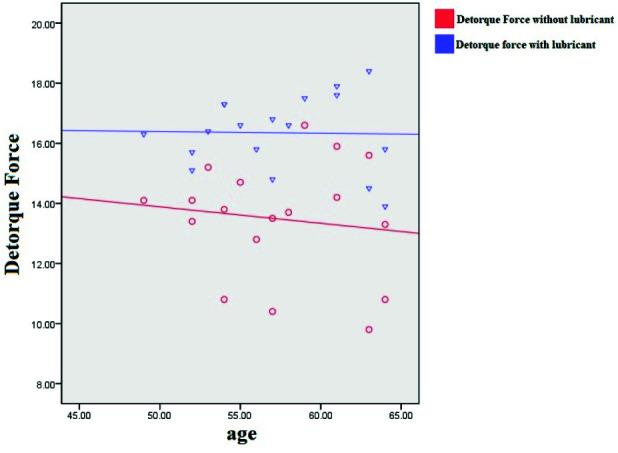
The mean detorque force was 13.4±1.94 in the non-lubricated group and 16.35± 1.24 in the lubricated group, which was significantly higher in the lubricated group (< 0.001). Other results of the study include the non-significance of the difference in detorque force within male and female groups (> 0.05), as well as the non-significance of Pearson's correlation between patients' age and detorque force (> 0.05).
CONCLUSION
According to the results, the use of lubricant significantly increases the detorque force, and it is recommended to use tetracycline eye ointment as a lubricant in implant treatment processes.
背景
尽管种植体取得了显著成功,但种植体-基台螺钉的机械故障对临床医生来说仍是一项挑战。在各种机械故障类型中,基台螺钉松动在文献中仍经常被报道。
目的
本研究旨在评估在临床使用6个月后,润滑剂对覆盖义齿患者定位器/角形基台拆卸力(去除力)的影响。
材料与方法
这项初步临床研究检测了20例无牙颌患者下颌两颗种植体位于颏孔之间时种植体的拆卸力。患者接受了全口上颌义齿和下颌覆盖义齿的制作。在交付环节加载附件之前,去除愈合基台,干燥种植体内部,随机地一些种植体接受1%四环素眼膏润滑剂,而其他种植体保持未润滑状态。根据种植体系统指南(20 N.cm)用规定扭矩固定基台。6个月后,使用扭矩计测量基台定位器的拆卸力。对获得的数据进行描述性统计、均值比较和Pearson相关性分析。本研究中显著性水平设定为P值<0.05。
结果
未润滑组的平均拆卸力为13.4±1.94,润滑组为16.35±1.24,润滑组显著更高(P<0.001)。该研究的其他结果包括男性和女性组之间拆卸力差异无显著性(P>0.05),以及患者年龄与拆卸力之间Pearson相关性无显著性(P>0.05)。
结论
根据结果,使用润滑剂显著增加了拆卸力,建议在种植治疗过程中使用四环素眼膏作为润滑剂。

 Zotero 插件