
癌症中的中性粒细胞胞外诱捕网:从机制到治疗
Neutrophil extracellular traps in cancer: From mechanisms to treatments.
作者信息
Wang Yifan, Yang Kangjie, Li Juan, Wang Chuanxin, Li Peilong, Du Lutao
机构信息
Department of Clinical Laboratory, Qilu Hospital of Shandong University, Shandong Provincial Key Laboratory of Innovation Technology in Laboratory Medicine, Jinan, PR China.
Department of Clinical Laboratory, The Second Hospital of Shandong University, Jinan, PR China.
出版信息
Clin Transl Med. 2025 Jun;15(6):e70368. doi: 10.1002/ctm2.70368.
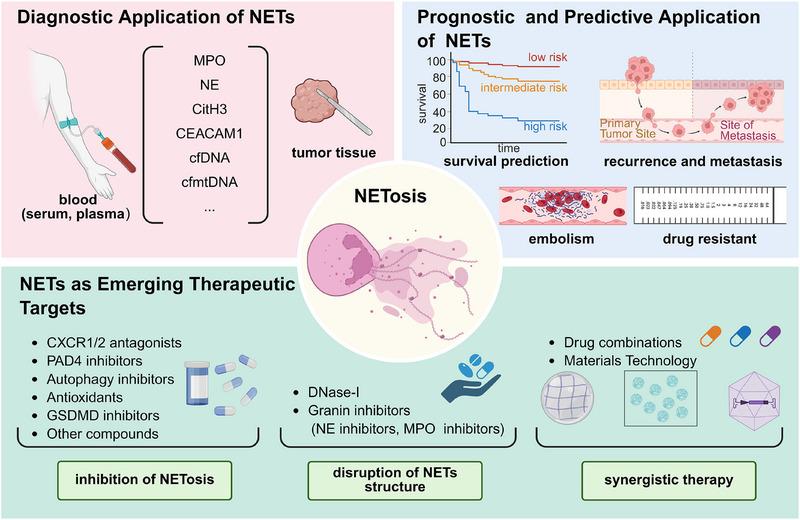
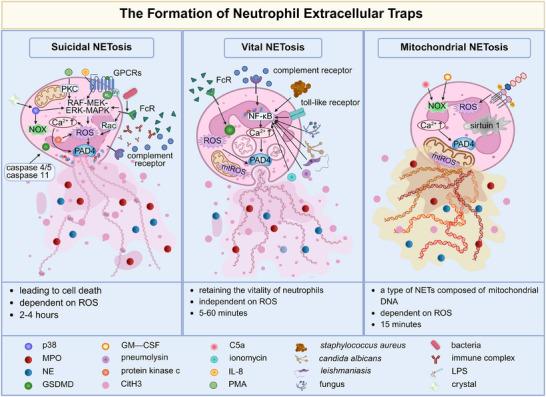
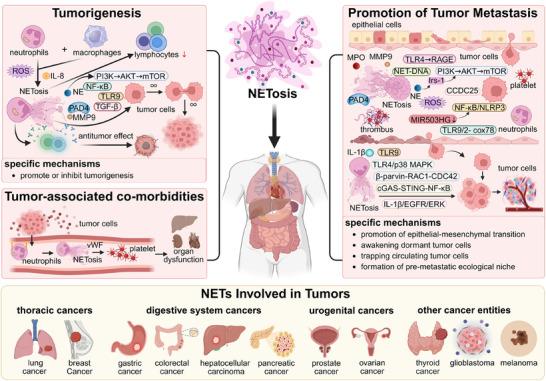
Neutrophil extracellular traps (NETs) are reticular ultrastructures released by activated neutrophils. As the reaction products of neutrophils, NETs have been identified as crucial effectors in pathogen defence and autoimmune diseases. Recently, increasing evidence suggest that this process also occurs in cancer. The formation and clearance of NETs are dynamically influenced by the tumour microenvironment, while NETs reciprocally play a dual role in either promoting or inhibiting tumour progression through their DNA scaffold, proteases and other granule-derived proteins. Given the interplay between NETs and tumours, active exploration is currently underway to harness their potential as tumour biomarkers and therapeutic targets. Here, we delve into the biochemical and immunological mechanisms underlying NETs formation within the tumour microenvironment, along with recent advances elucidating their multifaceted roles in tumourigenesis, metastasis and tumour-associated co-morbidities. Furthermore, we present emerging strategies for NETs-based tumour diagnostic approaches and therapeutics, with a special focus on the challenging questions that need to be answered within this field. KEY POINTS: The formation and clearance of NETs are dynamically influenced by the tumor microenvironment. NETs are engaged in tumorigenesis, formation, metastatic spread, and cancer-associated co-morbidities. NETs-based tumor biomarkers and therapeutic strategies warrant significant attention.
中性粒细胞胞外诱捕网(NETs)是活化的中性粒细胞释放的网状超微结构。作为中性粒细胞的反应产物,NETs已被确认为病原体防御和自身免疫性疾病中的关键效应物。最近,越来越多的证据表明这一过程也发生在癌症中。NETs的形成和清除受到肿瘤微环境的动态影响,而NETs通过其DNA支架、蛋白酶和其他颗粒衍生蛋白在促进或抑制肿瘤进展方面发挥双重作用。鉴于NETs与肿瘤之间的相互作用,目前正在积极探索利用它们作为肿瘤生物标志物和治疗靶点的潜力。在此,我们深入探讨肿瘤微环境中NETs形成的生化和免疫机制,以及阐明它们在肿瘤发生、转移和肿瘤相关合并症中多方面作用的最新进展。此外,我们介绍基于NETs的肿瘤诊断方法和治疗的新兴策略,特别关注该领域需要回答的具有挑战性的问题。要点:NETs的形成和清除受到肿瘤微环境的动态影响。NETs参与肿瘤发生、形成、转移扩散和癌症相关合并症。基于NETs的肿瘤生物标志物和治疗策略值得高度关注。

 Zotero 插件