
15岁及以上人群阿片类物质使用障碍的全球、区域和国家趋势及负担:1990年至2021年及2040年预测
Global, regional, and national trends and burden of opioid use disorder in individuals aged 15 years and above: 1990 to 2021 and projections to 2040.
作者信息
Wang Shuailei, He Yumiao, Huang Yuguang
机构信息
Department of Anesthesiology, Chinese Academy of Medical Sciences, Peking Union Medical College Hospital, Beijing, China.
出版信息
Epidemiol Psychiatr Sci. 2025 Jun 13;34:e32. doi: 10.1017/S2045796025100085.
AIM
Opioid use disorder (OUD) is a medical condition associated with problematic opioid use, leading to addiction and severe life impairments. This research delivers an in-depth evaluation of OUD burden and trends at global, regional and national levels.
METHODS
This study analysed the global burden of OUD from 1990 to 2021 using data from the 2021 Global Burden of Diseases, Injuries, and Risk Factors Study. Key metrics included age-standardized prevalence, incidence, mortality and disability-adjusted life years (DALYs), disaggregated by gender, age, region, country and socio-demographic index (SDI) quintiles. The average annual percentage change described trends, while the age-period-cohort model evaluated age, period and cohort effects. A Bayesian Age-period-cohort model predicted future OUD trends from 2022 to 2040.
RESULTS
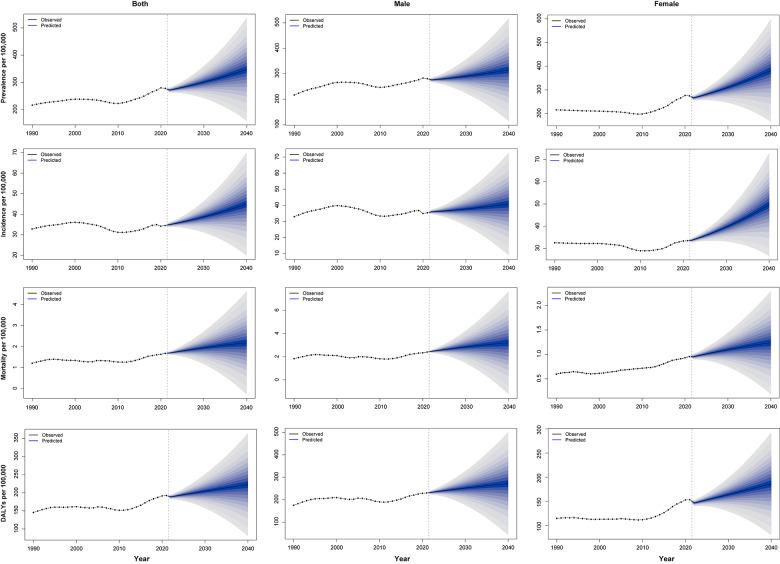
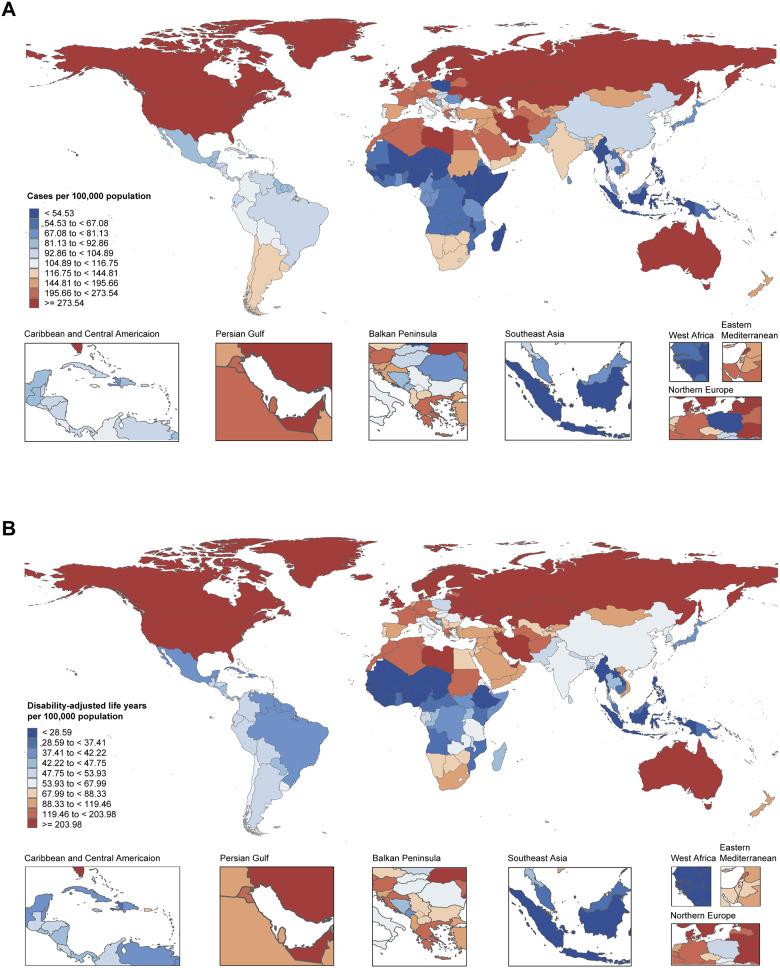
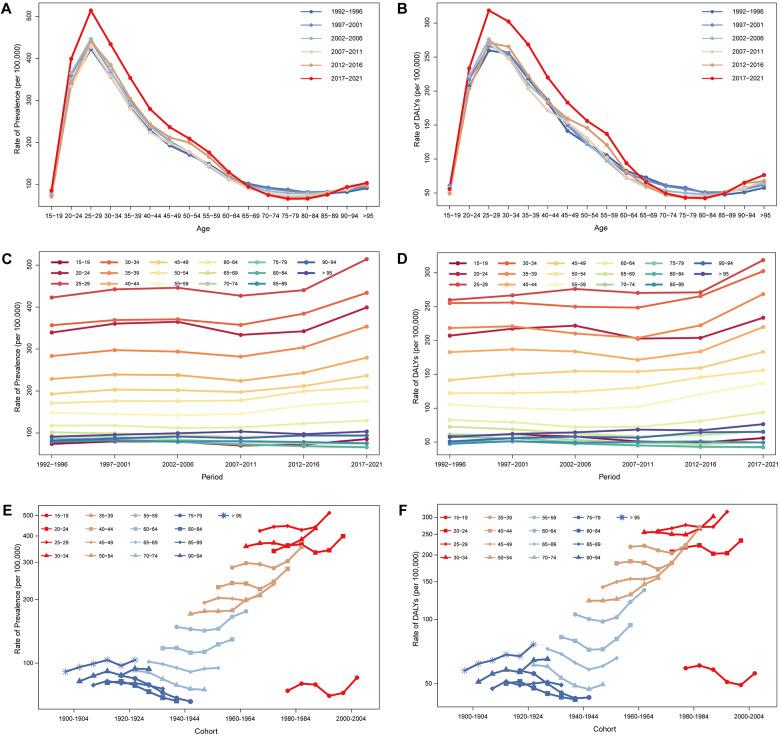
In 2021, the global burden of OUD remained substantial, with a total of 16,164,876 cases and a prevalence of 154.59 cases per 100,000 population (95% uncertainty interval [UI]: 131.06-181.26). In 2021, the global incidence of OUD reached 1,942,525 cases (95% UI: 1,643,342-2,328,363), and its global mortality reached 99,555 deaths (95% UI: 92,948-108,050), with DALYs amounting to 11,218,519 (95% UI: 9,188,658-13,159,551). Regionally, high SDI regions, particularly in the High-income North America, exhibited the greatest burden. Among countries, the United States faced the most severe burden and increase, with the highest prevalence (2014.62 per 100,000), incidence (151.84 per 100,000), mortality (15.37 per 100,000) and DALYs (1594.63 per 100,000), and all APPC values exceeding 5%. Males aged 20-39 years were the most affected demographic. However, forecasts indicate that the OUD burden among females will significantly increase over the next 20 years, with the prevalence and incidence expected to rise by 39% and 49%, respectively.
CONCLUSIONS
The global burden of OUD has statistically significantly increased from 1990 to 2021. There are marked disparities across regions, countries and SDI levels. High-SDI regions, particularly High-income North America, bear the heaviest burden, with young males (aged 20-39 years) being the most affected groups. However, caution should be exercised regarding the female population, as the number of affected individuals is rapidly increasing.
目的
阿片类物质使用障碍(OUD)是一种与阿片类物质使用问题相关的疾病,会导致成瘾和严重的生活损害。本研究对全球、区域和国家层面的OUD负担及趋势进行了深入评估。
方法
本研究利用《2021年全球疾病、伤害及风险因素负担研究》的数据,分析了1990年至2021年全球OUD负担。关键指标包括年龄标准化患病率、发病率、死亡率和伤残调整生命年(DALYs),并按性别、年龄、地区、国家和社会人口指数(SDI)五分位数进行分类。年均百分比变化描述趋势,年龄-时期-队列模型评估年龄、时期和队列效应。贝叶斯年龄-时期-队列模型预测了2022年至2040年的未来OUD趋势。
结果
2021年,全球OUD负担依然沉重,共有16164876例病例,每10万人中患病率为154.59例(95%不确定区间[UI]:131.06 - 181.26)。2021年,全球OUD发病率达1942525例(95% UI:1643342 - 2328363),全球死亡率达99555例(95% UI:92948 - 108050),DALYs达11218519例(95% UI:9188658 - 13159551)。在区域层面,高SDI地区,特别是高收入的北美地区,负担最重。在各国中,美国面临的负担最为严重且呈上升趋势,患病率(每10万人中2014.62例)、发病率(每10万人中151.84例)、死亡率(每10万人中15.37例)和DALYs(每10万人中1594.63例)均最高,且所有年均百分比变化值均超过5%。20至39岁的男性是受影响最严重的人群。然而,预测表明,未来20年女性中的OUD负担将显著增加,患病率和发病率预计分别上升39%和49%。
结论
1990年至2021年,全球OUD负担在统计学上显著增加。在区域、国家和SDI水平之间存在明显差异。高SDI地区,特别是高收入的北美地区,负担最重,年轻男性(20至39岁)是受影响最严重的群体。然而,对于女性群体应予以关注,因为受影响个体的数量正在迅速增加。


 Zotero 插件