
设计严重急性呼吸综合征冠状病毒2受体结合域免疫原,使免疫反应聚焦于保守的冠状病毒表位。
Design of SARS-CoV-2 RBD immunogens to focus immune responses toward conserved coronavirus epitopes.
作者信息
Harris Caitlin, Kapingidza A Brenda, San James E, Christopher Jayani, Gavitt Tyler, Rhodes Brianna, Janowska Katarzyna, O'Donnell Christopher, Lindenberger Jared, Huang Xiao, Sammour Salam, Berry Madison, Barr Maggie, Parks Rob, Newman Amanda, Overton Mary, Oguin Thomas, Acharya Priyamvada, Haynes Barton F, Saunders Kevin O, Wiehe Kevin, Azoitei Mihai L
机构信息
Duke Human Vaccine Institute, Duke University School of Medicine, Durham, North Carolina, USA.
Department of Cell Biology, Duke University School of Medicine, Durham, North Carolina, USA.
出版信息
J Virol. 2025 Jul 22;99(7):e0046525. doi: 10.1128/jvi.00465-25. Epub 2025 Jun 13.
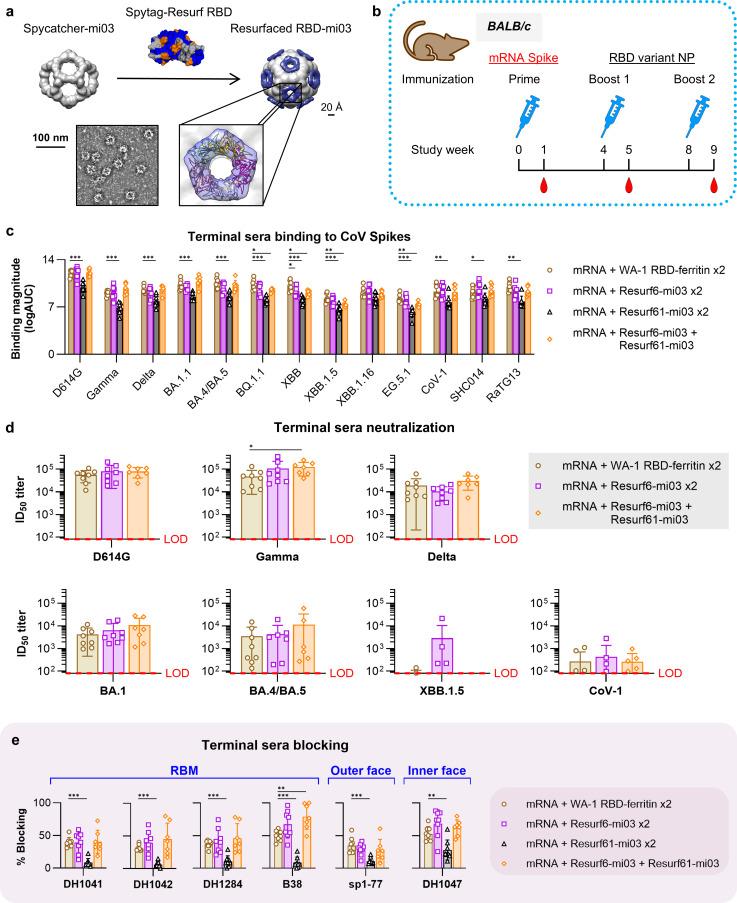
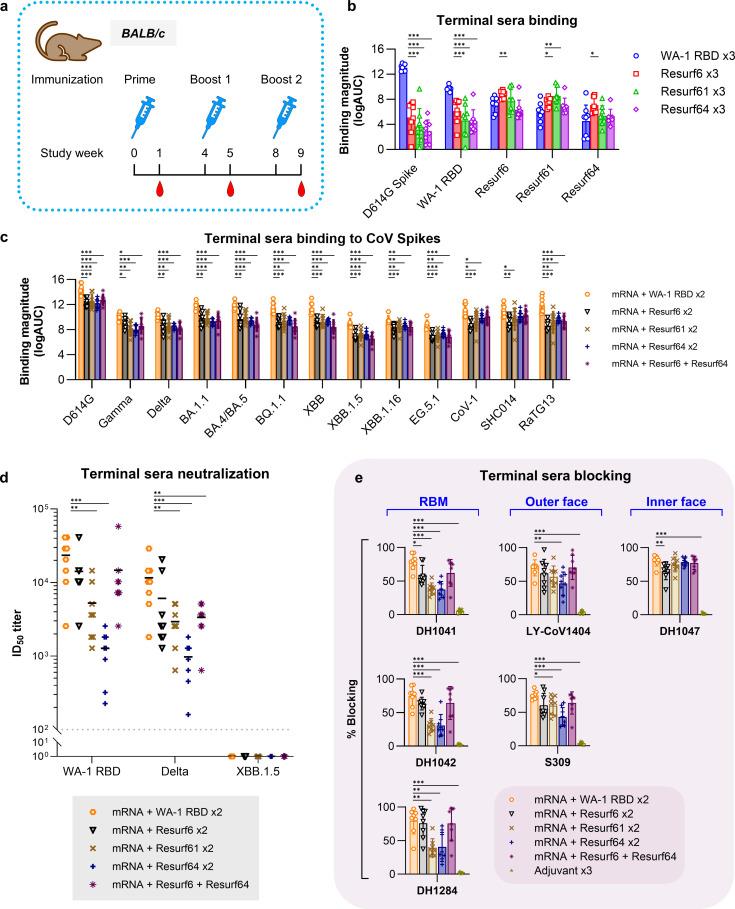
SARS-CoV-2 continues to evolve, with new variants emerging that evade pre-existing immunity and limit the efficacy of existing vaccines. One approach toward developing superior, variant-proof vaccines is to engineer immunogens that preferentially elicit antibodies with broad cross-reactivity against SARS-CoV-2 and its variants by targeting conserved epitopes on spike. The inner and outer faces of the receptor binding domain (RBD) are two such conserved regions targeted by antibodies that recognize diverse human and animal coronaviruses. To promote the elicitation of such antibodies by vaccination, we engineered "resurfaced" RBD immunogens that contained mutations at exposed RBD residues outside the target epitopes. In the context of pre-existing immunity, these vaccine candidates aim to disfavor the elicitation of strain-specific antibodies against the immunodominant receptor binding motif (RBM) while boosting the induction of inner and outer face antibodies. The engineered resurfaced RBD immunogens were stable, lacked binding to monoclonal antibodies with limited breadth, and maintained strong interactions with target broadly neutralizing antibodies. When used as vaccines, they limited humoral responses against the RBM as intended. Multimerization on nanoparticles further increased the immunogenicity of the resurfaced RBD immunogens, thus supporting resurfacing as a promising immunogen design approach to rationally shift natural immune responses to develop more protective vaccines.IMPORTANCESARS-CoV-2 is the third coronavirus to cause significant human disease over the last two decades. Despite their success in preventing serious disease, current SARS-CoV-2 vaccines must be updated regularly to match the circulating strains for continued protection. Therefore, it would be advantageous to develop vaccines that protect more broadly against SARS-CoV-2, its variants, and other pre-emergent coronaviruses. This may be achieved by preferentially eliciting antibodies against conserved regions of the spike protein that decorates the virus. Toward this goal, we engineered vaccine candidates to target the conserved inner and outer domains of the Receptor Binding Domain of SARS-CoV-2, by altering the surface of the wild-type protein such that strain-specific antibodies that bind outside these regions are no longer recognized. When used in animals with pre-existing SARS-CoV-2 immunity, these molecules reduce the elicitation of variant-specific antibodies, thus providing a blueprint to alter the natural immunodominance hierarchies of SARS-CoV-2 proteins.
严重急性呼吸综合征冠状病毒2(SARS-CoV-2)持续进化,新变种不断出现,这些变种能够逃避先前存在的免疫力,并限制现有疫苗的效力。开发更优质、抗变种疫苗的一种方法是设计免疫原,通过靶向刺突蛋白上的保守表位,优先诱导出对SARS-CoV-2及其变种具有广泛交叉反应性的抗体。受体结合域(RBD)的内表面和外表面是两个这样的保守区域,可被识别多种人类和动物冠状病毒的抗体靶向。为了通过疫苗接种促进此类抗体的诱导,我们设计了“表面重塑”的RBD免疫原,这些免疫原在目标表位之外的暴露RBD残基处含有突变。在已有免疫力的背景下,这些候选疫苗旨在抑制针对免疫显性受体结合基序(RBM)的毒株特异性抗体的诱导,同时增强内表面和外表面抗体的诱导。经过设计的表面重塑RBD免疫原很稳定,与广度有限的单克隆抗体不结合,并与目标广泛中和抗体保持强烈相互作用。用作疫苗时,它们按预期限制了针对RBM的体液反应。在纳米颗粒上进行多聚化进一步提高了表面重塑RBD免疫原的免疫原性,从而支持表面重塑作为一种有前景的免疫原设计方法,可合理改变天然免疫反应以开发更具保护性的疫苗。
重要性
SARS-CoV-2是过去二十年来第三种导致严重人类疾病的冠状病毒。尽管目前的SARS-CoV-2疫苗在预防严重疾病方面取得了成功,但必须定期更新以匹配流行毒株,以持续提供保护。因此,开发能更广泛地预防SARS-CoV-2、其变种及其他潜在冠状病毒的疫苗将具有优势。这可以通过优先诱导针对装饰病毒的刺突蛋白保守区域的抗体来实现。为实现这一目标,我们设计了候选疫苗,通过改变野生型蛋白的表面,使其不再被结合在这些区域之外的毒株特异性抗体识别,从而靶向SARS-CoV-2受体结合域的保守内域和外域。当在已有SARS-CoV-2免疫力的动物中使用时,这些分子减少了变种特异性抗体的诱导,从而为改变SARS-CoV-2蛋白的天然免疫优势等级提供了一个蓝图。


 Zotero 插件