
新型冠状病毒肺炎的长期神经和认知影响:对400多万患者的系统评价和荟萃分析
Long-term neurological and cognitive impact of COVID-19: a systematic review and meta-analysis in over 4 million patients.
作者信息
Elboraay Toka, Ebada Mahmoud A, Elsayed Maged, Aboeldahab Heba Ahmed, Salamah Hazem Mohamed, Rageh Omar, Elmallahy Mohamed, AboElfarh Hadeer Elsaeed, Mansour Lena Said, Nabil Yehia, Eltawab Ahmed Khaled Abd, Atwan Hany, Alkanj Souad
机构信息
Faculty of Medicine, Zagazig University, Zagazig, El-Sharkia, Egypt.
Medical Research Group of Egypt, Negida Academy, Arlington, MA, USA.
出版信息
BMC Neurol. 2025 Jun 14;25(1):250. doi: 10.1186/s12883-025-04174-9.
BACKGROUND
Neuropsychiatric symptoms emerged early in the COVID-19 pandemic as a key feature of the virus, with research confirming a range of neuropsychiatric manifestations linked to acute SARS-CoV-2 infection. However, the persistence of neurological symptoms in the post-acute and chronic phases remains unclear. This meta-analysis assesses the long-term neurological effects of COVID-19 in recovered patients, providing insights for mental health service planning.
METHODS
A comprehensive literature search was conducted across five electronic databases: PubMed, Scopus, Web of Science, EBSCO, and CENTRAL, up to March 22, 2024. Studies evaluating the prevalence of long-term neurological symptoms in COVID-19 survivors with at least six months of follow-up were included. Pooled prevalence estimates, subgroup analyses, and meta-regression were performed, and publication bias was assessed.
RESULTS
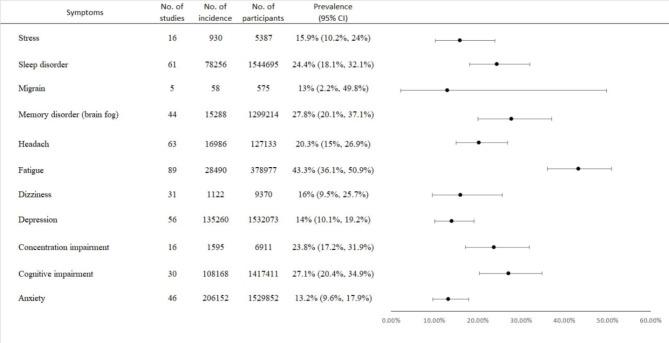
The prevalence rates for the different symptoms were as follows: fatigue 43.3% (95% CI [36.1-50.9%]), memory disorders 27.8% (95% CI [20.1-37.1%]), cognitive impairment 27.1% (95% CI [20.4-34.9%]), sleep disorders 24.4% (95% CI [18.1-32.1%]), concentration impairment 23.8% (95% CI [17.2-31.9%]), headache 20.3% (95% CI [15-26.9%]), dizziness 16% (95% CI [9.5-25.7%]), stress 15.9% (95% CI [10.2-24%]), depression 14.0% (95% CI [10.1-19.2%]), anxiety 13.2% (95% CI [9.6-17.9%]), and migraine 13% (95% CI [2.2-49.8%]). Significant heterogeneity was observed across all symptoms. Meta-regression analysis showed higher stress, fatigue, and headache in females, and increased stress and concentration impairment with higher BMI.
CONCLUSIONS
Neurological symptoms are common and persistent in COVID-19 survivors. This meta-analysis highlights the significant burden these symptoms place on individuals, emphasizing the need for well-resourced multidisciplinary healthcare services to support post-COVID recovery.
REGISTRATION AND PROTOCOL
This meta-analysis was registered in PROSPERO with registration number CRD42024576237.
背景
在新冠疫情早期,神经精神症状就作为该病毒的一个关键特征出现,研究证实了一系列与急性严重急性呼吸综合征冠状病毒2(SARS-CoV-2)感染相关的神经精神表现。然而,急性期后和慢性期神经症状的持续情况仍不清楚。这项荟萃分析评估了新冠康复患者的长期神经影响,为心理健康服务规划提供见解。
方法
截至2024年3月22日,在五个电子数据库(PubMed、Scopus、科学网、EBSCO和CENTRAL)中进行了全面的文献检索。纳入了评估至少随访6个月的新冠幸存者中长期神经症状患病率的研究。进行了合并患病率估计、亚组分析和元回归,并评估了发表偏倚。
结果
不同症状的患病率如下:疲劳43.3%(95%置信区间[36.1 - 50.9%])、记忆障碍27.8%(95%置信区间[20.1 - 37.1%])、认知障碍27.1%(95%置信区间[20.4 - 34.9%])、睡眠障碍24.4%(95%置信区间[18.1 - 32.1%])、注意力不集中23.8%(95%置信区间[17.2 - 31.9%])、头痛20.3%(95%置信区间[15 - 26.9%])、头晕16%(95%置信区间[9.5 - 25.7%])、压力15.9%(95%置信区间[10.2 - 24%])、抑郁14.0%(95%置信区间[10.1 - 19.2%])、焦虑13.2%(95%置信区间[9.6 - 17.9%])和偏头痛13%(95%置信区间[2.2 - 49.8%])。所有症状均观察到显著的异质性。元回归分析显示,女性的压力、疲劳和头痛程度更高,体重指数(BMI)越高,压力和注意力不集中越严重。
结论
神经症状在新冠幸存者中很常见且持续存在。这项荟萃分析突出了这些症状给个体带来的重大负担,强调需要资源充足的多学科医疗服务来支持新冠康复。
注册与方案
这项荟萃分析已在国际前瞻性系统评价注册库(PROSPERO)注册,注册号为CRD42024576237。

 Zotero 插件