
利用磁力或非磁力加热在毕赤酵母中进行无甲醇蛋白表达
Methanol-Free Protein Expression in Komagataella phaffii With Magnetic or Non-Magnetic Heating.
作者信息
Dagci Ibrahim, Arslan Seyda Yildiz, Solak Kubra, Acar Melek, Unver Yagmur, Mavi Ahmet
机构信息
Department of Molecular Biology and Genetics, Institute of Science and Technology, Atatürk University, Erzurum, Türkiye.
Department of Molecular Biology and Genetics, Faculty of Science, Atatürk University, Erzurum, Türkiye.
出版信息
Microb Biotechnol. 2025 Jun;18(6):e70183. doi: 10.1111/1751-7915.70183.
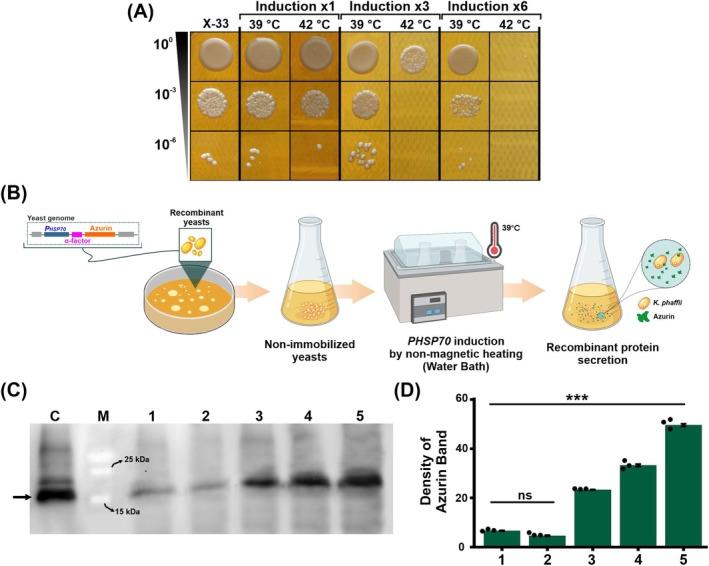
Komagataella phaffii is among the most widely used expression systems, with methanol-inducible promoters being preferred for protein expression due to their stringent regulation and exceptional strength. However, the applicability of this system, particularly in food and pharmaceutical products, is limited by methanol's toxic and pro-inflammatory properties. Therefore, obtaining a novel methanol-free expression system is necessary. In this study, we obtained a novel expression plasmid, pHSPαA, carrying the HSP70 promoter (P) to regulate heterologous expression through heat induction. The extracellular expression of azurin was achieved using this methanol-free system under the control of P, induced by either magnetic or non-magnetic heating. To enhance heat-induced expression, recombinant cells were immobilised with FeO@PEI nanoparticles, which facilitated heat release under an AC magnetic field, thereby increasing cell permeability and protein secretion. A time-dependent increase in protein expression was observed in non-magnetic heating but not under magnetic heating. However, immobilised cells exhibited a higher protein secretion capacity compared to non-immobilised cells. These findings suggest that the novel methanol-free expression system represents a promising alternative for heterologous gene expression, particularly for the production of therapeutically relevant and food-grade recombinant proteins.
毕赤酵母是应用最广泛的表达系统之一,由于其严格的调控和超强的强度,甲醇诱导型启动子在蛋白质表达中更受青睐。然而,该系统的适用性,特别是在食品和药品中的应用,受到甲醇毒性和促炎特性的限制。因此,获得一种新型无甲醇表达系统是必要的。在本研究中,我们获得了一种新型表达质粒pHSPαA,其携带HSP70启动子(P)以通过热诱导调节异源表达。在P的控制下,使用这种无甲醇系统通过磁加热或非磁加热诱导,实现了天青蛋白的细胞外表达。为了增强热诱导表达,用FeO@PEI纳米颗粒固定重组细胞,其在交流磁场下促进热量释放,从而增加细胞通透性和蛋白质分泌。在非磁加热中观察到蛋白质表达随时间增加,但在磁加热下未观察到。然而,与未固定的细胞相比,固定化细胞表现出更高的蛋白质分泌能力。这些发现表明,新型无甲醇表达系统是异源基因表达的一种有前景的替代方案,特别是对于治疗相关和食品级重组蛋白的生产。




 Zotero 插件