
用于推进帕金森病治疗的纯α-突触核蛋白和脂质化α-突触核蛋白聚集的机制模型。
A mechanistic model of pure and lipidic α-synuclein aggregation for advancing Parkinson's therapies.
作者信息
Righetti Elena, Marchetti Luca, Domenici Enrico, Reali Federico
机构信息
Fondazione The Microsoft Research - University of Trento Centre for Computational and Systems Biology (COSBI), Rovereto, Italy.
Department of Cellular, Computational and Integrative Biology (CIBIO), University of Trento, Trento, Italy.
出版信息
Commun Chem. 2025 Jun 14;8(1):186. doi: 10.1038/s42004-025-01558-3.
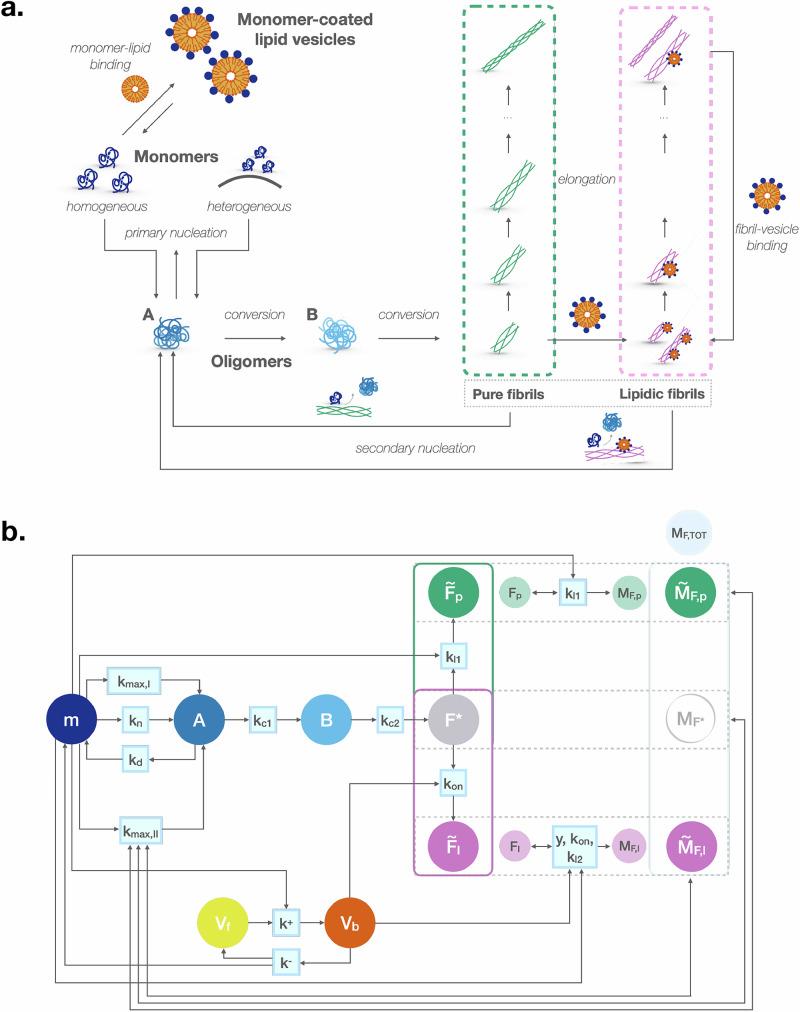
Alpha-synuclein (aSyn) plays a crucial role in Parkinson's disease, with various aggregates proposed as pathogenic triggers and therapeutic targets. However, anti-aSyn aggregation compounds often fail due to limited knowledge of the underlying molecular basis. In particular, interactions with lipid membranes are central to both physiological and pathological roles of aSyn, yet their underlying mechanisms remain unclear. Disrupting this balance may drive Parkinson's onset and progression, underscoring the need for a mechanistic understanding of pure and lipid-mediated aggregation. Building on well-established in vitro aggregation studies, we propose a mathematical model of aSyn accumulation incorporating both aggregation routes via a nucleation-conversion-polymerization process with self-amplifying loops and toxic oligomers. Model calibration uses data from in vitro assays mimicking physiologically relevant conditions, providing insights into transient and stable aSyn intermediates. Incorporating aSyn-lipid interactions enables in silico exploration of how lipid-to-aSyn ratio influences aggregation, with possible implications for neurodegeneration. Sensitivity analysis highlights secondary nucleation inhibition as a potential anti-aggregation strategy. Overall, our work contributes to a unified framework for investigating in vitro aSyn aggregation and evaluating Parkinson's therapies by building on existing models. It can serve as a stand-alone tool and a modular component in multiscale models, with potential applications in quantitative systems pharmacology.
α-突触核蛋白(aSyn)在帕金森病中起着关键作用,多种聚集体被认为是致病触发因素和治疗靶点。然而,由于对潜在分子基础的了解有限,抗aSyn聚集化合物往往效果不佳。特别是,与脂质膜的相互作用对于aSyn的生理和病理作用都至关重要,但其潜在机制仍不清楚。破坏这种平衡可能会推动帕金森病的发病和进展,这凸显了对纯聚集和脂质介导聚集的机制理解的必要性。基于成熟的体外聚集研究,我们提出了一个aSyn积累的数学模型,该模型纳入了通过成核-转化-聚合过程以及自我放大环和有毒寡聚体的两条聚集途径。模型校准使用了模拟生理相关条件的体外实验数据,从而深入了解瞬时和稳定的aSyn中间体。纳入aSyn-脂质相互作用能够在计算机上探索脂质与aSyn的比例如何影响聚集,这可能对神经退行性变有影响。敏感性分析突出了抑制二次成核作为一种潜在的抗聚集策略。总体而言,我们的工作通过在现有模型的基础上,为研究体外aSyn聚集和评估帕金森病治疗方法提供了一个统一的框架。它可以作为一个独立的工具以及多尺度模型中的一个模块化组件,在定量系统药理学中具有潜在应用。



 Zotero 插件