
推进套细胞淋巴瘤风险评估:应对一个动态变化的目标。
Advancing Mantle Cell Lymphoma Risk Assessment: Navigating a Moving Target.
作者信息
Ferrero Simone, Ragaini Simone
机构信息
Hematology Division, Department of Molecular Biotechnologies and Health Sciences, University of Torino, Torino, Italy.
出版信息
Hematol Oncol. 2025 Jun;43 Suppl 2(Suppl 2):e70072. doi: 10.1002/hon.70072.
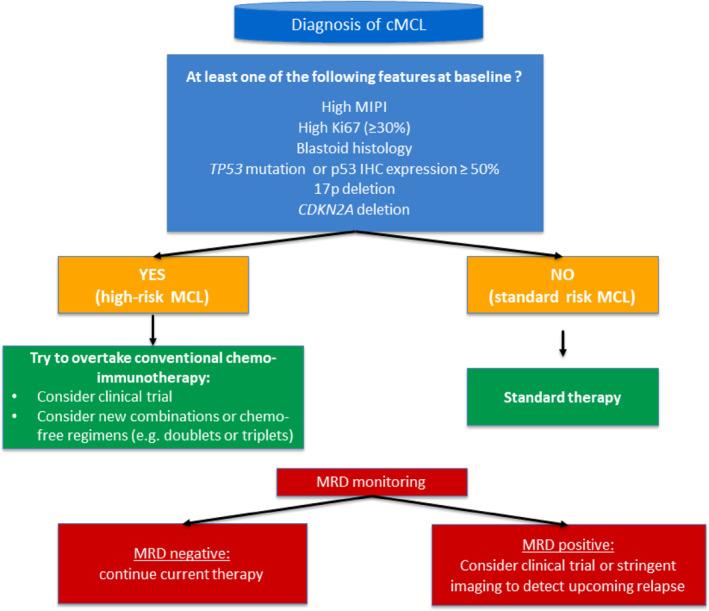
Mantle cell lymphoma (MCL) is a B-cell malignancy characterized by t(11;14)(q13;q32) translocation and heterogeneous clinical behavior. Advances in risk stratification enabled the distinction of conventional MCL (cMCL) from non-nodal MCL (nnMCL) subtypes, which presents with distinct biological and clinical features. Prognostic tools such as MIPI/MIPI-c, Ki-67 expression, and TP53 mutation/deletion status have enhanced risk assessment, while new genomic alterations including 17p deletion, CDKN2A loss are emerging as a new prognostic factors. Above all, TP53 disruption remains the major adverse factor, associated with poor outcomes despite new combination therapies. Although recent clinical trials are exploring innovative targeted strategies, the effective management of high-risk MCL remains challenging till now. Minimal residual disease (MRD) monitoring is now emerging as a dynamic prognostic tool, offering potential for treatment adaptation. The integration of molecular and clinical predictors into personalized therapeutic strategies along with MRD monitoring could represent the basis of the future algorithm of MCL management.
套细胞淋巴瘤(MCL)是一种B细胞恶性肿瘤,其特征为t(11;14)(q13;q32)易位及临床行为异质性。风险分层方面的进展使得能够区分传统MCL(cMCL)与非结内MCL(nnMCL)亚型,这两种亚型具有不同的生物学和临床特征。诸如MIPI/MIPI-c、Ki-67表达以及TP53突变/缺失状态等预后工具已加强了风险评估,而包括17p缺失、CDKN2A缺失在内的新基因组改变正成为新的预后因素。最重要的是,尽管有新的联合疗法,但TP53功能破坏仍然是主要的不利因素,与不良预后相关。尽管近期临床试验正在探索创新的靶向策略,但迄今为止,高危MCL的有效管理仍然具有挑战性。微小残留病(MRD)监测正作为一种动态预后工具崭露头角,为治疗调整提供了潜力。将分子和临床预测指标整合到个性化治疗策略中并结合MRD监测,可能代表未来MCL管理算法的基础。
 Zotero 插件