
肿瘤微环境中的自然杀伤细胞活性。
NK cell activity in the tumor microenvironment.
作者信息
Kuznetsova A V, Glukhova X A, Beletsky I P, Ivanov A A
机构信息
Laboratory of Molecular and Cellular Pathology, Russian University of Medicine, Ministry of Health of the Russian Federation, Moscow, Russia.
Laboratory of Regenerative Biology, Koltzov Institute of Developmental Biology, Russian Academy of Sciences, Moscow, Russia.
出版信息
Front Cell Dev Biol. 2025 May 30;13:1609479. doi: 10.3389/fcell.2025.1609479. eCollection 2025.
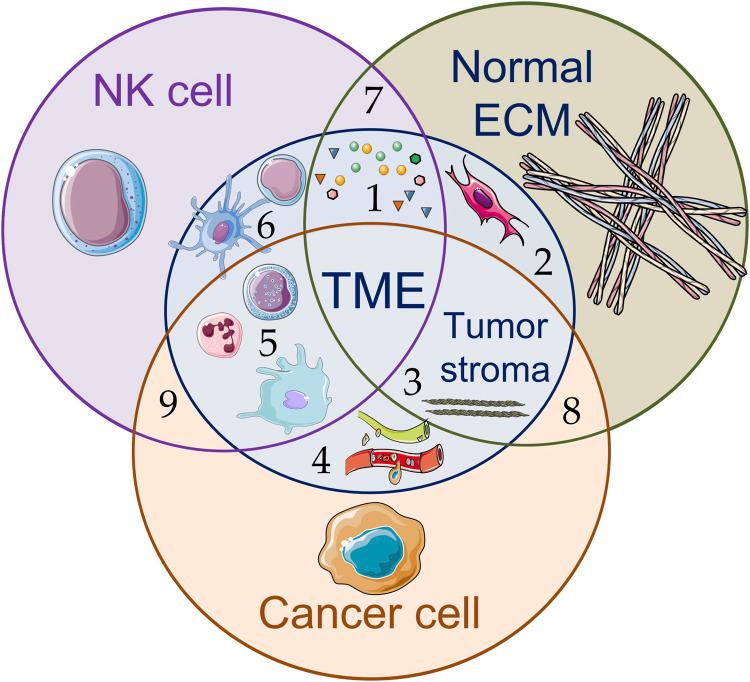
The formation of an immunosuppressive tumor microenvironment (TME) impairs natural killer (NK) cell infiltration and persistence within tumor tissue and significantly diminishes NK-mediated cytotoxicity. This presents a substantial barrier to the efficacy of NK cell therapy in solid tumors. Current strategies aim to overcome immune evasion by enhancing NK cell recognition and cytotoxicity, while promoting their persistence, infiltration, and resistance to the TME. This review focusses on the biophysical characteristics of TME and specific components of the extracellular matrix (ECM) that affect NK cell activity, with the goal of identifying therapeutic approaches to modulate the TME and create a supportive niche for adaptive immune cell function. Advancements in interdisciplinary collaborations integrating oncology, cell biology, physics, engineering, materials science, and nanotechnology are crucial in advancing therapeutic strategies targeting ECM rigidity and mechanotransduction signaling pathways.
免疫抑制性肿瘤微环境(TME)的形成会损害自然杀伤(NK)细胞在肿瘤组织中的浸润和持久性,并显著降低NK介导的细胞毒性。这对实体瘤中NK细胞疗法的疗效构成了重大障碍。目前的策略旨在通过增强NK细胞的识别和细胞毒性来克服免疫逃逸,同时促进它们的持久性、浸润以及对TME的抗性。本综述聚焦于TME的生物物理特性以及影响NK细胞活性的细胞外基质(ECM)的特定成分,目的是确定调节TME并为适应性免疫细胞功能创造支持性微环境的治疗方法。整合肿瘤学、细胞生物学、物理学、工程学、材料科学和纳米技术的跨学科合作进展对于推进针对ECM硬度和机械转导信号通路的治疗策略至关重要。


 Zotero 插件