
顺铂通过神经炎症、氧化应激和谷氨酸能受体mRNA的过表达诱导大鼠海马神经毒性和认知障碍。
Cisplatin induces hippocampal neurotoxicity and cognitive impairment in rats through neuroinflammation, oxidative stress, and overexpression of glutamatergic receptors mRNA.
作者信息
Alhowail Ahmad Hamad
机构信息
Department of Pharmacology and Toxicology, College of Pharmacy, Qassim University, Buraydah, Saudi Arabia.
出版信息
Front Pharmacol. 2025 May 30;16:1592511. doi: 10.3389/fphar.2025.1592511. eCollection 2025.
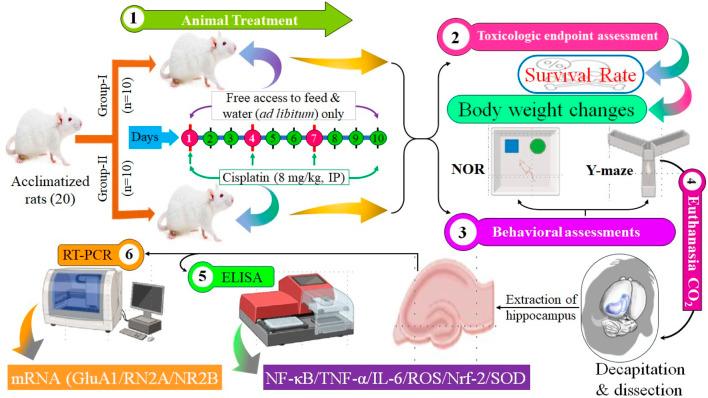
Chemotherapy-induced cognitive deficits are a prevalent adverse effect in patients with cancer undergoing chemotherapy. We investigated cisplatin-induced neurotoxicity by assessing neuroinflammation and expression of glutamate receptors. Two groups of eight-week-old rats (n = 10 per group) were used: control and cisplatin-treated. Cisplatin (8 mg/kg, i. p.) was administered each 2 days for three cycles. From rats hippocampi, we measured: concentrations of nuclear factor-kappa B (NF-κB), tumor necrosis factor (TNF)-α, and interleukin (IL)-6); mRNA countenance of synapse-related proteins (α-Amino-3-hydroxy-5-methyl-4-isoxazolepropionic acid receptors (AMPARs) and N-methyl-D-aspartic acid receptors (NMDARs); levels of reactive oxygen species (ROS), nuclear factor erythroid 2-related factor 2 (Nrf-2), superoxide dismutase (SOD); mitochondrial complex I (MCI) activity; lipid peroxidation. The cisplatin group exhibited significant reductions in survival rate to 40% and body weight, confirming the initiation of cisplatin toxicity. In contrast with the control group, the cisplatin group exhibited notably increased hippocampal levels of pro-inflammatory substances (NF-κB, TNF-α, IL-6), synapse-related proteins (AMPARs, NMDARs), and oxidative-stress mediators (ROS, Nrf-2, SOD). Cisplatin treatment resulted in declined MCI activity and increased lipid peroxidation. These findings indicate that cisplatin-induced cognitive impairment may be mediated by heightened hippocampal neuroinflammation and overactivation of glutamatergic receptors.
化疗引起的认知缺陷是接受化疗的癌症患者中普遍存在的不良反应。我们通过评估神经炎症和谷氨酸受体的表达来研究顺铂诱导的神经毒性。使用两组八周龄大鼠(每组n = 10):对照组和顺铂治疗组。每2天腹腔注射顺铂(8mg/kg),共三个周期。我们测量了大鼠海马体中核因子-κB(NF-κB)、肿瘤坏死因子(TNF)-α和白细胞介素(IL)-6的浓度;突触相关蛋白(α-氨基-3-羟基-5-甲基-4-异恶唑丙酸受体(AMPARs)和N-甲基-D-天冬氨酸受体(NMDARs))的mRNA含量;活性氧(ROS)、核因子红细胞2相关因子2(Nrf-2)、超氧化物歧化酶(SOD)的水平;线粒体复合物I(MCI)活性;脂质过氧化。顺铂组的存活率显著降低至40%,体重也下降,证实了顺铂毒性的开始。与对照组相比,顺铂组海马体中促炎物质(NF-κB、TNF-α、IL-6)、突触相关蛋白(AMPARs、NMDARs)和氧化应激介质(ROS、Nrf-2、SOD)的水平显著升高。顺铂治疗导致MCI活性下降和脂质过氧化增加。这些发现表明,顺铂诱导的认知障碍可能是由海马体神经炎症加剧和谷氨酸能受体过度激活介导的。



 Zotero 插件