
靶向循环肿瘤细胞与中性粒细胞的相互作用:抑制癌症转移的纳米工程策略
Targeting circulating tumor cell‒neutrophil interactions: nanoengineered strategies for inhibiting cancer metastasis.
作者信息
Su Yong, Leng Mingjing, Yang Qingqing, Jiang Wenbi, Xiang Gang, Long Ling, Zhou Xing
机构信息
School of Pharmacy and Bioengineering, Chongqing University of Technology, Chongqing, 400054, People's Republic of China.
Yunnan Key Laboratory of Stem Cell and Regenerative Medicine, Rehabilitation School, Kunming Medical University, Kunming, 650500, People's Republic of China.
出版信息
J Nanobiotechnology. 2025 Jun 17;23(1):449. doi: 10.1186/s12951-025-03522-8.
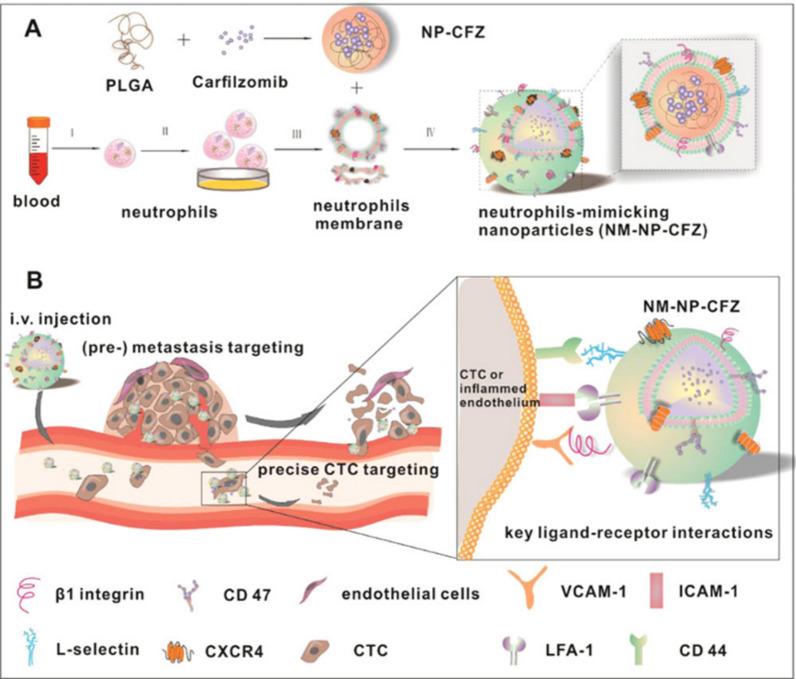
Metastasis remains the leading cause of cancer-related mortality, with a persistently poor prognosis for metastatic cancer patients despite extensive therapeutic efforts. Circulating tumor cells (CTCs), which detach from primary tumors and enter the bloodstream, can establish distant metastatic sites. These CTCs often form heterotypic clusters with white blood cells, especially neutrophils, through various interaction mechanisms, including intercellular adhesion, cytokine secretion, protease release, and the formation of neutrophil extracellular traps (NETs). These interactions enhance CTCs survival, proliferation, invasion, and transendothelial migration while simultaneously remodeling premetastatic niches and the tumor microenvironment. Consequently, pharmacologically disrupting CTC‒neutrophil crosstalk represents a promising strategy to curb metastatic spread and improve clinical outcomes. Recent breakthroughs in nanotechnology-based drug delivery systems have shown considerable potential in antimetastatic therapies, offering significant advantages over conventional treatments, which are often associated with severe side effects and limited efficacy. This review systematically explores nanoengineered strategies targeting CTC‒neutrophil interactions, addresses the current limitations and outlines future directions for developing clinically translatable nanotherapeutics.
转移仍然是癌症相关死亡的主要原因,尽管进行了广泛的治疗努力,但转移性癌症患者的预后仍然很差。循环肿瘤细胞(CTC)从原发性肿瘤脱离并进入血液,可以形成远处转移灶。这些CTC通常通过各种相互作用机制与白细胞,尤其是中性粒细胞形成异型簇,包括细胞间粘附、细胞因子分泌、蛋白酶释放以及中性粒细胞胞外陷阱(NET)的形成。这些相互作用增强了CTC的存活、增殖、侵袭和跨内皮迁移,同时重塑了转移前生态位和肿瘤微环境。因此,通过药理学方法破坏CTC与中性粒细胞的串扰是一种有前景的抑制转移扩散和改善临床结果的策略。基于纳米技术的药物递送系统的最新突破在抗转移治疗中显示出巨大潜力,与通常伴有严重副作用和疗效有限的传统治疗相比具有显著优势。本综述系统地探讨了针对CTC与中性粒细胞相互作用的纳米工程策略,阐述了当前的局限性,并概述了开发临床可转化纳米疗法的未来方向。




 Zotero 插件