
肠道微生物群对针对呼吸道病原体疫苗效力的免疫调节作用。
Immunomodulatory effects of gut microbiota on vaccine efficacy against respiratory pathogens.
作者信息
Xue Li, Wang Chunhua, Liu Chuanyu
机构信息
Department of Scientific Research, Xiangyang Central Hospital, Affiliated Hospital of Hubei University of Arts and Science, Xiangyang, China.
Department of Clinical Laboratory, Xiangyang No.1 People's Hospital, Hubei University of Medicine, Xiangyang, China.
出版信息
Front Immunol. 2025 Jun 3;16:1618921. doi: 10.3389/fimmu.2025.1618921. eCollection 2025.
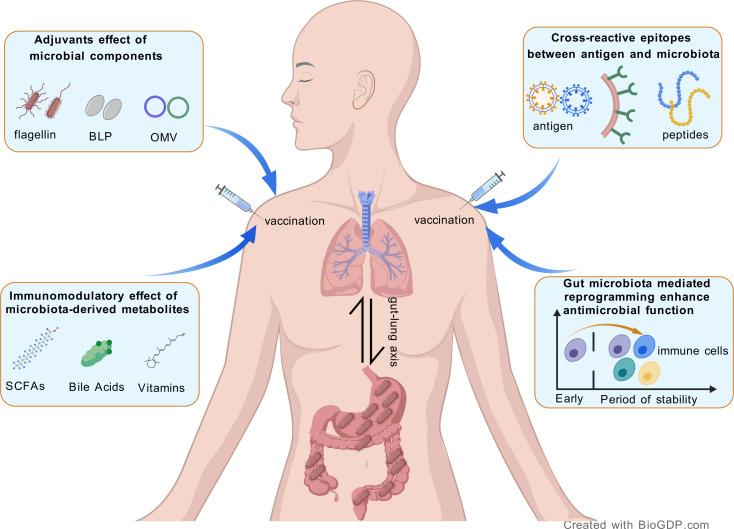
The outbreaks of respiratory pathogens like severe acute respiratory syndrome coronavirus 2 (SARS-CoV-2) and influenza virus (IV) have heightened the demand for highly effective vaccines that provide strong and durable immunity in human populations. However, immune responses to vaccination vary significantly among individuals and populations. Recent studies have demonstrated that the gut microbiota play an essential role in regulating respiratory pathogens vaccination-induced immune responses through the systemic effects of gut-lung axis on distant organs, the lungs. In this review, we first synthesize the changes in gut microbiota composition and immune responses that occur during respiratory pathogen infections and vaccination. Then, we discuss the underlying immunological mechanisms of bidirectional immunomodulatory effects between gut microbiota and vaccines. Finally, we explore the strategies for designing next-generation vaccines against respiratory pathogens in term of gut microbiota-mediated immunological pathway.
严重急性呼吸综合征冠状病毒2(SARS-CoV-2)和流感病毒(IV)等呼吸道病原体的爆发,增加了对能在人群中提供强大而持久免疫力的高效疫苗的需求。然而,个体和人群对疫苗接种的免疫反应差异很大。最近的研究表明,肠道微生物群通过肠-肺轴对远处器官(肺)的系统性作用,在调节呼吸道病原体疫苗诱导的免疫反应中起重要作用。在这篇综述中,我们首先综合了呼吸道病原体感染和疫苗接种期间肠道微生物群组成和免疫反应的变化。然后,我们讨论肠道微生物群与疫苗之间双向免疫调节作用的潜在免疫机制。最后,我们从肠道微生物群介导的免疫途径方面探索设计抗呼吸道病原体下一代疫苗的策略。
 Zotero 插件