
Kruppel样因子9可能通过影响核因子κB信号通路来调节软骨细胞的炎性损伤。
Kruppel-like factor 9 may regulate the inflammatory injury of chondrocytes by affecting NF-κB signaling.
作者信息
Gu Haoye, Han Xingming, Ding Yong, Deng Jianhua
机构信息
Department of Joint Surgery, The Sixth People's Hospital of Nantong, Affiliated Nantong Hospital of Shanghai University, No. 881 Yonghe Road, Chongchuan District, Jiangsu, 226000, China.
出版信息
J Orthop Surg Res. 2025 Jun 18;20(1):599. doi: 10.1186/s13018-025-05974-y.
BACKGROUND
Kruppel-like factor 9 (KLF9) is involved in the development of osteoarthritis (OA), which is a chronic joint disorder. However, the pathogenesis of OA remains unclear. This study aimed to investigate the relationship between KLF9 and the pathogenesis of OA.
METHODS
KLF9 expression in the Gene Expression Omnibus database was analyzed, and the most significantly upregulated and downregulated genes were visualized using a volcano map. Analyses were performed using Gene Ontology and Kyoto Encyclopedia of Genes and Genomes to determine the most significantly changed genes. Interleukin-1 beta (IL-1β) was applied to CHON-001 cells and human synovial cells (HSyCs) to establish an OA in vitro cell model. Real-time quantitative polymerase chain reaction (RT-qPCR) and western blot analysis were conducted to evaluate the expressions of KLF9 and cell death genes. Enzyme-linked immunosorbent assay (ELISA) was conducted to examine IL-1β, interleukin-6 (IL-6), and tumor necrosis factor alpha (TNF-α). IL-1β induced CHON-001 cells; HSyCs were transfected with KLF9 overexpression (OE); and ELISA was conducted to examine IL-1β, IL-6, and TNF-α. An inhibitor of nuclear factor kappa-light-chain-enhancer of activated B cells (NF-κB) was used, and its effects on CHON-001 cells and HSyC were examined.
RESULTS
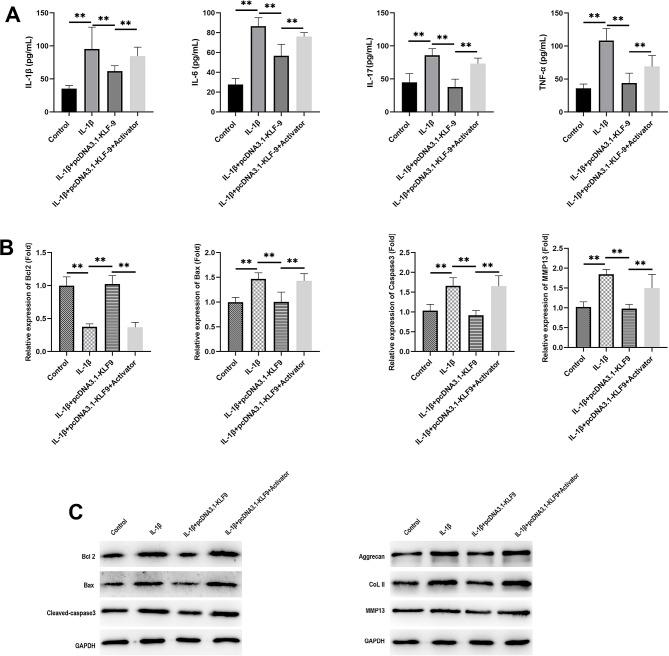
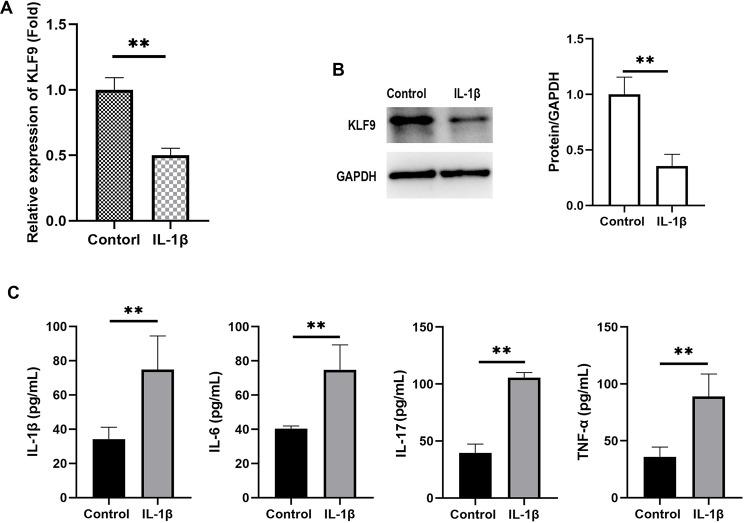
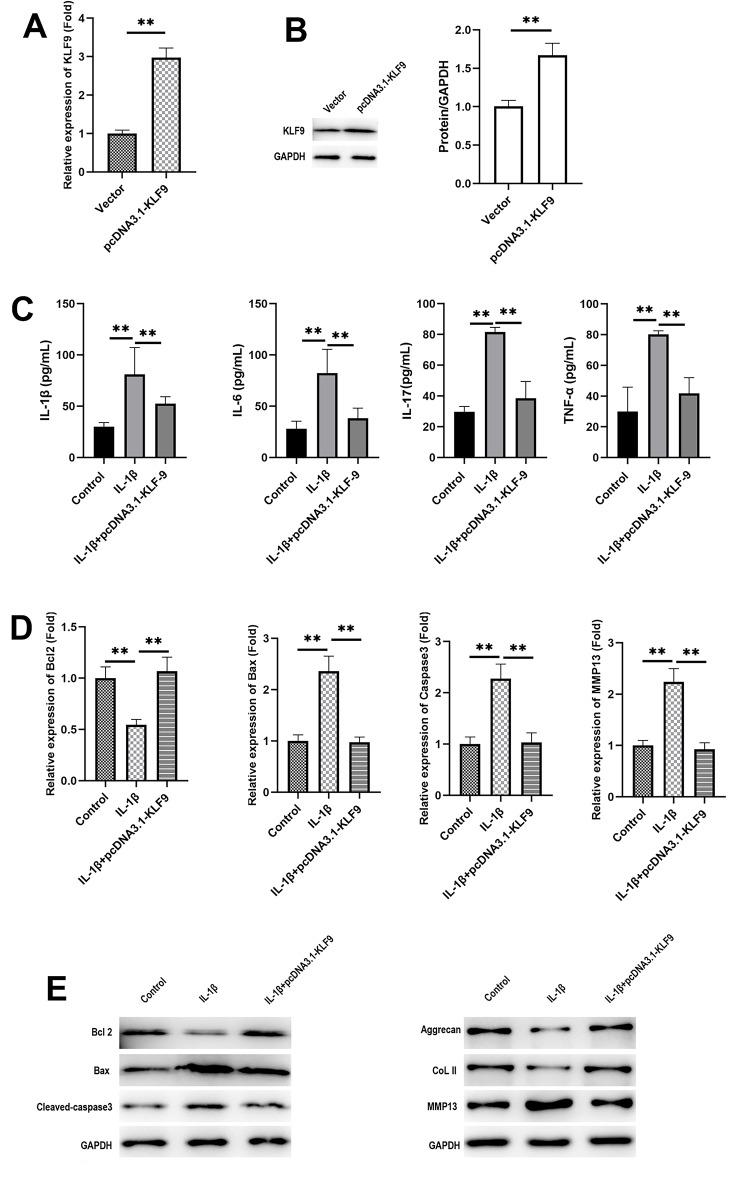
KLF9 was one of the most significantly downregulated genes during OA development. KLF9 was downregulated in IL-1β-treated CHON-001 cells and HSyCs. IL-1β induced the significant upregulation of IL-1β, IL-6, and TNF-α and increased cell death in CHON-001 cells and HSyCs. KLF9 OE partially mitigated the effects of IL-1β and markedly attenuated the IL-1β-induced upregulation of TNF-α and IL-6. IL-1β treatment significantly upregulated B-cell lymphoma 2-associated X protein (Bax) and Caspase-3 and downregulated B-cell lymphoma 2 (Bcl-2) on both messenger ribonucleic acid and protein levels, and KLF9 OE mitigated the effects of IL-1β. IL-1β decreased the levels of type II collagen and aggrecan, whereas KLF9 OE increased the levels of type II collagen and aggrecan. An NF-κB inhibitor could partially abrogate the KLF9-induced effects on Bax, Caspase-3, and Bcl-2. The NF-κB inhibitor also reversed the KLF9 OE-induced increase in the levels of type II collagen and aggrecan.
CONCLUSIONS
KLF9 mitigated the IL-1β-induced inflammatory condition via the NF-κB pathway.
背景
Kruppel样因子9(KLF9)参与骨关节炎(OA)的发展,OA是一种慢性关节疾病。然而,OA的发病机制仍不清楚。本研究旨在探讨KLF9与OA发病机制之间的关系。
方法
分析基因表达综合数据库中KLF9的表达情况,并使用火山图可视化上调和下调最显著的基因。利用基因本体论和京都基因与基因组百科全书进行分析,以确定变化最显著的基因。将白细胞介素-1β(IL-1β)应用于CHON-001细胞和人滑膜细胞(HSyCs),建立OA体外细胞模型。进行实时定量聚合酶链反应(RT-qPCR)和蛋白质印迹分析,以评估KLF9和细胞死亡基因的表达。采用酶联免疫吸附测定(ELISA)检测IL-1β、白细胞介素-6(IL-6)和肿瘤坏死因子-α(TNF-α)。用IL-1β诱导CHON-001细胞;将KLF9过表达(OE)转染到HSyCs中;并进行ELISA检测IL-1β、IL-6和TNF-α。使用活化B细胞核因子κB(NF-κB)抑制剂,并检测其对CHON-001细胞和HSyC的影响。
结果
KLF9是OA发展过程中下调最显著的基因之一。在IL-1β处理的CHON-001细胞和HSyCs中,KLF9表达下调。IL-1β诱导CHON-001细胞和HSyCs中IL-1β、IL-6和TNF-α显著上调,并增加细胞死亡。KLF9过表达部分减轻了IL-1β的作用,并显著减弱了IL-1β诱导的TNF-α和IL-6上调。IL-1β处理在信使核糖核酸和蛋白质水平上均显著上调B细胞淋巴瘤2相关X蛋白(Bax)和半胱天冬酶-3,并下调B细胞淋巴瘤2(Bcl-2),而KLF9过表达减轻了IL-1β的作用。IL-1β降低了Ⅱ型胶原蛋白和聚集蛋白聚糖的水平,而KLF9过表达则增加了Ⅱ型胶原蛋白和聚集蛋白聚糖的水平。NF-κB抑制剂可部分消除KLF9对Bax、半胱天冬酶-3和Bcl-2的诱导作用。NF-κB抑制剂还逆转了KLF9过表达诱导的Ⅱ型胶原蛋白和聚集蛋白聚糖水平的升高。
结论
KLF9通过NF-κB途径减轻IL-1β诱导的炎症状态。

 Zotero 插件