
趋化因子对心血管疾病中自噬调节作用的研究进展
Research progress on the regulation of autophagy in cardiovascular diseases by chemokines.
作者信息
Ma Jingfeng, Tan Xiaotong, Feng Juling, Li Zhihui, Tan Shuo, Li Boling, Zhao Lei
机构信息
The First Affiliated Hospital, Department of Gastrointestinal Surgery, Hengyang Medical School, University of South China, Hengyang, Hunan, 421001, China.
Research Lab of Translational Medicine, School of Basic Medical Sciences, Hengyang Medical School, University of South China, Hengyang, Hunan, 421001, China.
出版信息
Open Life Sci. 2025 Jun 17;20(1):20221026. doi: 10.1515/biol-2022-1026. eCollection 2025.
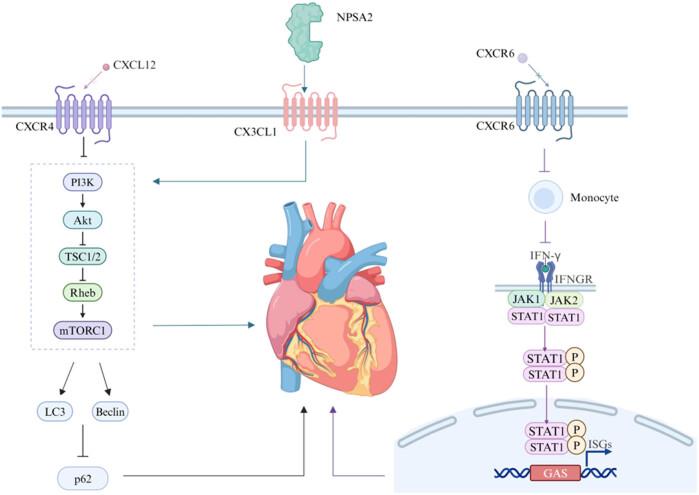
Cardiovascular diseases (CVD) are the leading cause of death worldwide. Chemokines are a class of proteins that possess characteristics of both chemoattractants and cytokines. They play a pivotal role in CVD by regulating the recruitment of immune cells and suppressing inflammatory responses. These proteins are crucial for maintaining cardiac function and for managing myocardial cell damage under various stress conditions. Autophagy, a vital intracellular degradation mechanism, is essential for clearing misfolded proteins and damaged organelles, thus promoting cell survival during starvation and other stress conditions. A substantial body of research indicates that chemokines can modulate the development of CVD by influencing the autophagy process. Research has shown that targeting pathways such as CXCR4 and CXCL12, defective CXCL16/CXCR6, and inhibiting CX3CL1 can regulate autophagy and impact CVD. The protective role of chemokines in CVD through the modulation of autophagy may offer new perspectives for treatment.
心血管疾病(CVD)是全球主要的死亡原因。趋化因子是一类兼具趋化剂和细胞因子特性的蛋白质。它们通过调节免疫细胞的募集和抑制炎症反应,在心血管疾病中发挥关键作用。这些蛋白质对于维持心脏功能以及在各种应激条件下处理心肌细胞损伤至关重要。自噬是一种重要的细胞内降解机制,对于清除错误折叠的蛋白质和受损细胞器至关重要,从而在饥饿和其他应激条件下促进细胞存活。大量研究表明,趋化因子可通过影响自噬过程来调节心血管疾病的发展。研究表明,靶向CXCR4和CXCL12等途径、缺陷型CXCL16/CXCR6以及抑制CX3CL1可调节自噬并影响心血管疾病。趋化因子通过调节自噬在心血管疾病中的保护作用可能为治疗提供新的视角。

 Zotero 插件