
纳入单核苷酸多态性与心理社会因素相互作用的多祖先全基因组关联分析确定了血清脂质的新基因座。
Multi-ancestry genome-wide association analyses incorporating SNP-by-psychosocial interactions identify novel loci for serum lipids.
作者信息
Bentley Amy R, Brown Michael R, Musani Solomon K, Schwander Karen L, Winkler Thomas W, Sims Mario, Kilpeläinen Tuomas O, Aschard Hugues, Bartz Traci M, Bielak Lawrence F, Chai Jin-Fang, Chitrala Kumaraswamy Naidu, Franceschini Nora, Graff Mariaelisa, Guo Xiuqing, Hartwig Fernando P, Horimoto Andrea R V R, Lim Elise, Liu Yongmei, Manning Alisa K, Nolte Ilja M, Noordam Raymond, Richard Melissa A, Smith Albert V, Sung Yun Ju, Vojinovic Dina, Wang Rujia, Wang Yujie, Feitosa Mary F, Harris Sarah E, Lyytikäinen Leo-Pekka, Pistis Giorgio, Rauramaa Rainer, van der Most Peter J, Ware Erin, Weiss Stefan, Wen Wanqing, Yanek Lisa R, Arking Dan E, Arnett Donna K, Ballantyne Christie, Boerwinkle Eric, Chen Yii-Der Ida, Daviglus Martha L, de Las Fuentes Lisa, de Vries Paul S, Delaney Joseph A C, Fretts Amanda M, Ekunwe Lynette, Faul Jessica D, Gallo Linda C, Heikkinen Sami, Homuth Georg, Ikram M Arfan, Isasi Carmen R, Jonas Jost Bruno, Keltikangas-Järvinen Liisa, Komulainen Pirjo, Kraja Aldi T, Krieger Jose E, Launer Lenore, Liu Jianjun, Lohman Kurt, Luik Annemarie I, Manichaikul Ani W, Marques-Vidal Pedro, Milaneschi Yuri, Mwasongwe Stanford E, O'Connell Jeffrey R, Rice Kenneth, Rich Stephen S, Schreiner Pamela J, Schwettmann Lars, Shikany James M, Shu Xiao-Ou, Smith Jennifer A, Snieder Harold, Sotoodehnia Nona, Tai E Shyong, Taylor Kent D, Tinker Lesley, Tsai Michael Y, Uitterlinden André G, van Duijn Cornelia M, van Heemst Diana, Waldenberger Melanie, Wallace Robert B, Wee Hwee-Lin, Weir David R, Wei Wen-Bin, Willems van Dijk Ko, Wilson Gregory, Yao Jie, Young Kristin L, Zhang Xiaoyu, Zhao Wei, Zhu Xiaofeng, Zonderman Alan B, Deary Ian J, Gieger Christian, Grabe Hans Jörgen, Lakka Timo A, Lehtimäki Terho, Oldehinkel Albertine J, Preisig Martin, Wang Ya-Xing, Zheng Wei, Evans Michele K, Province Michael, Gauderman James, Gudnason Vilmundur, Hartman Catharina A, Horta Bernardo L, Kardia Sharon L R, Kooperberg Charles, Liu Ching-Ti, Mook-Kanamori Dennis O, Penninx Brenda Wjh, Pereira Alexandre C, Peyser Patricia A, Psaty Bruce M, Rotter Jerome I, Sim Xueling, North Kari E, Rao Dabeeru C, Bierut Laura, Miller Clint L, Morrison Alanna C, Rotimi Charles N, Fornage Myriam, Fox Ervin R
机构信息
Center for Research on Genomics and Global Health, National Human Genome Research Institute, Bethesda, MD, 20892, USA.
Department of Epidemiology, School of Public Health, The University of Texas Health Science Center at Houston, Houston, TX, 77030, USA.
出版信息
Transl Psychiatry. 2025 Jun 20;15(1):207. doi: 10.1038/s41398-025-03418-z.
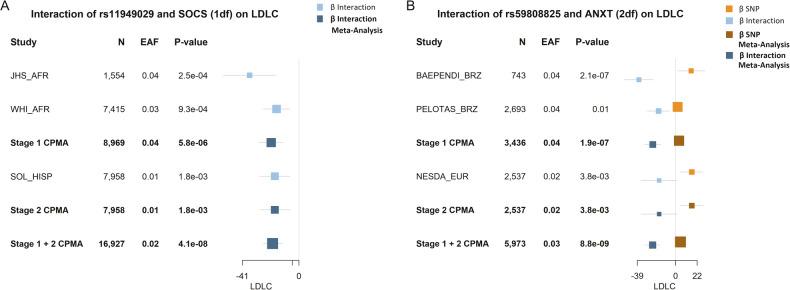
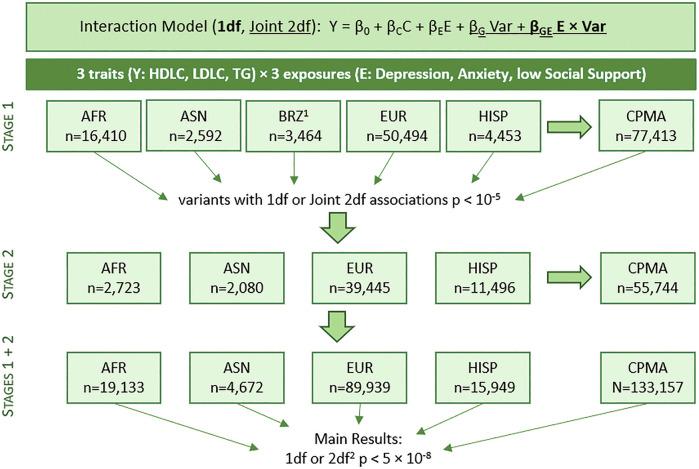
Serum lipid levels, which are influenced by both genetic and environmental factors, are key determinants of cardiometabolic health and are influenced by both genetic and environmental factors. Improving our understanding of their underlying biological mechanisms can have important public health and therapeutic implications. Although psychosocial factors, including depression, anxiety, and perceived social support, are associated with serum lipid levels, it is unknown if they modify the effect of genetic loci that influence lipids. We conducted a genome-wide gene-by-psychosocial factor interaction (G×Psy) study in up to 133,157 individuals to evaluate if G×Psy influences serum lipid levels. We conducted a two-stage meta-analysis of G×Psy using both a one-degree of freedom (1df) interaction test and a joint 2df test of the main and interaction effects. In Stage 1, we performed G×Psy analyses on up to 77,413 individuals and promising associations (P < 10) were evaluated in up to 55,744 independent samples in Stage 2. Significant findings (P < 5 × 10) were identified based on meta-analyses of the two stages. There were 10,230 variants from 120 loci significantly associated with serum lipids. We identified novel associations for variants in four loci using the 1df test of interaction, and five additional loci using the 2df joint test that were independent of known lipid loci. Of these 9 loci, 7 could not have been detected without modeling the interaction as there was no evidence of association in a standard GWAS model. The genetic diversity of included samples was key in identifying these novel loci: four of the lead variants displayed very low frequency in European ancestry populations. Functional annotation highlighted promising loci for further experimental follow-up, particularly rs73597733 (MACROD2), rs59808825 (GRAMD1B), and rs11702544 (RRP1B). Notably, one of the genes in identified loci (RRP1B) was found to be a target of the approved drug Atenolol suggesting potential for drug repurposing. Overall, our findings suggest that taking interaction between genetic variants and psychosocial factors into account and including genetically diverse populations can lead to novel discoveries for serum lipids.
血清脂质水平受遗传和环境因素的双重影响,是心脏代谢健康的关键决定因素。增进我们对其潜在生物学机制的理解具有重要的公共卫生和治疗意义。尽管包括抑郁、焦虑和感知到的社会支持在内的心理社会因素与血清脂质水平相关,但它们是否会改变影响脂质的基因位点的作用尚不清楚。我们在多达133157名个体中开展了一项全基因组基因与心理社会因素相互作用(G×Psy)研究,以评估G×Psy是否会影响血清脂质水平。我们使用单自由度(1df)相互作用检验以及主效应和相互作用效应的联合2df检验对G×Psy进行了两阶段荟萃分析。在第一阶段,我们对多达77413名个体进行了G×Psy分析,并在第二阶段对多达55744个独立样本中具有前景的关联(P<10)进行了评估。基于两个阶段的荟萃分析确定了显著结果(P<5×10)。有来自120个位点的10230个变异与血清脂质显著相关。我们使用相互作用的1df检验确定了四个位点变异的新关联,并使用2df联合检验确定了另外五个独立于已知脂质位点的位点。在这9个位点中,如果不将相互作用纳入模型,其中7个位点在标准全基因组关联研究(GWAS)模型中没有关联证据,因而无法被检测到。纳入样本的遗传多样性对于识别这些新位点至关重要:四个主要变异在欧洲血统人群中频率极低。功能注释突出了有前景的位点以供进一步实验跟进,特别是rs73597733(MACROD2)、rs59808825(GRAMD1B)和rs11702544(RRP1B)。值得注意的是,在确定的位点中发现的一个基因(RRP1B)是已获批药物阿替洛尔的靶点,这表明有药物重新利用的潜力。总体而言,我们的研究结果表明,考虑基因变异与心理社会因素之间的相互作用并纳入遗传多样性人群能够带来关于血清脂质水平的新发现。
 Zotero 插件