
腹横肌平面阻滞在腹壁成形术中对术后结局的影响。
Effect of transversus abdominis plane blocks in abdominoplasties on postoperative outcomes.
作者信息
Wellenbrock Sascha, Zidek Bettina, Chiarella Laetitia S, Nehls Fabian, Hiort Mirkka, Neef Vanessa, Hirsch Tobias, Maas Matthias, Kueckelhaus Maximilian
机构信息
Department of Plastic Surgery, University Hospital Muenster, Muenster, Germany.
Department of Plastic and Reconstructive Surgery, Institute for Musculoskeletal Medicine, University of Muenster, Muenster, Germany.
出版信息
BJS Open. 2025 May 7;9(3). doi: 10.1093/bjsopen/zraf067.
BACKGROUND
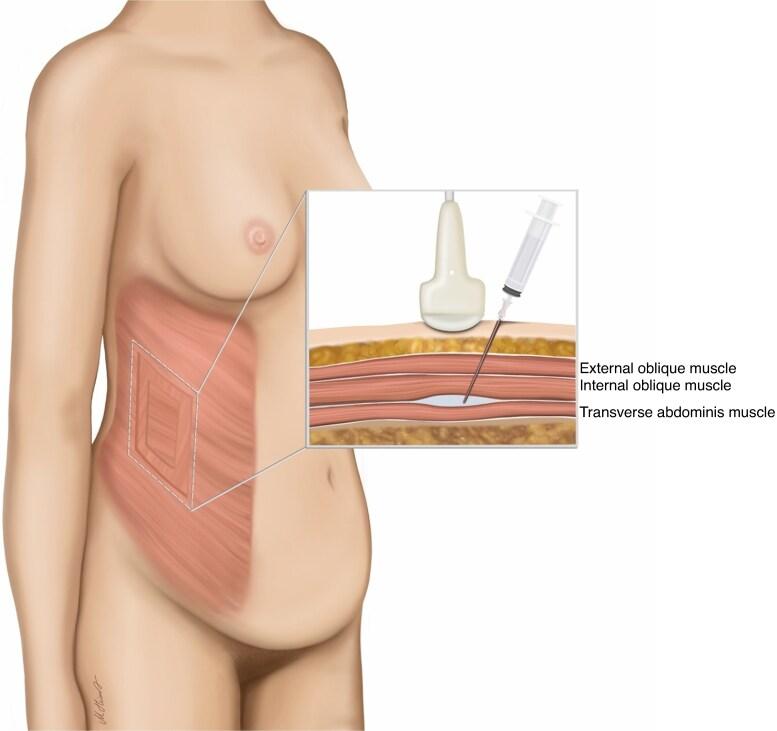
Acute postoperative pain after surgery may lead to significant complications including chronification of pain, impaired cardiopulmonary function, and increased healthcare costs. As a common and complex procedure, abdominoplasty is a key focus for pain management strategies. Although transversus abdominis plane blocks, which target the abdominal wall's sensory nerves to reduce postoperative pain by blocking nociceptive input, have shown promise in reducing postoperative pain in abdominal surgeries, their use in abdominoplasty remains underexplored.
METHODS
Outcomes for patients undergoing abdominoplasty between 2013 and 2024 were analysed, comparing those who received a transversus abdominis plane block with those who did not. Postoperative analgesia followed a standardized protocol using oral narcotics and piritramide. Pain outcomes were assessed in both groups via chart review. The primary outcome, length of hospital stay, was analysed by multivariable linear regression adjusted for patient and surgical factors. Secondary outcomes, including complications and revision rates, were assessed by logistic regression. Exploratory analyses examined how reductions in medication use affected length of hospital stay and discharge timing.
RESULTS
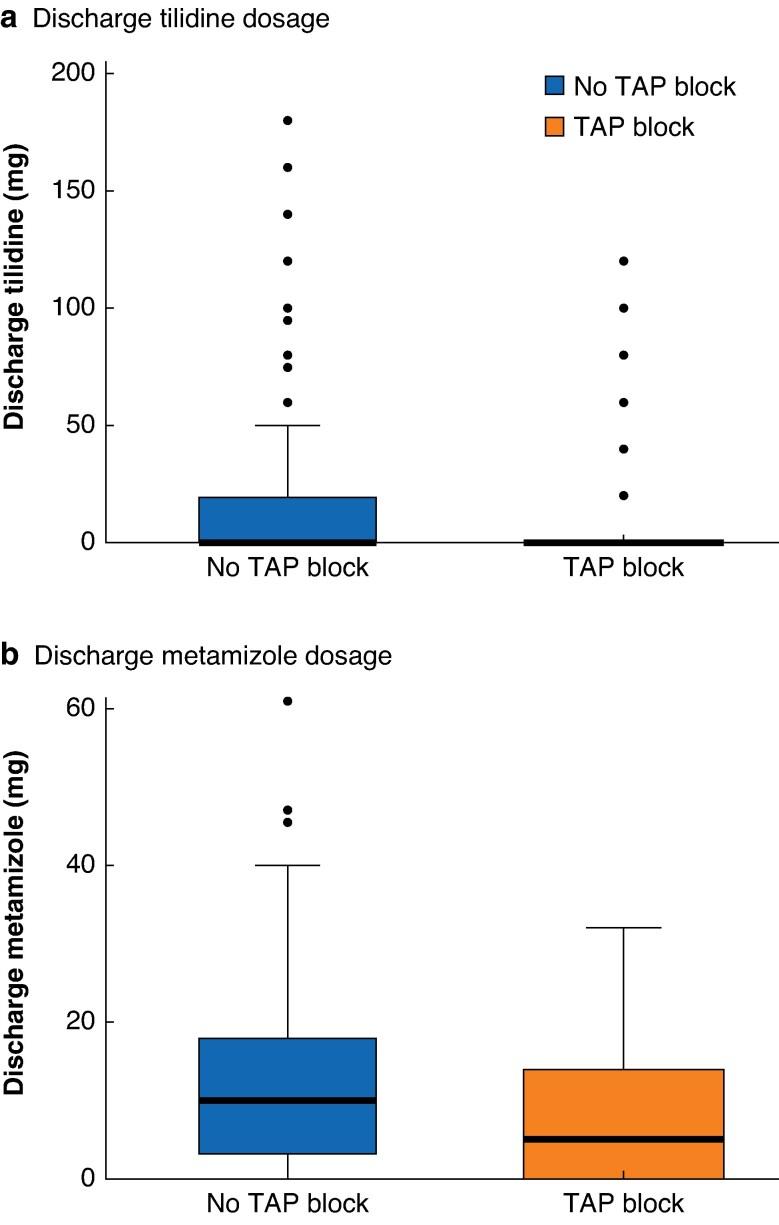
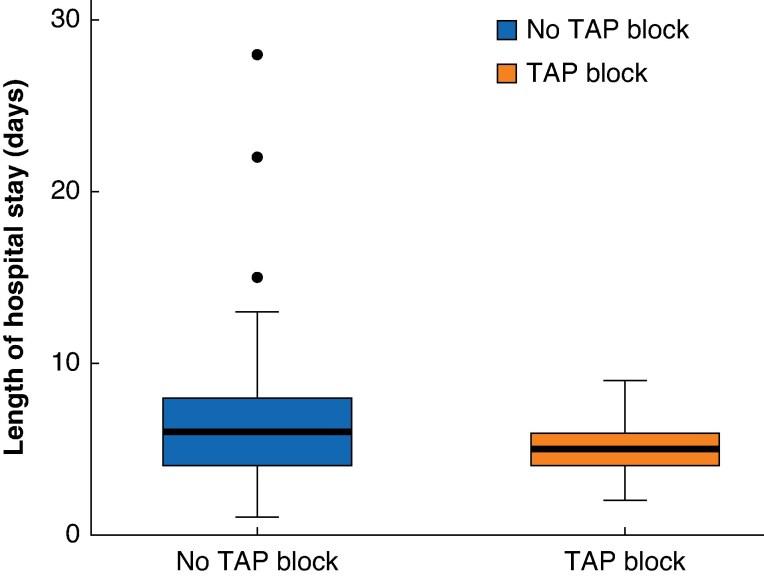
Overall, 192 patients who had an abdominoplasty were included in analyses: 93 had a transversus abdominis plane block and 99 did not. The transversus abdominis plane group had a significantly shorter hospital stay, with a reduction of 2.21 (95% confidence interval (c.i.) -3.07 to -1.36) days after adjusting for confounders (P < 0.001; effect size, Cohen's d 0.45). Surgical complications occurred in 46.9% of patients. The overall complication risk in the transversus abdominis plane block group was significantly reduced by 52% (adjusted odds ratio 0.44, 95% c.i. 0.23 to 0.84; P = 0.012; effect size 0.52), particularly the occurrence of haematoma (adjusted odds ratio 0.34; P = 0.031; effect size 0.66). Additionally, patients who had a transversus abdominis plane block required less postoperative medication, including lower tilidine (P = 0.038) and metamizole (P = 0.032) doses.
CONCLUSION
Use of the transversus abdominis plane block in patients who had an abdominoplasty was associated with improved postoperative outcomes, highlighting its potential as an effective pain management strategy and supporting its broader clinical application.
背景
手术后的急性疼痛可能导致严重并发症,包括疼痛慢性化、心肺功能受损以及医疗费用增加。作为一种常见且复杂的手术,腹壁成形术是疼痛管理策略的关键关注点。尽管腹横肌平面阻滞通过靶向腹壁感觉神经来阻断伤害性输入以减轻术后疼痛,在腹部手术中减轻术后疼痛方面已显示出前景,但其在腹壁成形术中的应用仍未得到充分探索。
方法
分析了2013年至2024年接受腹壁成形术的患者的结果,将接受腹横肌平面阻滞的患者与未接受该阻滞的患者进行比较。术后镇痛遵循使用口服麻醉药和匹米诺定的标准化方案。通过病历审查评估两组的疼痛结果。主要结局指标住院时间,通过对患者和手术因素进行调整的多变量线性回归分析。次要结局指标,包括并发症和翻修率,通过逻辑回归评估。探索性分析研究了药物使用减少如何影响住院时间和出院时间。
结果
总体而言,192例接受腹壁成形术的患者纳入分析:93例接受腹横肌平面阻滞,99例未接受。在调整混杂因素后,腹横肌平面阻滞组的住院时间显著缩短,减少了2.21天(95%置信区间(c.i.)-3.07至-1.36)(P<0.001;效应量,科恩d值0.45)。46.9%的患者发生手术并发症。腹横肌平面阻滞组的总体并发症风险显著降低了52%(调整后的优势比0.44,95%c.i.0.23至0.84;P=0.012;效应量0.52),尤其是血肿的发生(调整后的优势比0.34;P=0.031;效应量0.66)。此外,接受腹横肌平面阻滞的患者术后所需药物较少,包括较低剂量的替利定(P=0.038)和安乃近(P=0.032)。
结论
在接受腹壁成形术的患者中使用腹横肌平面阻滞与改善术后结局相关,突出了其作为有效疼痛管理策略的潜力,并支持其更广泛的临床应用。

 Zotero 插件