
基于人群队列的教育水平与心电图衍生的心血管衰老的关联:特罗姆瑟研究的中介分析
Associations of educational level with ECG-derived cardiovascular ageing in a population-based cohort: a mediation analysis from the Tromsø Study.
作者信息
Panthalanickal Vijayakumar Arya, Wilsgaard Tom, Schirmer Henrik, Lindekleiv Haakon, Attia Zachi I, Lopez-Jimenez Francisco, Leon David, Iakunchykova Olena
机构信息
Department of Community Medicine, UiT The Arctic University of Norway Faculty of Health Sciences, Tromsø, Norway
Department of Community Medicine, UiT The Arctic University of Norway Faculty of Health Sciences, Tromsø, Norway.
出版信息
BMJ Open. 2025 Jun 22;15(6):e088671. doi: 10.1136/bmjopen-2024-088671.
OBJECTIVE
To assess the association between educational level and cardiovascular age acceleration metric derived from ECG, and to determine whether this association is mediated by established cardiovascular disease (CVD) risk factors.
DESIGN
Prospective population-based cohort study (the Tromsø Study).
SETTING
General population of the Tromsø municipality, Norway.
PARTICIPANTS
The study sample consisted of 4367 participants of the Tromsø Study, who took part in both Tromsø6 (2007-2008) and Tromsø7 (2015-2016), had a 12-lead ECG obtained at Tromsø7 and did not report a history of heart attack, stroke or atrial fibrillation.
PRIMARY OUTCOME MEASURES
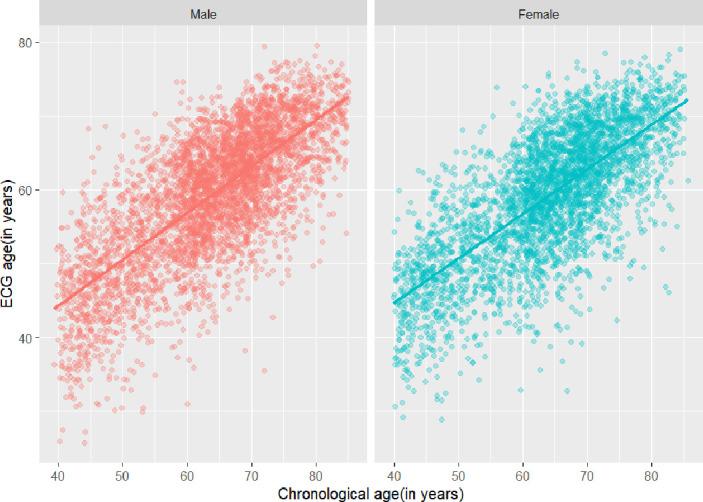
δ-age, a biomarker of cardiovascular ageing, is defined as the difference (in years) between an individual's ECG-predicted heart age and their chronological age. ECG-predicted heart age was estimated using a previously validated deep neural network.
RESULTS
Our findings indicate an inverse association between education and δ-age, with a regression coefficient per increment increase in education of -0.24 (95% CI -0.41 to -0.07) in the overall sample, -0.38 (95% CI -0.59 to -0.16) for women and -0.04 (95% CI -0.31 to 0.23) for men. Participants with the highest level of education (university/college for 4 or more years) had the lowest estimated δ-age with a regression coefficient of -0.69 years (95% CI -1.23 to -0.16) compared with the group with primary education for the overall sample, -1.05 years (95% CI -1.73 to -0.37) for women and -0.15 years (95% CI -1.03 to 0.73) for men. CVD risk factors mediated up to 75% of the association between overall education and δ-age, and 80% of the association among those with the highest education level (university/college for 4 or more years). Among women, 50% of the effect of overall education on δ-age was mediated by CVD risk factors, rising to 53% in the category with the highest level of education. However, in the subsample of men, there was no significant association between education and δ-age, and the mediation analysis produced natural direct and indirect effects pointing in opposite directions.
CONCLUSIONS
Cardiovascular ageing is inversely associated with educational level, an effect that appears to be largely mediated through established risk factors.
目的
评估教育水平与基于心电图得出的心血管年龄加速指标之间的关联,并确定这种关联是否由既定的心血管疾病(CVD)危险因素介导。
设计
基于人群的前瞻性队列研究(特罗姆瑟研究)。
地点
挪威特罗姆瑟市的普通人群。
参与者
研究样本包括4367名特罗姆瑟研究的参与者,他们同时参加了特罗姆瑟6(2007 - 2008年)和特罗姆瑟7(2015 - 2016年)研究,在特罗姆瑟7时进行了12导联心电图检查,且未报告有心脏病发作、中风或心房颤动病史。
主要结局指标
δ年龄,作为心血管衰老的生物标志物,定义为个体心电图预测的心脏年龄与其实际年龄之间的差值(以年为单位)。心电图预测的心脏年龄使用先前验证的深度神经网络进行估计。
结果
我们的研究结果表明教育与δ年龄之间存在负相关,在总体样本中,教育程度每增加一级,回归系数为 -0.24(95%置信区间 -0.41至 -0.07),女性为 -0.38(95%置信区间 -0.59至 -0.16),男性为 -0.04(95%置信区间 -0.31至0.23)。教育程度最高(大学/学院学习4年或以上)的参与者估计的δ年龄最低,与小学教育组相比,总体样本的回归系数为 -0.69岁(95%置信区间 -1.23至 -0.16),女性为 -1.05岁(95%置信区间 -1.73至 -0.37),男性为 -0.15岁(95%置信区间 -1.03至0.73)。CVD危险因素介导了总体教育与δ年龄之间高达75%的关联,以及教育程度最高组(大学/学院学习4年或以上)之间80%的关联。在女性中,总体教育对δ年龄的影响有50%由CVD危险因素介导,在教育程度最高组中这一比例升至53%。然而,在男性亚组中,教育与δ年龄之间无显著关联,中介分析产生的自然直接效应和间接效应方向相反。
结论
心血管衰老与教育水平呈负相关,这种效应似乎主要通过既定的危险因素介导。

 Zotero 插件