
PACS患者中单核细胞区室失调。
Dysregulated monocyte compartment in PACS patients.
作者信息
Kronstein-Wiedemann Romy, Teichert Madeleine, Michel Elisa, Berg Janina, Robinson George, Tausche Kristin, Kolditz Martin, Bergleiter Johannes, Thiel Jessica, Koschel Dirk, Künzel Stephan R, Hölig Kristina, Tonn Torsten, Rossol Manuela
机构信息
Laboratory for Experimental Transfusion Medicine, Transfusion Medicine, Faculty of Medicine Carl Gustav Carus, Technische Universität Dresden, Dresden, Germany.
Institute for Transfusion Medicine, German Red Cross Blood Donation Service North-East, Dresden, Germany.
出版信息
Front Immunol. 2025 Jun 6;16:1613034. doi: 10.3389/fimmu.2025.1613034. eCollection 2025.
INTRODUCTION
1-5% of all patients with COVID-19, a disease caused by infection with Severe Acute Respiratory Syndrome Virus 2 (SARS-Cov-2), even those with mild COVID-19 symptoms, continue to have symptoms after initial recovery. Symptoms associated with the post-acute sequelae of COVID-19 (PACS) include, among others, fatigue, shortness of breath, cough, and cognitive dysfunction. Since the dysregulated immune response appears to be caused by the sustained activation of certain immune cells, including monocytes, and the release of specific cytokines, the aim of our study was to investigate the effect of PACS disease on monocyte subpopulations.
METHODS
Twenty-two healthy and thirty-two patients with PACS were included into this study. We performed blood gas analysis and measured hematological parameters from peripheral blood of PACS patients and compared them with healthy donors. Surface markers to identify monocyte subpopulations were analyzed by flow cytometry.
RESULTS
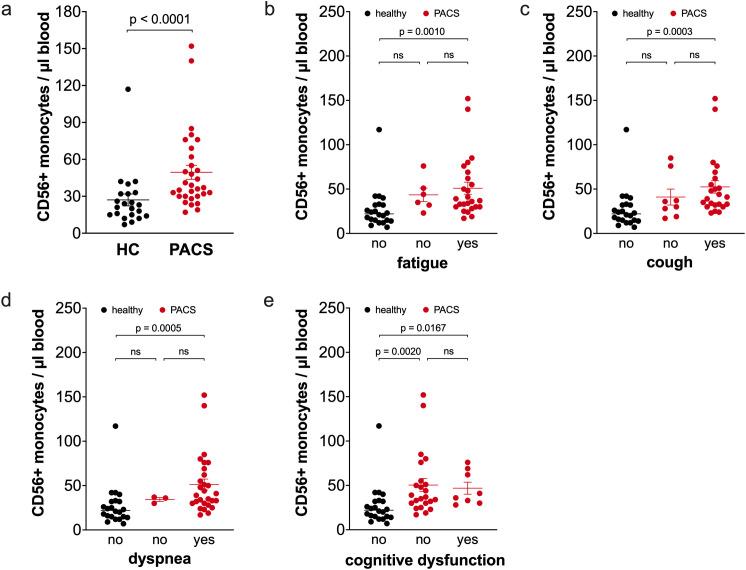
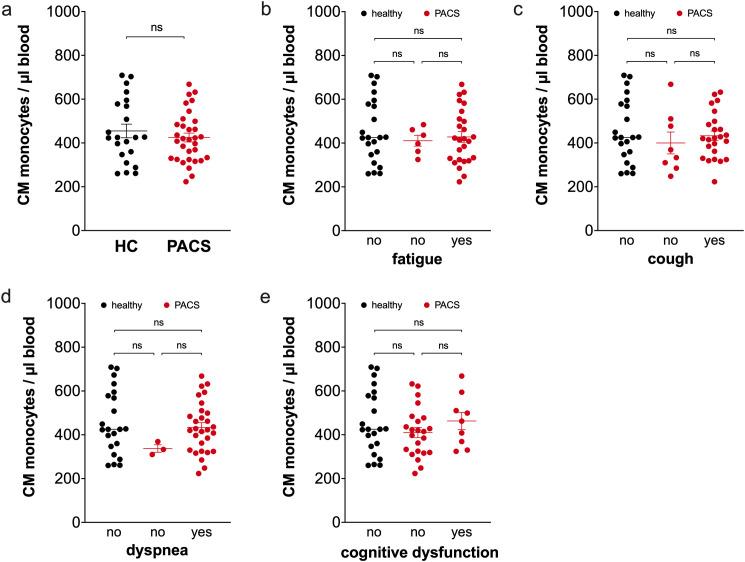
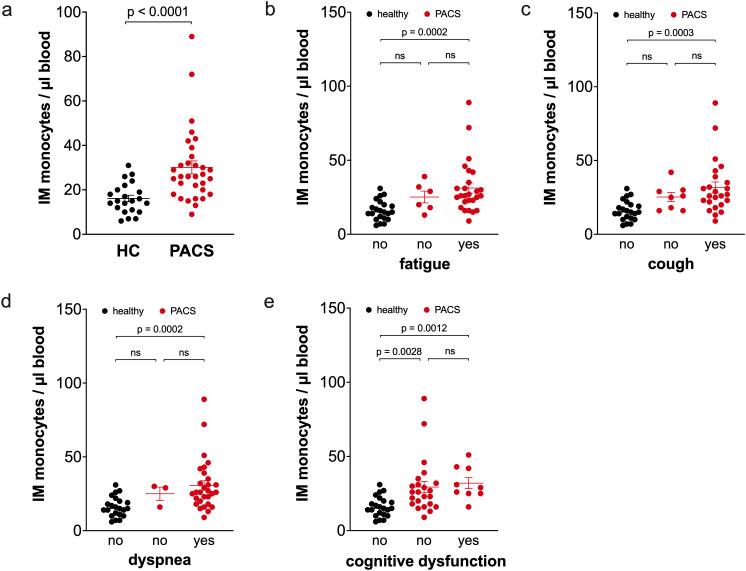
PACS patients had higher numbers of intermediate and CD56+ monocytes, whereas the numbers of total monocytes, classical and non-classical monocytes were normal compared to healthy donors. Comparison of patients with and without fatigue, cough, and dyspnea showed no difference in monocyte subset frequencies. However, patients with cognitive dysfunction had increased numbers of non-classical monocytes compared to patients without this symptom.
DISCUSSION
This suggests a disturbed homeostasis of the monocyte subsets in the peripheral blood of patients with PACS.
引言
在所有感染严重急性呼吸综合征冠状病毒2(SARS-CoV-2)所致疾病COVID-19的患者中,1%至5%的患者,即使是那些症状较轻的COVID-19患者,在初次康复后仍持续有症状。与COVID-19急性后遗症(PACS)相关的症状包括疲劳、呼吸急促、咳嗽和认知功能障碍等。由于免疫反应失调似乎是由某些免疫细胞(包括单核细胞)的持续激活以及特定细胞因子的释放引起的,我们研究的目的是调查PACS疾病对单核细胞亚群的影响。
方法
本研究纳入了22名健康人和32名PACS患者。我们对PACS患者的外周血进行了血气分析并测量了血液学参数,并将其与健康供体进行比较。通过流式细胞术分析用于识别单核细胞亚群的表面标志物。
结果
与健康供体相比,PACS患者的中间单核细胞和CD56+单核细胞数量较多,而总单核细胞、经典单核细胞和非经典单核细胞数量正常。对有和没有疲劳、咳嗽和呼吸困难的患者进行比较,发现单核细胞亚群频率没有差异。然而,与没有这种症状的患者相比,有认知功能障碍的患者非经典单核细胞数量增加。
讨论
这表明PACS患者外周血中单核细胞亚群的稳态受到干扰。


 Zotero 插件