
注意力缺陷多动障碍与疼痛之间的基因相互作用提示神经发育途径和共病风险。
Genetic Interplay Between Attention-Deficit/Hyperactivity Disorder and Pain Suggests Neurodevelopmental Pathways and Comorbidity Risk.
作者信息
Ciochetti Nicolas P, de Oliveira Victor F, Junger-Santos Iago, Bandeira Cibele E, Tavares Maria E, Vitola Eduardo S, Rohde Luis A, de Andrade Gustavo Melo, da Silva Bruna S, Grevet Eugenio H, Dotto Bau Claiton H, Rovaris Diego L
机构信息
Laboratory of Physiological Genomics of Mental Health, Instituto de Ciências Biomédicas, Universidade de São Paulo, São Paulo, Brazil.
ADHD Outpatient Program & Developmental Psychiatry Program, Hospital de Clínicas de Porto Alegre, Universidade Federal do Rio Grande do Sul, Porto Alegre, Brazil.
出版信息
Biol Psychiatry Glob Open Sci. 2025 Apr 25;5(4):100517. doi: 10.1016/j.bpsgos.2025.100517. eCollection 2025 Jul.
BACKGROUND
In this study, we investigated the genetic connections between attention-deficit/hyperactivity disorder (ADHD), migraine (MGN), and multisite chronic pain (MCP). The goal was to identify specific shared biological mechanisms that contribute to the overlap between ADHD and these pain-related conditions.
METHODS
We utilized various post-genome-wide association study analyses on summary data from samples ranging between 225,534 and 766,345 individuals. In an independent sample of patients with ADHD and control participants (665 cases and 995 controls), we evaluated MGN and MCP polygenic risk scores (PRSs) in relation to comorbid profiles, symptom severity, and neuroimaging brain scores.
RESULTS
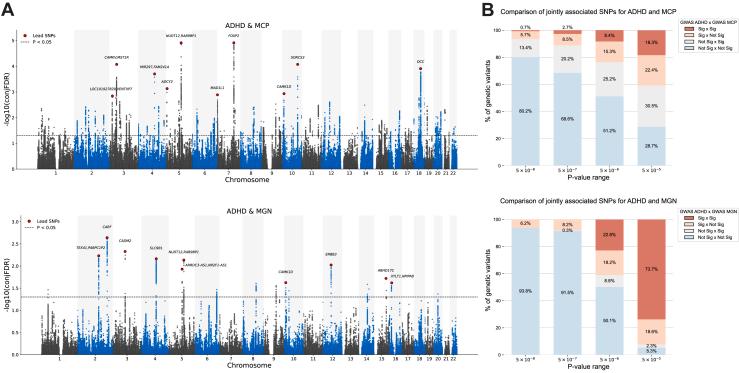
The findings show a strong biological overlap between ADHD and MCP, with a less pronounced relationship with MGN. Key regions and genes associated with ADHD and MCP were enriched in neurodevelopmental pathways, including those involved in neuron projection morphogenesis and nervous system development. Drug-set enrichment analysis identified that some of these pathways are potentially influenced by paracetamol, a drug that has been implicated as a class I environmental risk factor for ADHD when exposure occurs prenatally. Causal inference analysis using a 5-fold larger ADHD summary dataset demonstrated stronger effects of MCP on ADHD than the reverse. In the independent sample, higher MCP PRSs were linked to structural brain features, increased comorbidity with substance use and bipolar disorder, and heightened severity of ADHD symptoms.
CONCLUSIONS
These findings underscore the significant genetic relationship between ADHD and MCP, suggesting that shared genetic factors may influence brain development and contribute to diverse clinical outcomes in ADHD.
背景
在本研究中,我们调查了注意力缺陷多动障碍(ADHD)、偏头痛(MGN)和多部位慢性疼痛(MCP)之间的遗传联系。目标是确定导致ADHD与这些疼痛相关病症重叠的特定共同生物学机制。
方法
我们对225,534至766,345名个体样本的汇总数据进行了各种全基因组关联研究后的分析。在一个由ADHD患者和对照参与者组成的独立样本(665例病例和995名对照)中,我们评估了MGN和MCP多基因风险评分(PRSs)与共病情况、症状严重程度和神经影像学脑评分的关系。
结果
研究结果显示ADHD和MCP之间存在强烈的生物学重叠,与MGN的关系则不太明显。与ADHD和MCP相关的关键区域和基因在神经发育途径中富集,包括那些参与神经元投射形态发生和神经系统发育 的途径。药物集富集分析确定,其中一些途径可能受到对乙酰氨基酚的影响,对乙酰氨基酚在产前接触时被认为是ADHD的I类环境风险因素。使用比ADHD汇总数据集大5倍的数据集进行的因果推断分析表明,MCP对ADHD的影响比相反情况更强。在独立样本中,较高的MCP PRSs与脑结构特征、物质使用和双相情感障碍的共病增加以及ADHD症状的严重程度增加有关。
结论
这些发现强调了ADHD和MCP之间的重要遗传关系,表明共同的遗传因素可能影响大脑发育,并导致ADHD出现多种临床结果。


 Zotero 插件