
2021年全球疾病负担研究显示:50岁及以上男性喉癌因吸烟和饮酒导致的可减轻负担
Reducible burden of laryngeal cancer in men aged 50 and older attributable to smoking and alcohol use: insights from the global burden of disease study 2021.
作者信息
Chen Ru, Deng Jing, Sun Yao, Sun Dongxun, Lu Haibin, Sima Guoqi
机构信息
Department of Otolaryngology, The First Hospital of Jiaxing, The Affiliated Hospital of Jiaxing University, Jiaxing, China.
出版信息
Front Public Health. 2025 Jun 9;13:1577138. doi: 10.3389/fpubh.2025.1577138. eCollection 2025.
BACKGROUND
Smoking, alcohol use, advanced age, and male gender are well-established risk factors for laryngeal cancer. As smoking and alcohol consumption are modifiable behaviors, the burden of laryngeal cancer attributable to these factors is potentially reducible. This study aims to quantify the global, regional and national burden of laryngeal cancer attributable to smoking and alcohol use in men aged 50 years and older, assess temporal trends from 1990 to 2021, and project the disease burden through 2040.
METHODS
The burden of laryngeal cancer was assessed using data from the Global Burden of Disease 2021, including deaths, disability-adjusted life years (DALYs), years of life lost (YLLs), and years lived with disability (YLDs). The estimated average percentage change (EAPC) was used to evaluate trends in the disease burden from 1990 to 2021. Finally, projections for 2040 were generated and calculated with Nordpred.
RESULTS
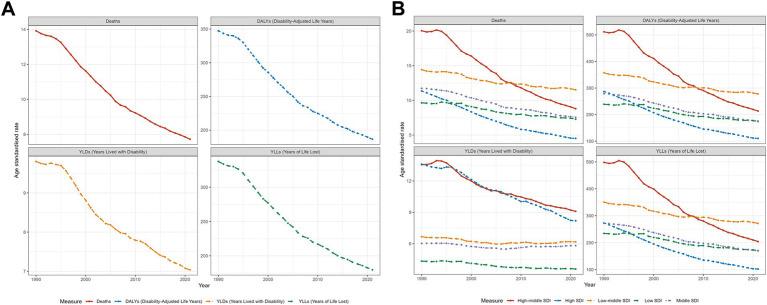
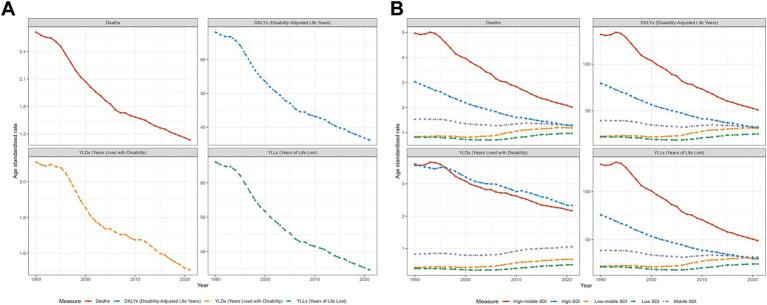
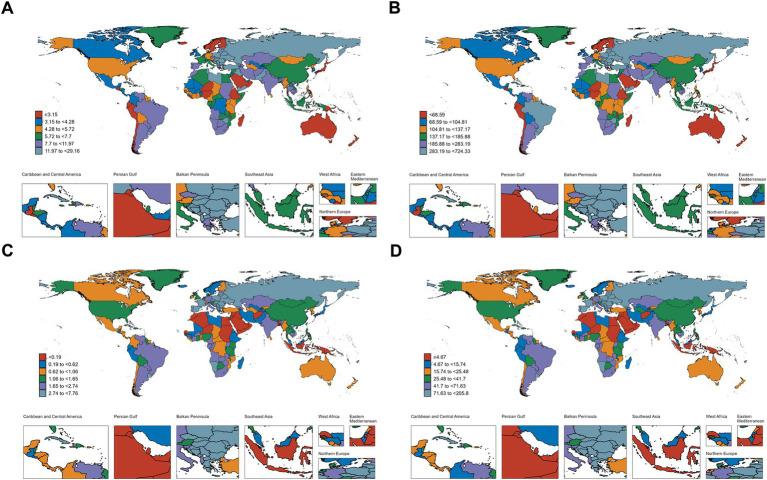
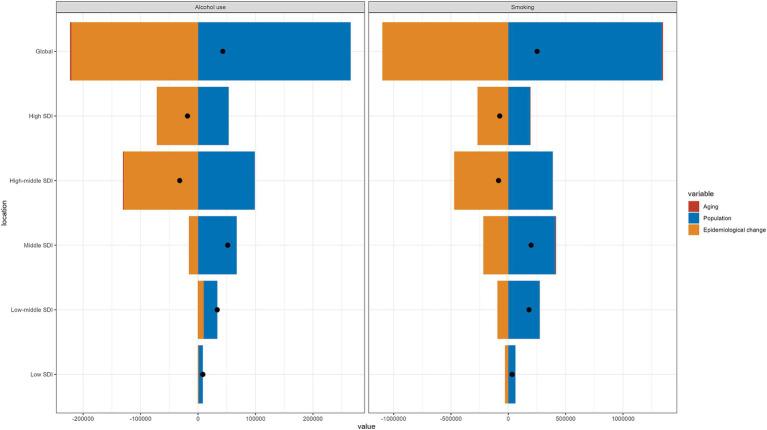
From 1990 to 2021, globally, the absolute burden of laryngeal cancer-measured by deaths, DALYs, YLLs, and YLDs-attributable to smoking and alcohol use increased among men aged 50 years and older, despite declining age-standardized rates (ASRs). Regionally, Central and Eastern Europe experienced the highest burden, which may be attributed to historically elevated rates of smoking and alcohol consumption in these regions. Countries with the greatest disease burden related to smoking at the national level include Cuba, Montenegro, Seychelles, Georgia, and Monaco, while Montenegro, Bulgaria, Romania, and Monaco have the highest alcohol-related burden. By 2040, the overall burden is projected to rise.
CONCLUSION
Smoking and alcohol-related laryngeal cancer will pose a significant public health challenge in the future. As the aging demographic continues to grow, the disease burden among older adult men is expected to rise. There are notable regional and national differences in terms of deaths, DALYs, YLLs, and YLDs. To address the rising burden, targeted public health actions are urgently required. These include higher taxation on tobacco and alcohol, comprehensive bans on related advertising, stricter enforcement of sales and age restrictions, enhanced health education regarding their health risks, and strengthened efforts in early screening.
背景
吸烟、饮酒、高龄和男性性别是喉癌公认的危险因素。由于吸烟和饮酒是可改变的行为,因此由这些因素导致的喉癌负担有可能降低。本研究旨在量化50岁及以上男性中因吸烟和饮酒导致的喉癌的全球、区域和国家负担,评估1990年至2021年的时间趋势,并预测到2040年的疾病负担。
方法
使用《2021年全球疾病负担》的数据评估喉癌负担,包括死亡人数、伤残调整生命年(DALYs)、生命损失年数(YLLs)和残疾生存年数(YLDs)。估计平均百分比变化(EAPC)用于评估1990年至2021年疾病负担的趋势。最后,使用Nordpred生成并计算了2040年的预测数据。
结果
从1990年到2021年,在全球范围内,尽管年龄标准化率(ASRs)有所下降,但50岁及以上男性中因吸烟和饮酒导致的喉癌绝对负担(以死亡人数、DALYs、YLLs和YLDs衡量)有所增加。在区域层面,中欧和东欧的负担最高,这可能归因于这些地区历史上较高的吸烟和饮酒率。在国家层面,与吸烟相关疾病负担最大的国家包括古巴、黑山、塞舌尔、格鲁吉亚和摩纳哥,而黑山、保加利亚、罗马尼亚和摩纳哥与酒精相关的负担最高。到2040年,预计总体负担将上升。
结论
吸烟和酒精相关的喉癌在未来将构成重大的公共卫生挑战。随着老年人口持续增长,老年男性中的疾病负担预计将会上升。在死亡人数、DALYs、YLLs和YLDs方面存在显著的区域和国家差异。为应对不断上升的负担,迫切需要有针对性的公共卫生行动。这些行动包括提高烟草和酒精税、全面禁止相关广告、更严格地执行销售和年龄限制、加强关于其健康风险的健康教育以及加大早期筛查力度。


 Zotero 插件