
从预测到预防:1型糖尿病中胰岛自身抗体的复杂性
From Prediction to Prevention: The Intricacies of Islet Autoantibodies in Type 1 Diabetes.
作者信息
Khine Aye, Quandt Zoe
机构信息
Division of Diabetes, Endocrinology and Metabolism, Department of Medicine, University of California San Francisco, San Francisco, CA, 94143, USA.
Diabetes Center, University of California, San Francisco, San Francisco, CA, 94143, USA.
出版信息
Curr Diab Rep. 2025 Jun 24;25(1):38. doi: 10.1007/s11892-025-01595-1.
PURPOSE OF REVIEW
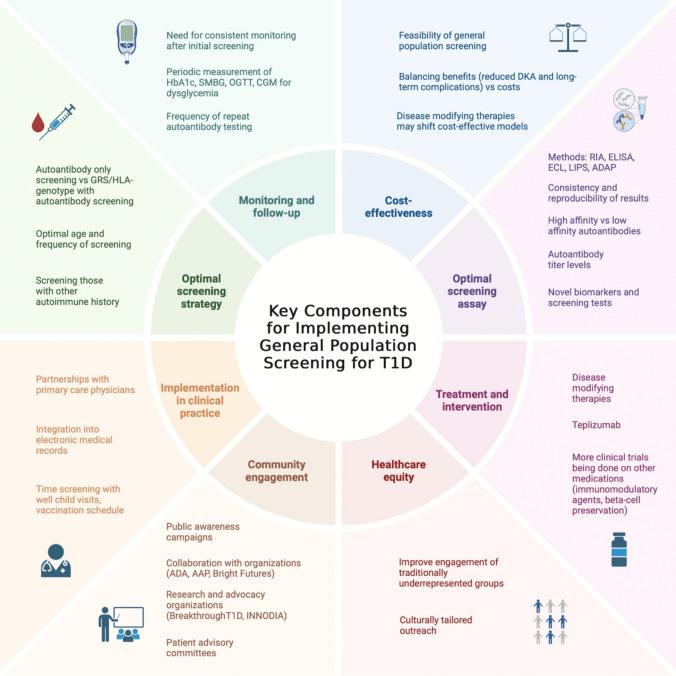
This review synthesizes current knowledge on islet autoantibodies (IAs) as predictive biomarkers for type 1 diabetes (T1D), focusing on their role in disease staging, autoantibody patterns, advancements in screening methodologies, and the implications of implementing population-wide screening initiatives.
RECENT FINDINGS
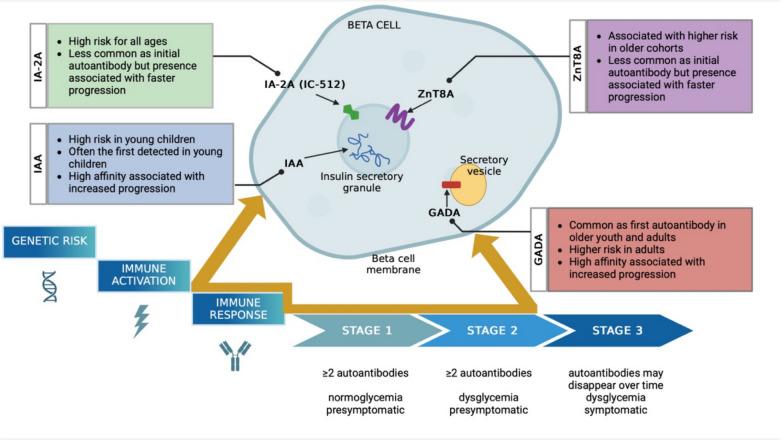
Autoantibody profiling has refined T1D risk stratification, with progression rates influenced by IA characteristics including number, type, order of appearance, and affinity. While screening efforts initially targeted genetically at-risk groups, approximately 90% of new TID diagnoses occur in individuals without a family history, underscoring the need for broader population-based screening. The approval of teplizumab, a therapy shown to delay clinical T1D onset, represents a paradigm shift by providing an intervention following early identification through screening. Technological advancements have further optimized IA detection and therapeutic strategies. However, challenges such as cost-effectiveness, implementation logistics, and assay standardization remain. T1D is a chronic autoimmune disorder characterized by progressive pancreatic beta-cell destruction, leading to insulin deficiency. The natural history of T1D is typically marked by the appearance of IAs long before clinical symptoms emerge, providing a window for early detection and intervention. Identifying at-risk individuals during this asymptomatic phase can reduce disease severity at clinical onset and facilitate timely application of disease-modifying therapies like teplizumab. Emerging evidence emphasizes that IA characteristics collectively shape disease risk and progression. Advancements in screening technologies and therapies continue to support the integration of IA screening into clinical care, marking a significant step toward effective T1D prevention and management.
综述目的
本综述综合了目前关于胰岛自身抗体(IAs)作为1型糖尿病(T1D)预测生物标志物的知识,重点关注其在疾病分期中的作用、自身抗体模式、筛查方法的进展以及实施全人群筛查计划的意义。
最新发现
自身抗体谱分析完善了T1D风险分层,疾病进展率受IAs特征影响,包括数量、类型、出现顺序和亲和力。虽然筛查工作最初针对有遗传风险的人群,但约90%的新T1D诊断发生在无家族病史的个体中,这凸显了进行更广泛的基于人群筛查的必要性。替普珠单抗(一种已证实可延缓临床T1D发病的疗法)的获批,通过在筛查早期识别后提供干预,代表了一种范式转变。技术进步进一步优化了IAs检测和治疗策略。然而,成本效益、实施流程和检测标准化等挑战依然存在。T1D是一种慢性自身免疫性疾病,其特征是胰腺β细胞进行性破坏,导致胰岛素缺乏。T1D的自然病程通常在临床症状出现很久以前就以IAs的出现为标志,这为早期检测和干预提供了一个窗口。在这个无症状阶段识别高危个体可以降低临床发病时的疾病严重程度,并促进像替普珠单抗这样的疾病修饰疗法的及时应用。新出现的证据强调,IAs特征共同塑造疾病风险和进展。筛查技术和疗法的进步继续支持将IAs筛查纳入临床护理,这标志着在有效预防和管理T1D方面迈出了重要一步。
 Zotero 插件