
贝宁医院抗菌药物使用的现患率调查:抗菌药物管理计划的必要性
Point-Prevalence Survey of Antimicrobial Use in Benin Hospitals: The Need for Antimicrobial Stewardship Programs.
作者信息
Delfosse Sarah, Yehouenou Carine Laurence, Dohou Angèle, Fiogbe Dessièdé Ariane, Dalleur Olivia
机构信息
Faculté de Pharmacie et des Sciences Biomédicales (FASB), Université Catholique de Louvain (UCLouvain), 1348 Brussels, Belgium.
Pharmacy, Clinique Saint-Luc Bouge (SLBO), 5004 Namur, Belgium.
出版信息
Antibiotics (Basel). 2025 Jun 18;14(6):618. doi: 10.3390/antibiotics14060618.
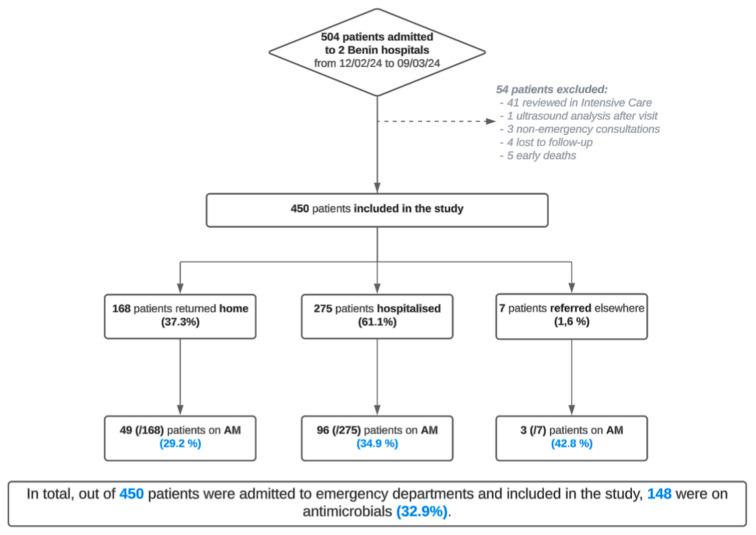
Antimicrobial resistance (AMR) is a public health concern worldwide, particularly in low-to-middle-income countries with few antimicrobial stewardship programs and few laboratories equipped for diagnosis. As point-prevalence surveys (PPSs) are a well-known tool for assessing antimicrobial use, we adjusted standardized Global-PPS for use in two hospitals in Benin and included an analysis based on the 2021 WHO AWaRe classification. Of the 450 patients enrolled, 148 received antimicrobials (AMs) (overall prevalence 32.9%), most of them orally (54.2%). Both hospitals had a high rate of Access and Watch antibiotics use, and both prescribed mainly metronidazole. In four prescriptions, hospital A used a non-recommended association of antibiotics, such as ceftriaxone + sulbactam and ofloxacin + ornidazole. While hospital A prescribed predominantly amoxicillin + clavulanic acid (19/92; 21%) and ceftriaxone (14/92; 15%), hospital B prescribed ampicillin (24/120; 20%) and cefuroxime (14/120; n = 12%). In hospital B, surgical antimicrobial prophylaxis (SAP) was suboptimal. While there were no single-dose prophylaxis prescriptions, all one-day prophylaxis (SP2) involved ampicillin for cesarean sections. In patients in intensive care units, prolonged prophylaxis (>1 day, SP3) accounted for all postoperative prescriptions. These findings highlight the critical need for implementing antimicrobial stewardship programs, expanding diagnostic laboratory capacity to minimize empirical prescribing, and strengthening medical student training to ensure quality and rational antibiotic use, thereby addressing the growing challenge of resistance in resource-limited settings.
抗菌药物耐药性(AMR)是全球公共卫生关注的问题,在抗菌药物管理计划较少且配备诊断设备的实验室较少的中低收入国家尤为如此。由于现患率调查(PPS)是评估抗菌药物使用情况的知名工具,我们对标准化的全球现患率调查进行了调整,以用于贝宁的两家医院,并纳入了基于2021年世界卫生组织(WHO)AWaRe分类的分析。在纳入的450名患者中,148名接受了抗菌药物(AM)治疗(总体患病率32.9%),其中大多数为口服给药(54.2%)。两家医院的可及类和观察类抗生素使用率都很高,且主要开具甲硝唑。在四张处方中,医院A使用了不推荐的抗生素联合用药,如头孢曲松+舒巴坦和氧氟沙星+奥硝唑。医院A主要开具阿莫西林+克拉维酸(19/92;21%)和头孢曲松(14/92;15%),而医院B则开具氨苄西林(24/120;20%)和头孢呋辛(14/120;12%)。在医院B,外科抗菌药物预防(SAP)并不理想。虽然没有单剂量预防处方,但所有一日预防(SP2)均涉及剖宫产使用氨苄西林。在重症监护病房的患者中,延长预防(>1天,SP3)占所有术后处方。这些发现凸显了实施抗菌药物管理计划、扩大诊断实验室能力以尽量减少经验性用药以及加强医学生培训以确保抗生素质量和合理使用的迫切需求,从而应对资源有限环境中日益严峻的耐药性挑战。

 Zotero 插件