
VEXAS综合征与阿尔茨海默病——存在关联吗?
VEXAS Syndrome and Alzheimer's Disease-Are There Connections?
作者信息
Sowa Aleksandra, Malicka Marta, Biernacka Magdalena, Beszłej Jan Aleksander, Leszek Jerzy
机构信息
Department of Psychiatry, Wroclaw Medical University, 50-367 Wroclaw, Poland.
出版信息
Brain Sci. 2025 May 26;15(6):573. doi: 10.3390/brainsci15060573.
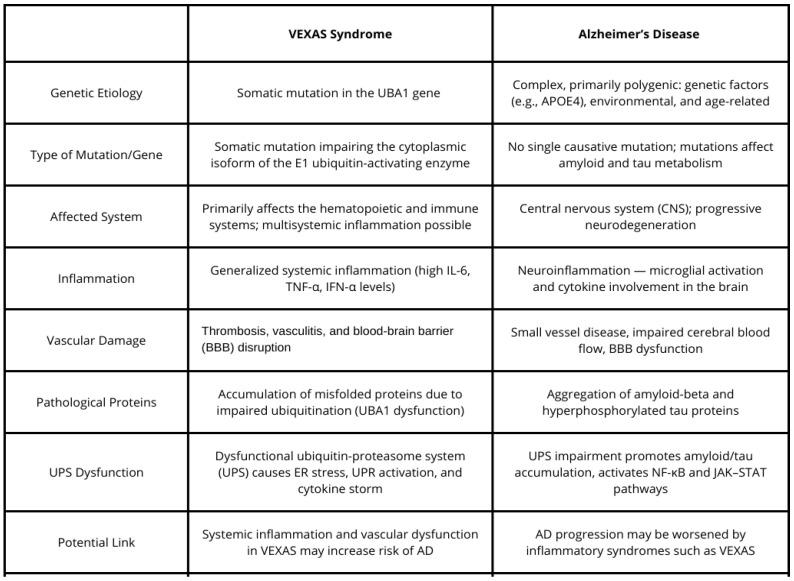
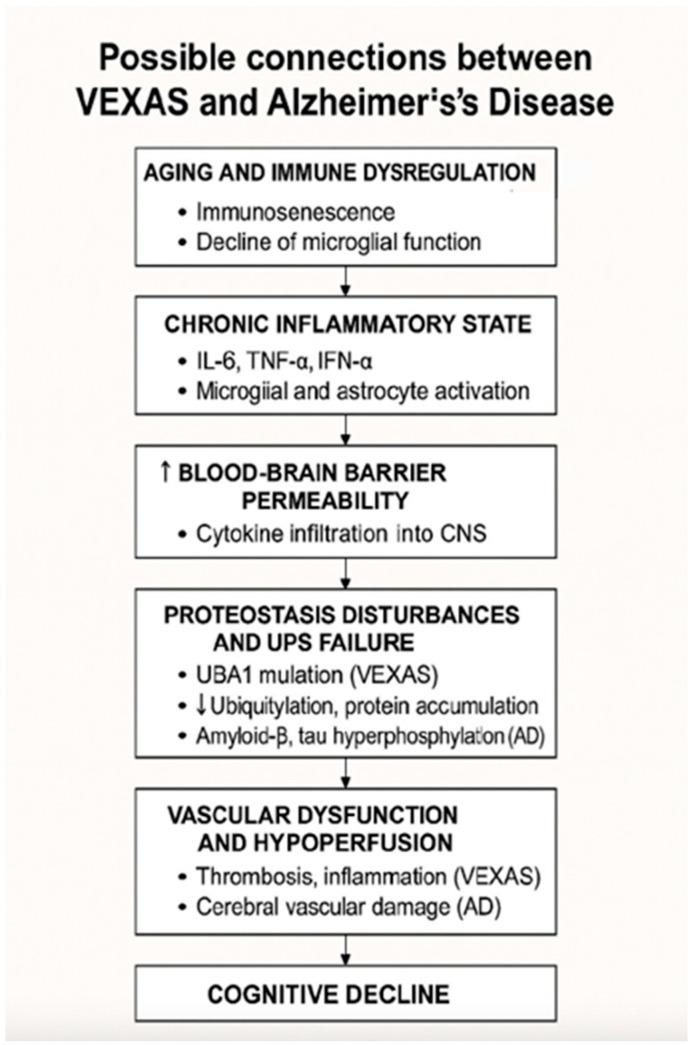
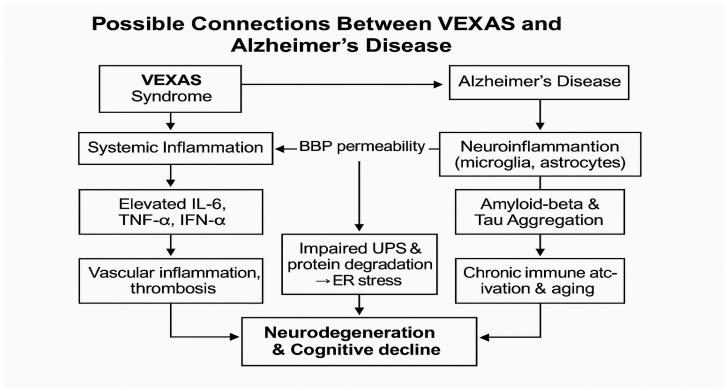
VEXAS syndrome and Alzheimer's disease (AD), though distinct in clinical manifestations, share overlapping pathophysiological mechanisms, including systemic inflammation, protein misfolding, and vascular dysfunction. VEXAS syndrome, a rare autoinflammatory disorder characterized by somatic UBA1 mutations, systemic inflammation, and hematologic abnormalities, presents primarily in older males. Meanwhile, AD, the leading cause of dementia, involves progressive neurodegeneration driven by amyloid-beta plaques, tau tangles, and chronic neuroinflammation. This article explores potential connections between the two conditions, focusing on inflammation, neurovascular changes and cellular stress. Systemic inflammation observed in VEXAS syndrome may potentiate neuroinflammatory processes in Alzheimer's disease (AD), as circulating proinflammatory cytokines have the capacity to cross the blood-brain barrier (BBB), thereby inducing glial activation and promoting neuroinflammation. Additionally, coexisting vascular dysfunctions characteristic of both conditions may synergistically contribute to accelerated cognitive decline. Both conditions involve disruption of the ubiquitin-proteasome system, with UBA1 mutations being specific to VEXAS. Given the established role of UBA1 in maintaining neuronal homeostasis, investigating the overlapping and distinct molecular mechanisms may provide valuable insights into their pathophysiology. The review underscores the need for further research to elucidate these links and improve therapeutic strategies, especially for individuals affected by both disorders.
VEXAS综合征和阿尔茨海默病(AD)虽然临床表现不同,但在病理生理机制上存在重叠,包括全身炎症、蛋白质错误折叠和血管功能障碍。VEXAS综合征是一种罕见的自身炎症性疾病,其特征为体细胞UBA1突变、全身炎症和血液学异常,主要发生于老年男性。与此同时,作为痴呆症的主要病因,AD涉及由β-淀粉样蛋白斑块、tau缠结和慢性神经炎症驱动的进行性神经退行性变。本文探讨了这两种疾病之间的潜在联系,重点关注炎症、神经血管变化和细胞应激。VEXAS综合征中观察到的全身炎症可能会增强阿尔茨海默病(AD)中的神经炎症过程,因为循环中的促炎细胞因子有能力穿过血脑屏障(BBB),从而诱导胶质细胞活化并促进神经炎症。此外,这两种疾病共有的血管功能障碍可能会协同导致认知能力加速下降。这两种疾病都涉及泛素-蛋白酶体系统的破坏,其中UBA1突变是VEXAS综合征所特有的。鉴于UBA1在维持神经元稳态中的既定作用,研究重叠和不同的分子机制可能为它们的病理生理学提供有价值的见解。该综述强调需要进一步研究以阐明这些联系并改进治疗策略,特别是对于同时受这两种疾病影响的个体。

 Zotero 插件