
多重耐药感染与代谢综合征:一种被忽视的双向关系。
Multidrug-Resistant Infections and Metabolic Syndrome: An Overlooked Bidirectional Relationship.
作者信息
Acierno Carlo, Nevola Riccardo, Barletta Fannia, Rinaldi Luca, Sasso Ferdinando Carlo, Adinolfi Luigi Elio, Caturano Alfredo
机构信息
Department of Infectious Diseases, Azienda Ospedaliera Regionale San Carlo, 85100 Potenza, Italy.
Liver Unit, Azienda Ospedaliera di Rilievo Nazionale S. G. Moscati, "A. Landolfi" Hospital, 83029 Solofra, Italy.
出版信息
Biomedicines. 2025 May 30;13(6):1343. doi: 10.3390/biomedicines13061343.
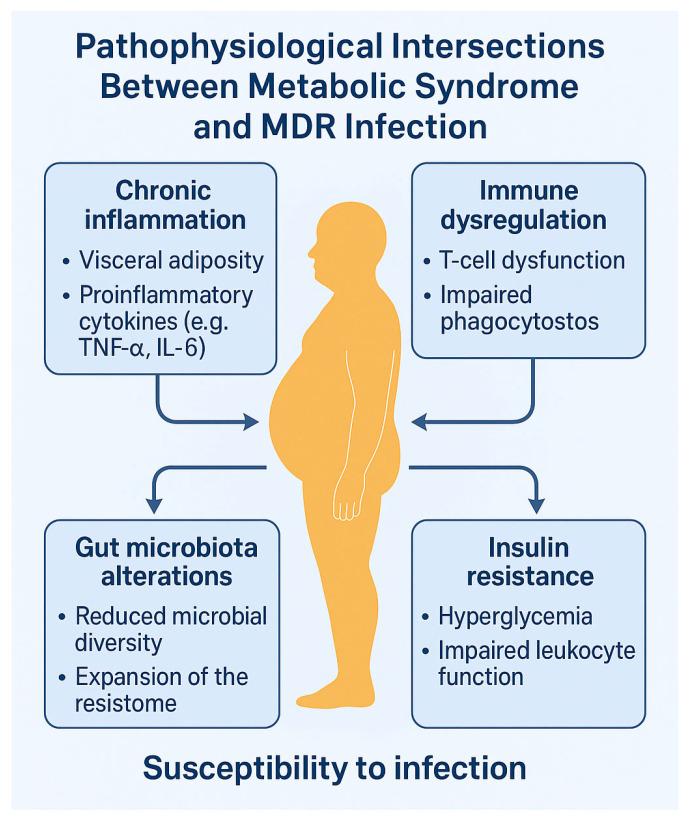
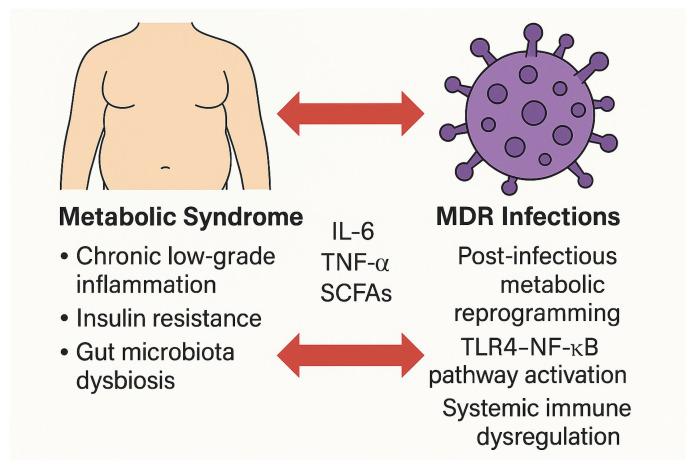
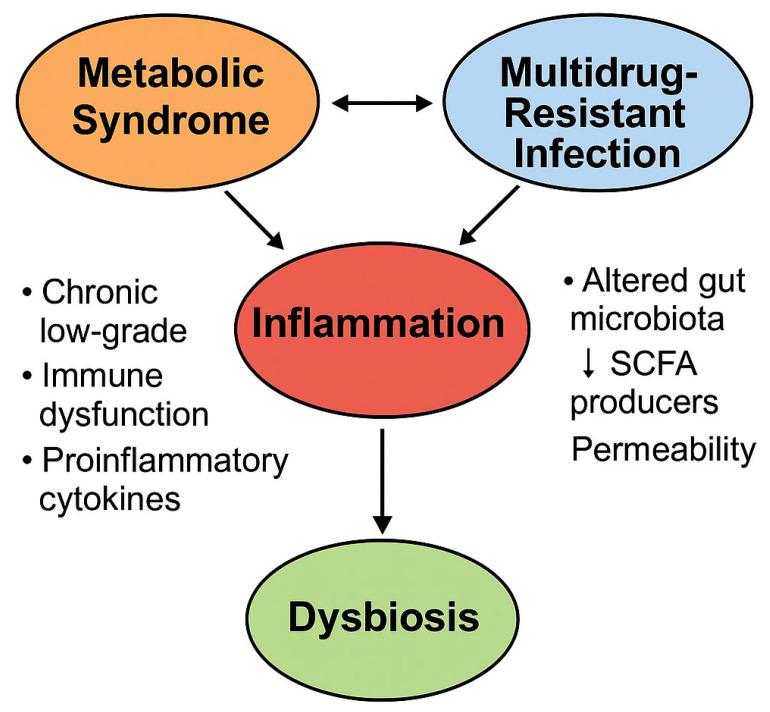
Over the past two decades, metabolic syndrome (MetS) and infections caused by multidrug-resistant (MDR) pathogens have emerged as converging global health challenges. Traditionally investigated as separate entities, accumulating evidence increasingly supports a bidirectional relationship between them, mediated by chronic inflammation, immune dysregulation, gut microbiota alterations, and antibiotic-driven expansion of the resistome. This narrative review examines the complex immunometabolic interplay linking MetS and MDR infections, focusing on molecular mechanisms, clinical implications, and prospective research directions. A systematic literature search was conducted using major databases, including PubMed and Scopus, targeting studies from the last 15 years that explore the interface between metabolic dysfunction and antimicrobial resistance. Particular attention is given to key immunometabolic pathways such as the IRS-PI3K-AKT-mTOR axis; the contribution of visceral adiposity and Toll-like receptor (TLR)-mediated inflammation; and the role of gut dysbiosis in augmenting both susceptibility to infections and metabolic derangements. Evidence is presented supporting the hypothesis that MetS increases host vulnerability to MDR pathogens, while chronic MDR infections may reciprocally induce systemic metabolic reprogramming. Viral infections with established metabolic sequelae (e.g., HIV, hepatitis C virus [HCV], and cytomegalovirus [CMV]) are also considered to broaden the conceptual framework. Although current data remain largely associative and fragmented, the emerging MetS-MDR syndemic model poses substantial challenges for translational research, antimicrobial stewardship, and personalized therapeutic strategies. Recognizing this reciprocal relationship is pivotal for refining infection risk stratification, optimizing treatment, and informing public health policies. Further investigations are warranted to elucidate the magnitude and directionality of this association and to identify predictive immunometabolic biomarkers that may guide targeted interventions in high-risk populations.
在过去二十年中,代谢综合征(MetS)和多重耐药(MDR)病原体引起的感染已成为日益严峻的全球性健康挑战。传统上它们被作为独立的实体进行研究,但越来越多的证据支持它们之间存在双向关系,这种关系由慢性炎症、免疫失调、肠道微生物群改变以及抗生素驱动的耐药基因组扩张介导。本叙述性综述探讨了将MetS与MDR感染联系起来的复杂免疫代谢相互作用,重点关注分子机制、临床意义和前瞻性研究方向。使用包括PubMed和Scopus在内的主要数据库进行了系统的文献检索,目标是过去15年中探索代谢功能障碍与抗菌药物耐药性之间关系的研究。特别关注关键的免疫代谢途径,如胰岛素受体底物-磷脂酰肌醇-3激酶-蛋白激酶B-哺乳动物雷帕霉素靶蛋白(IRS-PI3K-AKT-mTOR)轴;内脏肥胖和Toll样受体(TLR)介导的炎症的作用;以及肠道菌群失调在增加感染易感性和代谢紊乱方面的作用。现有证据支持以下假设:MetS会增加宿主对MDR病原体的易感性,而慢性MDR感染可能反过来诱导全身代谢重编程。具有既定代谢后遗症的病毒感染(如人类免疫缺陷病毒、丙型肝炎病毒[HCV]和巨细胞病毒[CMV])也被认为拓宽了概念框架。尽管目前的数据在很大程度上仍具有关联性且零散,但新出现的MetS-MDR综合征模型对转化研究、抗菌药物管理和个性化治疗策略提出了重大挑战。认识到这种相互关系对于完善感染风险分层、优化治疗以及为公共卫生政策提供信息至关重要。有必要进一步开展研究,以阐明这种关联的程度和方向性,并确定可能指导对高危人群进行靶向干预的预测性免疫代谢生物标志物。


 Zotero 插件