
被动深蹲起立和步态辅助外骨骼对人体运动影响的研究
Investigations on the Effects of a Passive Standing-from-Squatting and Gait Assistive Exoskeleton on Human Motion.
作者信息
Lin Yu-Chih, Lin Sih-You, Kao Shih-Yu
机构信息
Department of Mechanical and Mechatronic Engineering, National Taiwan Ocean University, No.2, Beining Rd., Jhongjheng District, Keelung 20224, Taiwan.
出版信息
Bioengineering (Basel). 2025 May 30;12(6):590. doi: 10.3390/bioengineering12060590.
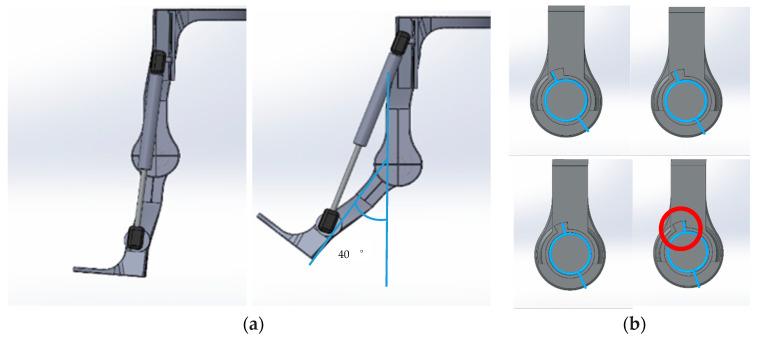
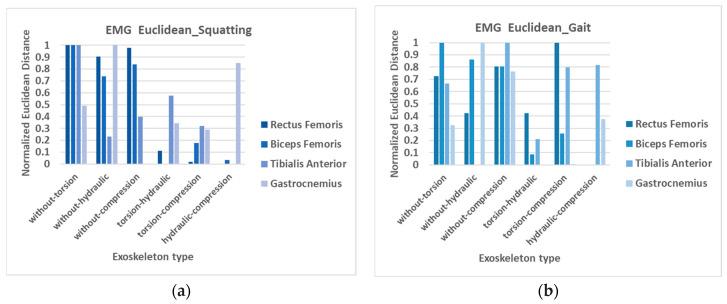
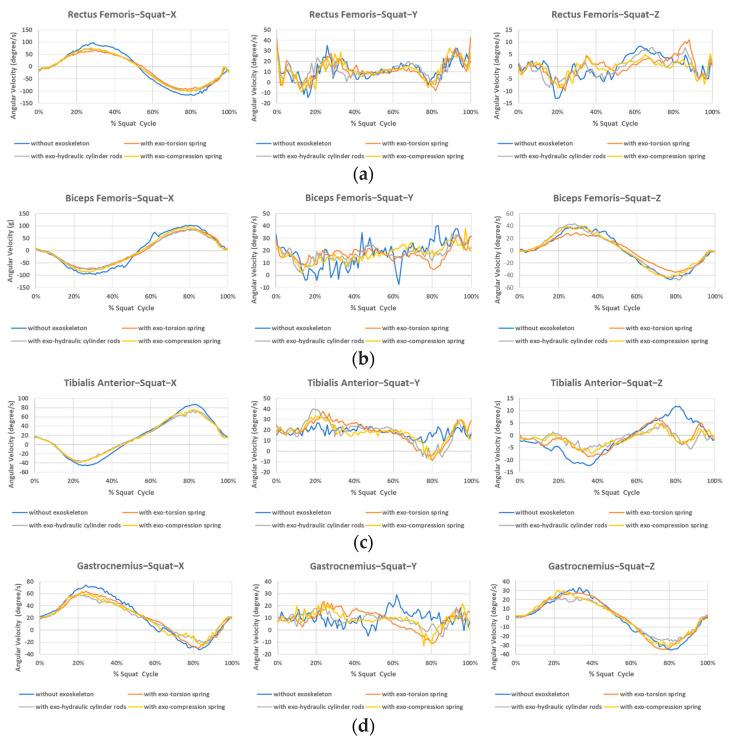
The aim of this study is to examine the biomechanical interaction between an assistive wearable exoskeleton and the human body. For this purpose, a passive exoskeleton is designed to provide support during the transition from a squatting position to standing, while also enabling the resilient components to become active during the initial and mid-swing phases of level walking. The active period can be adjusted by a slot, which triggers the activation of the resilient components when the exoskeleton's flexion angle exceeds a critical value. This study also compares the effect of using different passive powered components in the exoskeleton. Electromyography (EMG) signals and angular velocity during human motion are collected and analyzed. Experimental results indicate that the designed assistive exoskeleton effectively reduces muscle effort during squatting/standing motion, as intended. The exoskeleton reduces the flexion/extension (-axis) angular velocity during both squatting/standing and the swing phase of gait. The oscillation of the angular velocity curve about the -axis during gait is larger without the exoskeleton, suggesting that the exoskeleton may introduce interference but also a stabilizing effect in certain dimensions during gait. This study provides a stronger foundation for advancing the design of both passive and active powered exoskeletons.
本研究的目的是研究辅助可穿戴外骨骼与人体之间的生物力学相互作用。为此,设计了一种被动外骨骼,以在从蹲姿到站立的过渡过程中提供支撑,同时还能使弹性部件在水平行走的初始和摆动中期阶段发挥作用。激活期可通过一个狭槽进行调节,当外骨骼的弯曲角度超过临界值时,该狭槽会触发弹性部件的激活。本研究还比较了在外骨骼中使用不同被动动力部件的效果。收集并分析了人体运动过程中的肌电图(EMG)信号和角速度。实验结果表明,所设计的辅助外骨骼按预期有效地减少了蹲姿/站立运动过程中的肌肉用力。外骨骼在蹲姿/站立和步态摆动阶段均降低了屈伸(-轴)角速度。没有外骨骼时,步态期间角速度曲线围绕-轴的振荡更大,这表明外骨骼可能会引入干扰,但在步态的某些维度上也有稳定作用。本研究为推进被动和主动动力外骨骼的设计提供了更坚实的基础。






 Zotero 插件