
替雷利珠单抗与TIGIT:开创癌症免疫治疗的新时代。
Tiragolumab and TIGIT: pioneering the next era of cancer immunotherapy.
作者信息
Ghasemi Kosar
机构信息
Department of Pharmacology and Toxicology, School of Pharmacy, Jundishapur University of Medical Sciences, Ahvaz, Iran.
Cellular and Molecular Research Center, Jundishapur University of Medical Sciences, Ahvaz, Iran.
出版信息
Front Pharmacol. 2025 Jun 11;16:1568664. doi: 10.3389/fphar.2025.1568664. eCollection 2025.
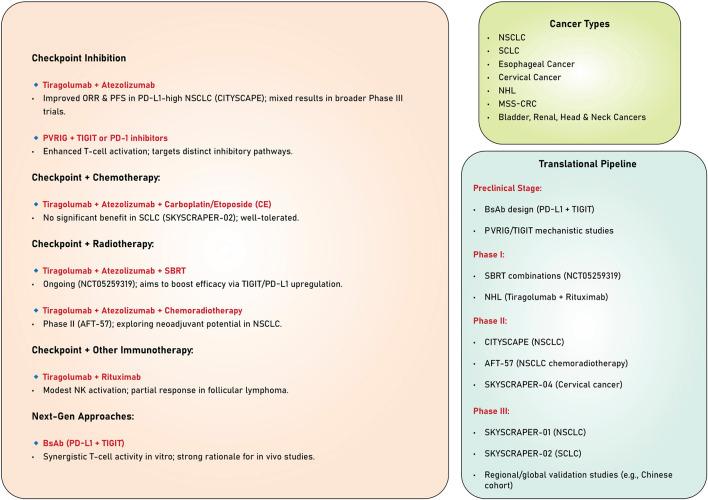
Tiragolumab, a monoclonal antibody (mAb) targeting T cell immunoreceptor with Ig and ITIM domains (TIGIT), represents a novel approach in cancer immunotherapy. TIGIT, an immunological checkpoint receptor, suppresses T cell activation and promotes immune evasion in various cancers. By inhibiting TIGIT, Tiragolumab enhances T cell-mediated anti-tumor immunity, particularly when combined with programmed cell death-1 (PD-1) and programmed death-ligand 1 (PD-L1) inhibitors. This synergy arises from complementary mechanisms, where TIGIT blockade reduces CD155-mediated suppression, amplifying PD-1/PD-L1-driven T cell activation. Phase II and III trials, including the CITYSCAPE trial for non-small cell lung cancer (NSCLC), have shown improved objective response rates (37% vs. 21% with PD-L1 inhibitor monotherapy) and progression-free survival (PFS), with manageable adverse effects. However, the potential of other checkpoint inhibitors, such as Lymphocyte Activation Gene 3 (LAG3), T-cell immunoglobulin and mucin domain-3 (TIM-3), or cytotoxic T-lymphocyte-associated protein 4 (CTLA-4), remains underexplored compared to TIGIT. This review summarizes TIGIT's molecular mechanisms, preclinical and clinical data, and limitations, including resistance mechanisms (e.g., upregulation of alternative checkpoints), biomarker development, and the need for broader investigation into alternative inhibitors to optimize combination therapies for personalized, durable cancer treatment.
替雷戈鲁单抗是一种靶向具有Ig和ITIM结构域的T细胞免疫受体(TIGIT)的单克隆抗体(mAb),代表了癌症免疫治疗的一种新方法。TIGIT是一种免疫检查点受体,可抑制T细胞活化并促进多种癌症中的免疫逃逸。通过抑制TIGIT,替雷戈鲁单抗增强了T细胞介导的抗肿瘤免疫,特别是与程序性细胞死亡蛋白1(PD-1)和程序性死亡配体1(PD-L1)抑制剂联合使用时。这种协同作用源于互补机制,其中TIGIT阻断减少了CD155介导的抑制作用,增强了PD-1/PD-L1驱动的T细胞活化。包括用于非小细胞肺癌(NSCLC)的CITYSCAPE试验在内的II期和III期试验显示,客观缓解率有所提高(与PD-L1抑制剂单药治疗相比,分别为37%和21%),无进展生存期(PFS)延长,且不良反应可控。然而,与TIGIT相比,其他检查点抑制剂如淋巴细胞活化基因3(LAG3)、T细胞免疫球蛋白和粘蛋白结构域3(TIM-3)或细胞毒性T淋巴细胞相关蛋白4(CTLA-4)的潜力仍未得到充分探索。本综述总结了TIGIT的分子机制、临床前和临床数据以及局限性,包括耐药机制(如替代检查点的上调)、生物标志物开发,以及需要更广泛地研究替代抑制剂,以优化个性化、持久癌症治疗的联合疗法。

 Zotero 插件