
白细胞端粒长度与女性生殖系统疾病之间的因果关系:一项双向孟德尔随机化研究。
Causal relationships between leukocyte telomere length and female reproductive system diseases: a bidirectional Mendelian randomization study.
作者信息
She Jun-Sen, Liu Rui, Mao Su-Qing, Zhou Bo-Kang, Wu Xiao-Jing, Ding Meng-Zhen, Wang Ling-Xiang, Cao Yi-Ning, Wu Hai-Yan, Long Yu-Hang, Guo Fei, Huang He-Feng, Gao Ling
机构信息
International Institutes of Medicine, the Fourth Affiliated Hospital, Zhejiang University School of Medicine, Yiwu 322000, China.
The Quzhou Affiliated Hospital of Wenzhou Medical University, Quzhou People's Hospital, Quzhou 324000, China.
出版信息
Reprod Dev Med. 2025 Jun;9(2):83-91. doi: 10.1097/RD9.0000000000000108. Epub 2024 Sep 27.
OBJECTIVE
Although numerous observational studies have revealed a correlation between leukocyte telomere length (LTL) and female reproductive system diseases (RSDs), the findings of these studies have tended to be consistent. In this study, we accordingly sought to clarify the causal relationships between LTL and RSDs.
METHODS
We performed a bidirectional two-sample Mendelian randomization (MR) analysis using pooled statistics from genome-wide association studies of LTL and nine female RSDs. The final results were analyzed using five MR methods, with the inverse variance weighted (IVW) method used as the primary outcome. We applied MR-PRESSO to exclude outliers. Sensitivity analyses were also conducted to assess heterogeneity and pleiotropy.
RESULTS
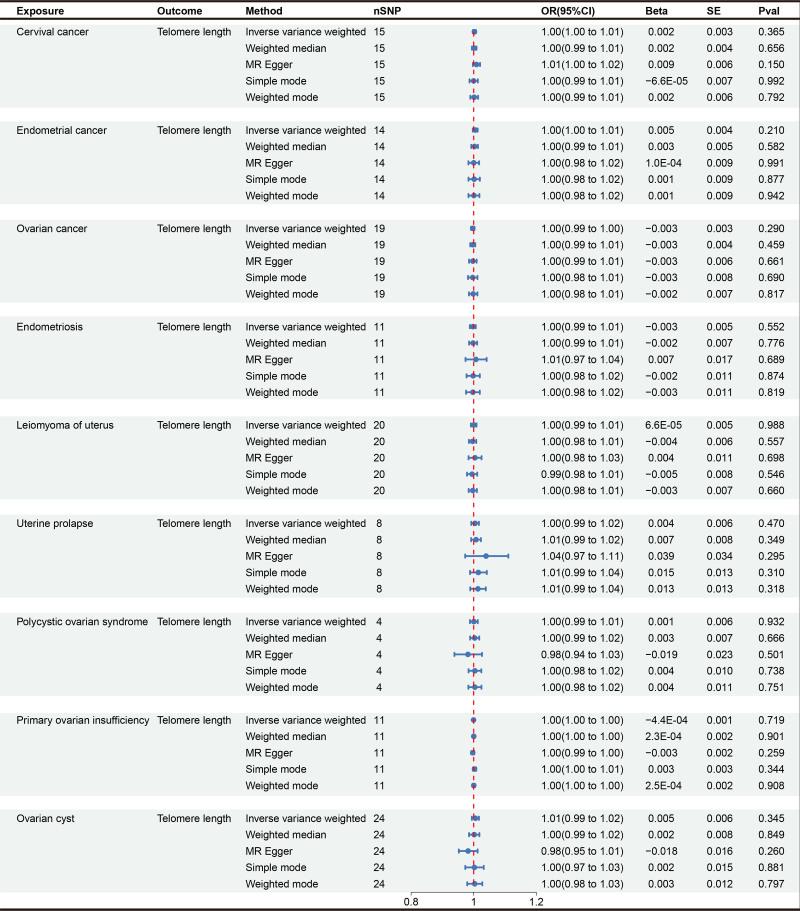
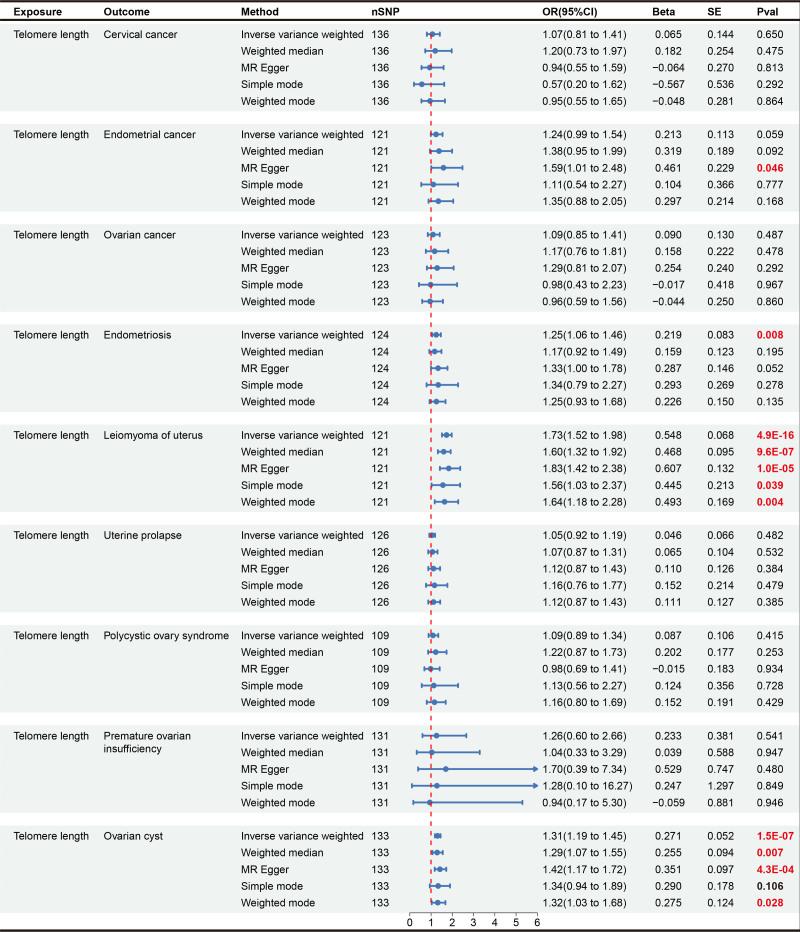
In the forward MR analysis, a genetic prediction of longer LTLs was found to be causally associated with higher risks of endometriosis (IVW: odds ratio [] = 1.25, 95% confidence interval [] = 1.06-1.46, = 0.008), leiomyoma of the uterus (IVW: = 1.73, 95% = 1.52-1.98, = 4.9E-16), and ovarian cysts (IVW: = 1.31, 95% :1.19-1.45, = 1.5E-07). In the reverse MR results, female RSDs were shown to have no significant effect on LTLs (all values >0.05). Sensitivity analysis confirmed the robustness of these results.
CONCLUSIONS
Our findings substantiate the assumption that a genetically predicted longer LTL elevates the risk of endometriosis, leiomyoma of the uterus, and ovarian cysts, with no influence of RSDs on LTL. These findings contribute to establishing a causal link between LTL and RSDs, overcoming the constraints of earlier observational studies. They also imply that LTL could potentially serve as a biomarker for the occurrence of endometriosis, leiomyoma of the uterus, and ovarian cysts.
目的
尽管众多观察性研究揭示了白细胞端粒长度(LTL)与女性生殖系统疾病(RSD)之间的相关性,但这些研究结果往往并不一致。因此,在本研究中,我们试图阐明LTL与RSD之间的因果关系。
方法
我们使用来自LTL和九种女性RSD全基因组关联研究的汇总统计数据进行了双向双样本孟德尔随机化(MR)分析。最终结果使用五种MR方法进行分析,以逆方差加权(IVW)方法作为主要结果。我们应用MR-PRESSO排除异常值。还进行了敏感性分析以评估异质性和多效性。
结果
在前瞻性MR分析中,发现LTL较长的遗传预测与子宫内膜异位症(IVW:比值比[] = 1.25,95%置信区间[] = 1.06 - 1.46,= 0.008)、子宫肌瘤(IVW:= 1.73,95% = 1.52 - 1.98,= 4.9E - 16)和卵巢囊肿(IVW:= 1.31,95%:1.19 - 1.45,= 1.5E - 07)的较高风险存在因果关系。在反向MR结果中,女性RSD对LTL没有显著影响(所有值>0.05)。敏感性分析证实了这些结果的稳健性。
结论
我们的研究结果证实了以下假设:遗传预测的较长LTL会增加子宫内膜异位症、子宫肌瘤和卵巢囊肿的风险,而RSD对LTL没有影响。这些发现有助于建立LTL与RSD之间的因果联系,克服了早期观察性研究的局限性。它们还意味着LTL可能潜在地作为子宫内膜异位症、子宫肌瘤和卵巢囊肿发生的生物标志物。

 Zotero 插件