
早期与晚期分娩硬膜外镇痛对经产妇的影响:一项回顾性单中心研究
Effects of Early and Late Labor Epidural Analgesia on Multiparous Women: A Retrospective Monocentric Study.
作者信息
Varma Eswary, Fatima Zeenat, Singh Nilanjana
机构信息
Department of Obstetrics and Gynecology, Kanad Hospital, Al Ain, ARE.
出版信息
Cureus. 2025 May 26;17(5):e84825. doi: 10.7759/cureus.84825. eCollection 2025 May.
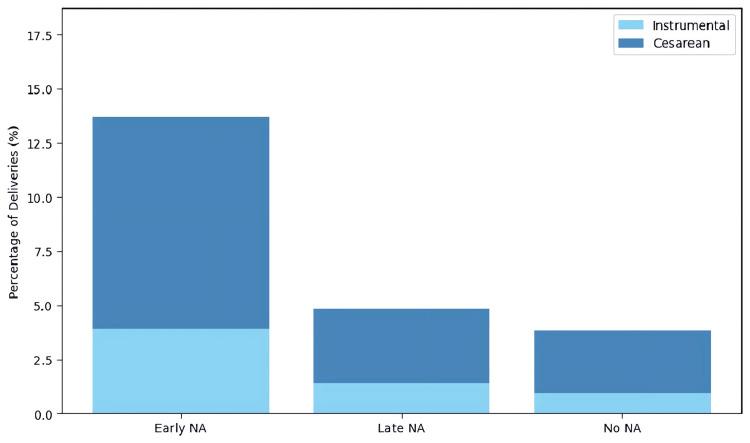
Background Epidural analgesia is a popular and effective method of pain relief in labor, but the optimal timing of its administration remains unclear for multiparous women. Some evidence suggests that initiating epidurals very early in labor may be associated with increased interventions. This study aimed to evaluate whether early labor epidural analgesia (initiated before active labor) affects delivery outcomes in multiparous women compared to late epidural or no epidural analgesia. Methodology We conducted a retrospective, single-center, cohort study of term multiparous women (at least 37 weeks of gestation) with singleton, cephalic pregnancies and no prior cesarean delivery, who gave birth between November 1, 2023, and April 30, 2024. Participants were divided into the following three groups based on use of neuraxial analgesia: no neuraxial analgesia (n = 421), early neuraxial analgesia (less than 3 cm of cervical dilation; n = 102), or late neuraxial analgesia (3 cm of dilation or more; n = 145). Primary outcomes were mode of delivery (vaginal versus cesarean), use of oxytocin for labor augmentation, and postpartum hemorrhage of at least 1,000 mL. Secondary outcomes included admission to a neonatal intensive care unit, Apgar scores below 7 at five minutes, and meconium-stained amniotic fluid. Results A total of 668 multiparous women were included. The early neuraxial analgesia group had the highest rates of labor induction (46/102, 45.10%), labor augmentation (41/102, 40.20%), and cesarean delivery (10/102, 9.80%), while the no neuraxial analgesia group had the lowest rates (98/421, 23.28%; 60/421, 14.25%; and 12/421, 2.85%, respectively). Spontaneous vaginal delivery rates were 88/102 (86.27%) for early neuraxial analgesia, 138/145 (95.17%) for late neuraxial analgesia, and 405/421 (96.20%) for no neuraxial analgesia. Postpartum hemorrhage of at least 1,000 mL occurred in 6/102 (5.88%) of the early neuraxial analgesia group, 6/145 (4.14%) of the late neuraxial analgesia group, and 8/421 (1.90%) of those without neuraxial analgesia. Neonatal intensive care unit admissions were slightly higher in the early neuraxial analgesia group (4/102, 3.92%) compared with late neuraxial analgesia (3/145, 2.07%) and no neuraxial analgesia (3/421, 0.71%) groups. Five-minute Apgar scores below 7 remained low in all groups, ranging from 0/102 (0.00%) to 1/145 (0.69%). Conclusions Among multiparous women, initiating epidural analgesia in early labor was associated with higher rates of labor augmentation and operative delivery, whereas late epidural analgesia or no epidural analgesia was linked to fewer interventions. Despite these differences, serious maternal complications and neonatal outcomes remained favorable across all groups. These findings suggest that delaying epidural initiation until active labor may help minimize interventions without compromising maternal or neonatal safety.
背景
硬膜外镇痛是分娩时常用且有效的疼痛缓解方法,但经产妇硬膜外镇痛的最佳给药时机仍不明确。一些证据表明,在分娩早期就开始使用硬膜外镇痛可能会增加干预措施。本研究旨在评估与晚期硬膜外镇痛或不使用硬膜外镇痛相比,分娩早期硬膜外镇痛(在活跃期之前开始)是否会影响经产妇的分娩结局。
方法
我们对2023年11月1日至2024年4月30日期间分娩的单胎头位妊娠、既往无剖宫产史的足月经产妇(妊娠至少37周)进行了一项回顾性、单中心队列研究。根据神经轴索镇痛的使用情况,将参与者分为以下三组:未使用神经轴索镇痛(n = 421)、早期神经轴索镇痛(宫颈扩张小于3 cm;n = 102)或晚期神经轴索镇痛(扩张3 cm或以上;n = 145)。主要结局包括分娩方式(阴道分娩与剖宫产)、使用缩宫素加强宫缩以及产后出血至少1000 mL。次要结局包括入住新生儿重症监护病房、5分钟时阿氏评分低于7分以及羊水粪染。
结果
共纳入668名经产妇。早期神经轴索镇痛组的引产率(46/102,45.10%)、宫缩加强率(41/102,40.20%)和剖宫产率(10/102,9.80%)最高,而未使用神经轴索镇痛组的这些比率最低(分别为98/421,23.28%;60/421,14.25%;12/421,2.85%)。早期神经轴索镇痛组的自然阴道分娩率为88/102(86.27%),晚期神经轴索镇痛组为138/145(95.17%),未使用神经轴索镇痛组为405/421(96.20%)。早期神经轴索镇痛组6/102(5.88%)、晚期神经轴索镇痛组6/145(4.14%)以及未使用神经轴索镇痛组8/421(1.90%)发生了至少1000 mL的产后出血。早期神经轴索镇痛组入住新生儿重症监护病房的比例(4/102,3.92%)略高于晚期神经轴索镇痛组(3/145,2.07%)和未使用神经轴索镇痛组(3/421,0.71%)。所有组5分钟时阿氏评分低于7分的比例仍然较低,范围从0/102(0.00%)到1/145(0.69%)。
结论
在经产妇中,分娩早期开始硬膜外镇痛与宫缩加强率和手术分娩率较高相关,而晚期硬膜外镇痛或不使用硬膜外镇痛与较少的干预措施相关。尽管存在这些差异,但所有组的严重母体并发症和新生儿结局仍然良好。这些发现表明,将硬膜外镇痛的开始时间推迟到活跃期可能有助于在不影响母体或新生儿安全的情况下尽量减少干预措施。

 Zotero 插件