
中国山东不同零售生肉中[具体细菌名称]和耐甲氧西林[具体细菌名称]的流行情况及特征
Prevalence and Characterization of and Methicillin-Resistant from Different Retail Raw Meats in Shandong, China.
作者信息
Zhao Xiaonan, Hou Bingyu, Ju Zijing, Wang Wenbo
机构信息
Institute of Animal Science and Veterinary Medicine, Shandong Academy of Agricultural Sciences, Jinan 250100, China.
CAS Key Laboratory of Microbial Physiological and Metabolic Engineering, Chinese Academy of Sciences, Beijing 100101, China.
出版信息
Microorganisms. 2025 Jun 11;13(6):1361. doi: 10.3390/microorganisms13061361.
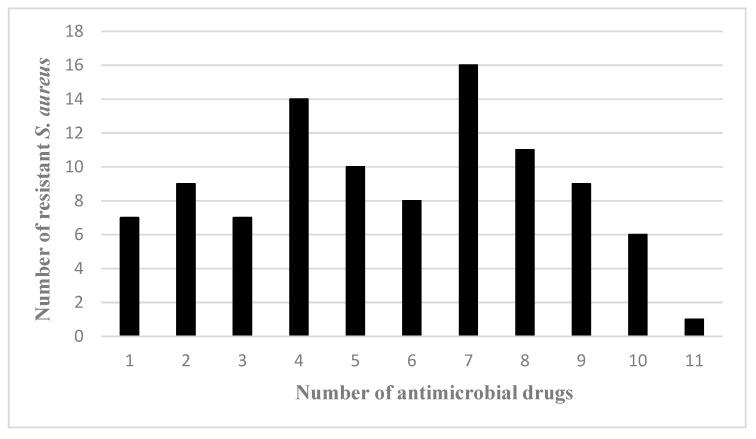
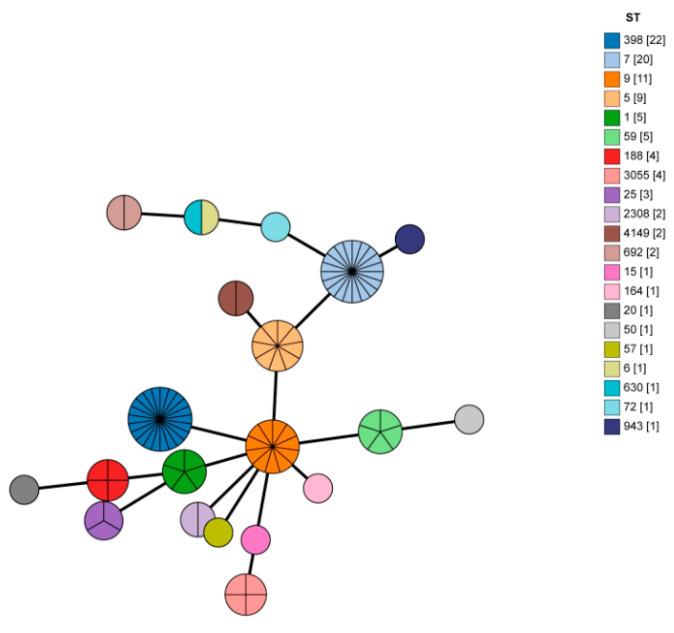
is an important cause of food intoxication, which has the potential to induce diverse infections, toxinoses and life-threatening diseases among humans and animals. This study investigated the prevalence, antimicrobial resistance, and genetic diversity of and methicillin-resistant (MRSA) in retail raw meat from Shandong (March 2021-October 2022). The distribution of virulence genes, antimicrobial susceptibility, and genetic diversity of these isolates were analyzed. From a total of 442 samples, 87 (19.7%) and 11 (2.5%) MRSA were isolated. According to the antimicrobial susceptibility testing, it was found that all the isolates were resistant to at least one antimicrobial. Most isolates (95.9%) were resistant to penicillin, with high resistance to ampicillin (82.7%) and multidrug resistance in 76.5% of cases. One isolate could simultaneously resist eleven antimicrobials (ERY-CLI-GEN-SMZ-FFC-PEN-PRL-AMC-CIP-TET-AMP). In contrast, all the isolates showed sensitivity to vancomycin. The most prevalent virulence gene was , accounting for 10.2%, followed by (8.2%). Regarding genetic polymorphism, these isolates were divided into 21 different sequence types (STs) using multilocus sequence typing (MLST) and 33 staphylococcal protein A () types using spaTyper 1.0 tool. The most prevalent sequence types were ST398 (22.4%), followed by ST7 (20.4%), while ST59, ST1, ST188, ST9, ST398, and ST7 were observed in MRSA isolates. The most prevalent types were t034 (15.3%), followed by t899 (10.2%), while t441, t127, t184, t899, t034, and t091 were observed in MRSA isolates. In conclusion, our study highlights the high prevalence of and MRSA in different retail raw meats in Shandong. This poses a potential threat to food safety and underscores the need for enhanced surveillance and stricter antibiotic control measures.
是食物中毒的一个重要原因,它有可能在人和动物中引发多种感染、毒素中毒和危及生命的疾病。本研究调查了山东零售生肉中(2021年3月至2022年10月)和耐甲氧西林金黄色葡萄球菌(MRSA)的流行情况、抗菌药物耐药性及遗传多样性。分析了这些分离株的毒力基因分布、抗菌药物敏感性及遗传多样性。从总共442份样本中,分离出87株(19.7%)和11株(2.5%)MRSA。根据抗菌药物敏感性试验,发现所有分离株至少对一种抗菌药物耐药。大多数分离株(95.9%)对青霉素耐药,对氨苄西林耐药率高(82.7%),76.5%的病例存在多重耐药。一株分离株可同时耐受11种抗菌药物(ERY-CLI-GEN-SMZ-FFC-PEN-PRL-AMC-CIP-TET-AMP)。相比之下,所有分离株对万古霉素敏感。最常见的毒力基因是,占10.2%,其次是(8.2%)。关于遗传多态性,使用多位点序列分型(MLST)将这些分离株分为21种不同的序列类型(STs),使用spaTyper 1.0工具分为33种葡萄球菌蛋白A()类型。最常见的序列类型是ST398(22.4%),其次是ST7(20.4%),而在MRSA分离株中观察到ST59、ST1、ST188、ST9、ST398和ST7。最常见的类型是t034(15.3%),其次是t899(10.2%),而在MRSA分离株中观察到t441、t127、t184、t899、t034和t091。总之,我们的研究突出了山东不同零售生肉中和MRSA的高流行率。这对食品安全构成了潜在威胁,并强调需要加强监测和采取更严格的抗生素控制措施。


 Zotero 插件