
饮食中ω-6与ω-3多不饱和脂肪酸比例调节炎症相关基因表达并影响饮食诱导肥胖小鼠模型生化参数的改善。
Dietary -6:-3 PUFA Ratio Modulates Inflammation-Related Gene Expression and Influences Improvements in Biochemical Parameters in a Murine Model of Diet-Induced Obesity.
作者信息
Gutierrez-Guerra Alejandro, Cambron-Mora Diego, Rodriguez-Echevarria Roberto, Hernández-Bello Jorge, Campos-Pérez Wendy, Canales-Aguirre Alejandro A, Pérez-Robles Mariana, Martinez-Lopez Erika
机构信息
Instituto de Nutrigenética y Nutrigenómica Traslacional, Departamento de Biología Molecular y Genómica, Centro Universitario de Ciencias de la Salud, Universidad de Guadalajara, Guadalajara 44340, Mexico.
Doctorado en Ciencias Biomédicas, Centro Universitario de Ciencias de la Salud, Universidad de Guadalajara, Guadalajara 44340, Mexico.
出版信息
Nutrients. 2025 Jun 13;17(12):1996. doi: 10.3390/nu17121996.
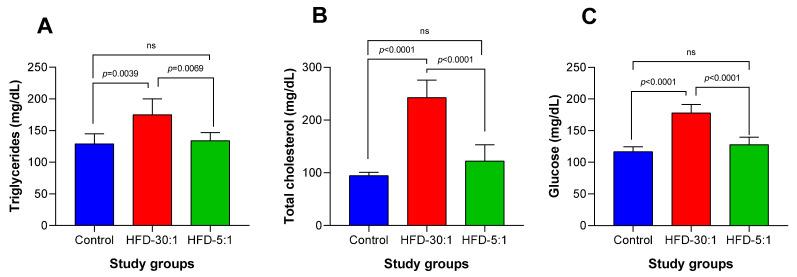
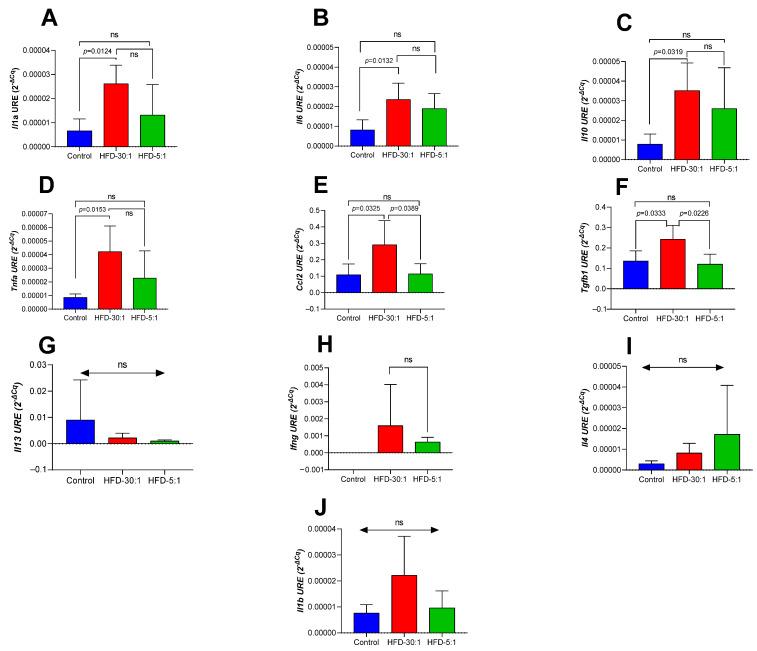
: An unbalanced dietary intake of omega-6 (-6) and omega-3 (-3) polyunsaturated fatty acids (PUFAs) has been associated with chronic inflammation and oxidative stress, both of which contribute to the pathophysiology of obesity. : We aimed to evaluate the effects of a diet with an -6:-3 PUFA ratio of 5:1 on body composition, biochemical parameters, and the gene expression of cytokines and antioxidant enzymes in a murine model of diet-induced obesity. : A diet-induced obesity model was established in C57BL6/J mice over 17 weeks. Mice were then fed different diets for 8 weeks: a control diet (chow), a high-fat diet with a 30:1 -6:-3 ratio (HFD-30:1), and a high-fat diet enriched with -3 fatty acids, with a 5:1 -6:-3 ratio (HFD-5:1). Body weight and food intake were monitored throughout this study. Biochemical parameters were measured, and the expression of antioxidant enzymes and cytokine genes was analyzed by qPCR. Data were analyzed using GraphPad Prism software. : The HFD-5:1 group exhibited a significant reduction in body weight ( = 0.0182), liver tissue weight ( = 0.01), serum glucose levels ( = 0.010), area under the curve (AUC) ( = 0.0161), cholesterol ( < 0.0001), and triglycerides ( = 0.0069) compared to the HFD-30:1 group. The body weight in the HFD-5:1 group decreased to levels comparable to the control group. Additionally, the expression of the inflammatory cytokine genes ( = 0.0389) and ( = 0.0226) was significantly reduced. : These findings suggest that adjusting the dietary -6:-3 ratio to 5:1 modulates inflammation-related gene expression and improves metabolic markers in obese mice, supporting its potential relevance for future translational research.
膳食中ω-6(-6)和ω-3(-3)多不饱和脂肪酸(PUFAs)摄入不均衡与慢性炎症和氧化应激有关,这两者都促成了肥胖的病理生理过程。我们旨在评估ω-6:ω-3多不饱和脂肪酸比例为5:1的饮食对饮食诱导肥胖小鼠模型的身体成分、生化参数以及细胞因子和抗氧化酶基因表达的影响。在17周内建立C57BL6/J小鼠饮食诱导肥胖模型。然后小鼠接受不同饮食8周:对照饮食(普通饲料)、ω-6:ω-3比例为30:1的高脂饮食(HFD-30:1)和富含ω-3脂肪酸、ω-6:ω-3比例为5:1的高脂饮食(HFD-5:1)。在整个研究过程中监测体重和食物摄入量。测量生化参数,并通过qPCR分析抗氧化酶和细胞因子基因的表达。使用GraphPad Prism软件分析数据。与HFD-30:1组相比,HFD-5:1组的体重(P = 0.


 Zotero 插件