
采用逐步降解法制备具有环境相关性的聚苯乙烯纳米颗粒
Preparation of Polystyrene Nanoparticles with Environmental Relevance Using a Gradual Degradation Method.
作者信息
Nakatani Hisayuki, Asano Mika, Sakamoto Masaki, Motokucho Suguru, Dao Anh Thi Ngoc, Kim Hee-Jin, Yagi Mitsuharu, Kyozuka Yusaku
机构信息
Chemistry and Materials Engineering Program, Graduate School of Integrated Science and Technology, Nagasaki University, 1-14 Bunkyo-machi, Nagasaki 852-8521, Japan.
Organization for Marine Science and Technology, Nagasaki University, 1-14 Bunkyo-machi, Nagasaki 852-8521, Japan.
出版信息
Polymers (Basel). 2025 Jun 19;17(12):1715. doi: 10.3390/polym17121715.
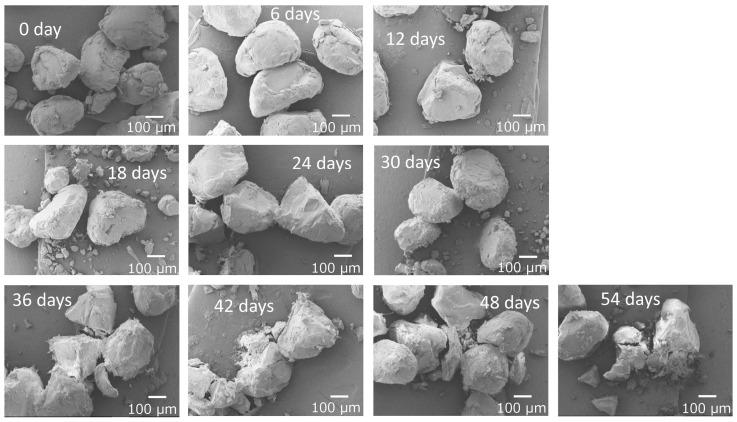
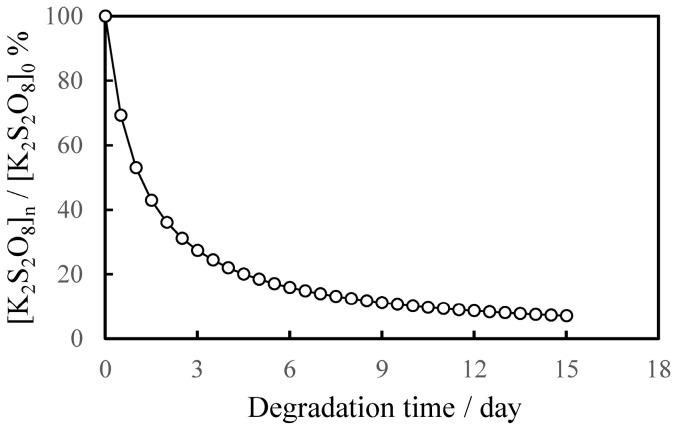
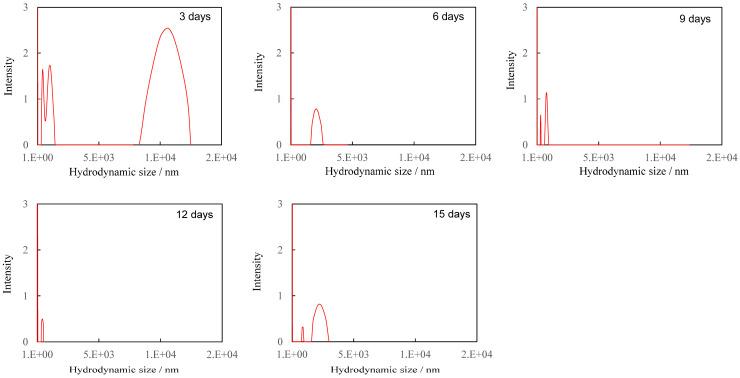
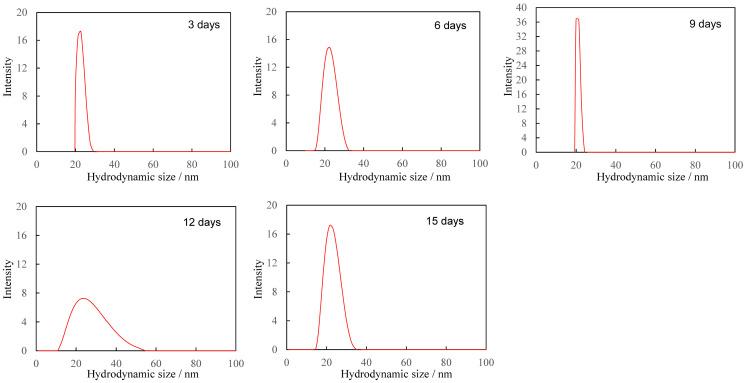
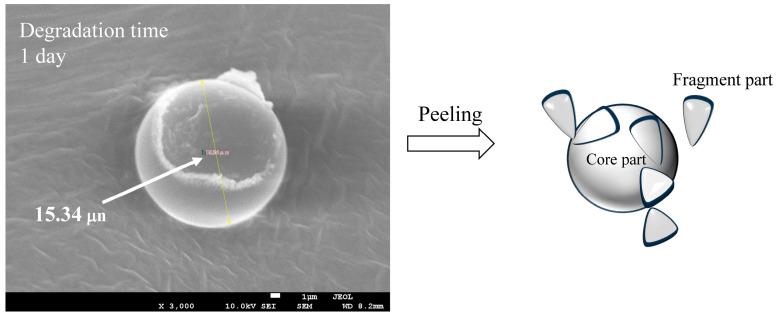
This study investigates the environmental degradation of polystyrene (PS) microparticles and flakes using a gradual degradation method. The concentration of SO• decreased exponentially, simulating the environmental conditions. The nanofragment size of PS particles evolved dynamically, fluctuating from below 250 nm at 3 days to 300-500 nm at 6 days, then forming two peaks below 200 nm at 9 days, before shifting to a single peak below 100 nm at 12 days. At 15 days, the distribution expanded to two peaks between 500 nm and 200 nm. The polydispersity index (PDI) varied unpredictably, and fragments below 100 nm fluctuated between 10 and 50 nm independent of time. SEM analysis revealed an initial peeling process, with the outermost layer peeling off. The core size of the PS particles decreased rapidly from 11,000 nm to 2500 nm within 6 days and stabilized at 1000 nm after 9 days. The PS flakes showed minimal shape change until 24 days, but surface roughness increased by 30 days, leading to fragmentation. By 42 days, the flakes partially broke into ca. 100 μm pieces. The initial morphology significantly influenced the breakdown pattern, suggesting multiple breakdown mechanisms other than peeling.
本研究采用逐步降解法研究了聚苯乙烯(PS)微粒和薄片的环境降解情况。SO•浓度呈指数下降,模拟了环境条件。PS颗粒的纳米碎片尺寸动态演变,从第3天低于250 nm波动到第6天的300 - 500 nm,然后在第9天形成两个低于200 nm的峰,在第12天转变为低于100 nm的单峰。在第15天,分布扩展到500 nm至200 nm之间的两个峰。多分散指数(PDI)变化不可预测,低于100 nm的碎片在10至50 nm之间波动,与时间无关。扫描电子显微镜(SEM)分析显示了一个初始剥离过程,最外层剥落。PS颗粒的核心尺寸在6天内从11,000 nm迅速减小到2500 nm,并在9天后稳定在1000 nm。PS薄片在24天之前形状变化最小,但到30天时表面粗糙度增加,导致破碎。到42天时,薄片部分破碎成约100μm的碎片。初始形态显著影响了分解模式,表明除了剥离之外还有多种分解机制。


 Zotero 插件