
针对老年初级保健患者潜在不适当处方的干预措施:系统评价与荟萃分析
Interventions to Address Potentially Inappropriate Prescribing for Older Primary Care Patients: A Systematic Review and Meta-Analysis.
作者信息
Persaud Nav, Workentin Aine, Rizvi Amal, Pierson Tiphaine, Bortolussi-Courval Émilie, Liu Kathy, Bennett Alexandria, Shaver Nicole, Skidmore Becky, Vyas Niyati, Pap Robert, Almoli Faris, Lee Todd C, Sirois Caroline, McCracken Rita K, Papillon-Ferland Louise, McDonald Emily G
机构信息
MAP Centre for Urban Health Solutions, Li Ka Shing Knowledge Institute, St Michael's Hospital, Unity Health Toronto, Toronto, Ontario, Canada.
Department of Family and Community Medicine, University of Toronto, Toronto, Ontario, Canada.
出版信息
JAMA Netw Open. 2025 Jun 2;8(6):e2517965. doi: 10.1001/jamanetworkopen.2025.17965.
IMPORTANCE
Prescriptions for potentially inappropriate medications are common and, by definition, may carry risks that outweigh benefits.
OBJECTIVE
To determine whether interventions to address potentially inappropriate prescribing for older primary care patients are associated with changes in the number of medications prescribed, drug-related harms, hospitalizations, and mortality.
DATA SOURCES
MEDLINE, Embase, and the Cochrane Central Register of Controlled Trials were searched from inception to September 6, 2024.
STUDY SELECTION
Randomized clinical trials of interventions to address potentially inappropriate prescribing for older primary care patients (aged ≥65 years) residing in the community or in long-term care facilities, such as nursing homes or assisted-living facilities, were included.
DATA EXTRACTION AND SYNTHESIS
Two researchers independently screened the records and abstracted data using the Preferred Reporting Items for Systematic Reviews and Meta-Analyses (PRISMA) reporting guideline. Data were pooled using random-effects models.
MAIN OUTCOMES AND MEASURES
The planned outcomes were the number of medications, nonserious adverse drug reactions, injurious falls, quality of life, medical visits, emergency department visits, hospitalizations, and all-cause mortality. Random-effects meta-analyses were performed using the inverse variance method for similar studies, reporting risk ratios (RRs) or standardized mean differences (SMDs). Heterogeneity was assessed with I2 values, and publication bias was assessed with funnel plots and the Egger regression test.
RESULTS
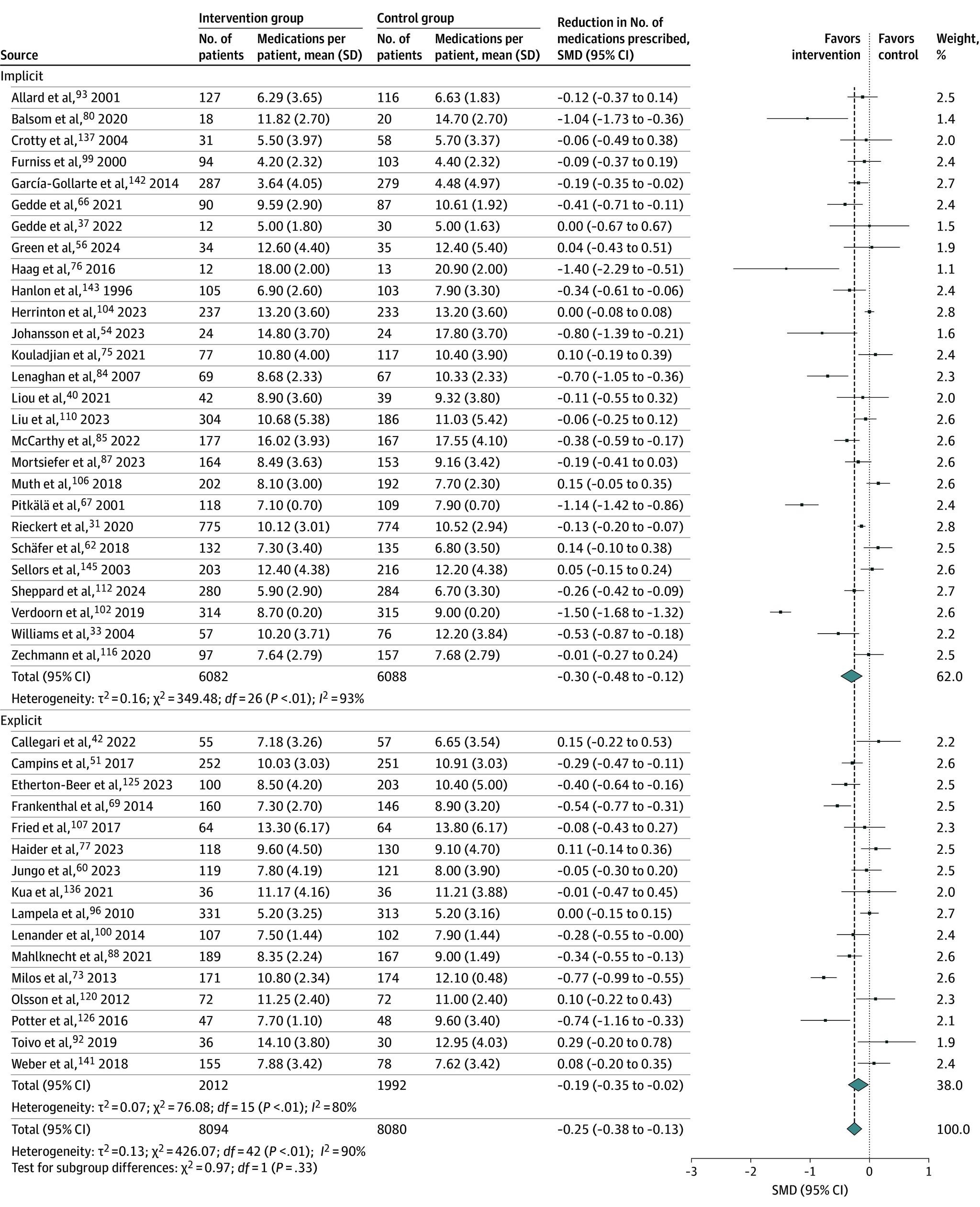
Of the 14 649 records identified, 118 randomized clinical trials (comprising 417 412 patients) were included in this review. Interventions to address potentially inappropriate prescribing were associated with a reduction in the number of medications prescribed (SMD, -0.25 [95% CI, -0.38 to -0.13]), equivalent to approximately 0.5 fewer medications per patient. However, there were no substantial differences in the other outcomes, including nonserious adverse drug reactions (RR, 0.92 [95% CI, 0.58-1.46]), injurious falls (SMD, 0.01 [95% CI, -0.12 to 0.14]), quality of life (SMD, 0.09 [95% CI, -0.04 to 0.23]), medical visits (SMD, 0.02 [95% CI, -0.02 to 0.07]), emergency department admissions (RR, 1.02 [95% CI, 0.96-1.08]), hospitalizations (RR, 0.95 [95% CI, 0.89-1.02]), or all-cause mortality (RR, 0.94 [95% CI, 0.85-1.04]).
CONCLUSIONS AND RELEVANCE
In this systematic review and meta-analysis, interventions to address potentially inappropriate prescribing were associated with reductions in the number of medications prescribed, with no substantial change in other outcomes. These findings suggest that inappropriate prescribing interventions may be implemented to safely reduce the number of medications prescribed to older adults in the primary care setting. Future studies should continue to evaluate these interventions using standardized criteria and consistently report potential harms to support data synthesis and capture key outcomes such as quality of life, hospitalization, and mortality.
重要性
开具可能不适当药物的处方很常见,并且根据定义,可能带来的风险超过益处。
目的
确定针对老年初级保健患者潜在不适当处方的干预措施是否与所开药物数量、药物相关危害、住院率和死亡率的变化相关。
数据来源
检索了MEDLINE、Embase和Cochrane对照试验中央注册库,检索时间从建库至2024年9月6日。
研究选择
纳入了针对居住在社区或长期护理机构(如养老院或辅助生活设施)中的老年初级保健患者(年龄≥65岁)潜在不适当处方的干预措施的随机临床试验。
数据提取与合成
两名研究人员独立筛选记录,并使用系统评价和Meta分析的首选报告项目(PRISMA)报告指南提取数据。使用随机效应模型汇总数据。
主要结局与测量指标
计划的结局包括药物数量、非严重药物不良反应、伤害性跌倒、生活质量、就诊次数、急诊就诊次数、住院率和全因死亡率。对类似研究使用逆方差法进行随机效应Meta分析,报告风险比(RR)或标准化均数差(SMD)。用I²值评估异质性,用漏斗图和Egger回归检验评估发表偏倚。
结果
在识别出的14649条记录中,本综述纳入了118项随机临床试验(包括417412名患者)。针对潜在不适当处方的干预措施与所开药物数量的减少相关(SMD,-0.25 [95%CI,-0.38至-0.13]),相当于每位患者少开约0.5种药物。然而,在其他结局方面没有实质性差异,包括非严重药物不良反应(RR,0.92 [95%CI,0.58 - 1.46])、伤害性跌倒(SMD,0.01 [95%CI,-0.12至0.14])、生活质量(SMD,0.09 [95%CI,-0.04至0.23])、就诊次数(SMD,0.02 [95%CI,-0.02至0.07])、急诊入院率(RR,1.02 [95%CI,0.96 - 1.08])、住院率(RR,0.95 [95%CI,0.89 - 1.02])或全因死亡率(RR,0.94 [95%CI,0.85 - 1.04])。
结论与意义
在这项系统评价和Meta分析中,针对潜在不适当处方的干预措施与所开药物数量的减少相关,而其他结局没有实质性变化。这些发现表明,可以实施不适当处方干预措施,以安全地减少初级保健环境中开具给老年人的药物数量。未来的研究应继续使用标准化标准评估这些干预措施,并持续报告潜在危害,以支持数据合成并捕捉关键结局,如生活质量、住院率和死亡率。



 Zotero 插件