
印度旁遮普邦一项关于产后移动健康与虚拟社会支持干预对新生儿及婴儿健康和喂养方式的初步效果:准实验性前后对照试点研究
Preliminary Effectiveness of a Postnatal mHealth and Virtual Social Support Intervention on Newborn and Infant Health and Feeding Practices in Punjab, India: Quasi-Experimental Pre-Post Pilot Study.
作者信息
Verma Garima Singh, Gopalakrishnan Lakshmi, Ayadi Alison El, Diamond-Smith Nadia, Bagga Rashmi, Dhir Shashi Kant, Singh Pushpendra, Gill Navneet, Miglani Vaibhav, Mutyala Naveen, Kankaria Ankita, Kaur Jasmeet, Ahuja Alka, Kumar Vijay, Duggal Mona
机构信息
Department of Obstetrics and Gynecology, Postgraduate Institute of Medical Education and Research, Chandigarh, India.
Institute for Global Health Sciences, University of California San Francisco, San Francisco, CA, United States.
出版信息
JMIR Pediatr Parent. 2025 Jun 27;8:e65581. doi: 10.2196/65581.
BACKGROUND
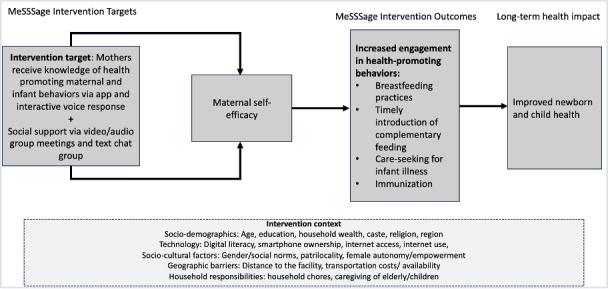
We evaluated a pilot mobile health (mHealth) intervention aimed at improving postnatal maternal and infant health. The intervention featured provider-led group sessions for education, health care communication, in-person care referrals, and virtual mHealth support for postpartum mothers through weekly calls, texts, interactive voice response (IVR), and a phone app.
OBJECTIVE
We aimed to assess the preliminary effectiveness of the pilot mHealth intervention, MeSSSSage (Maa Shishu Swasthya Sahayak Samooh, which means maternal and child health support group), on infant health knowledge, behaviors, and outcomes at 6 months post partum. We focus on maternal knowledge of infant danger signs and optimal young child feeding practices at 6 months post partum and also evaluate maternal care-seeking behaviors for infants, adherence to age-appropriate immunization, and infant and young child feeding practices such as early initiation of breastfeeding and complementary feeding.
METHODS
We evaluated the preliminary effectiveness of an intervention on maternal health knowledge among 135 participants in Punjab, India, who completed pre- and postintervention surveys. The intervention, led by research personnel with backgrounds similar to community health officers, aimed to empower society and support universal health coverage if successful. We assessed changes in knowledge of maternal danger signs and the appropriate age for introducing different food groups over 6 months post partum. Additionally, we examined postintervention differences in health-seeking behavior for infants, adherence to age-appropriate immunizations, and adoption of breastfeeding and complementary feeding practices among women in the synchronous (group call), asynchronous (IVR and app), and control arms.
RESULTS
Of 12 infant risk factors, maternal knowledge of infant danger signs remained low (mean range: 1.85-2.31 preintervention and 1.81-2.22 postintervention). Participants in the synchronous arm had a statistically significant higher mean increase (mean difference: 0.87, 95% CI 0.06-1.69) compared to the control arm. Participants in synchronous arms had nearly 3-fold increased odds of infant health checkup by a clinical provider than asynchronous arm participants (odds ratio [OR] 2.72, 95% CI 1.02-7.23). No significant differences were noted in age-appropriate vaccine coverage among infants between arms, though vaccination coverage was more than 80% across all arms. Early initiation of breastfeeding remained low across all arms (~47%).
CONCLUSIONS
Our pilot study on group-based mHealth education and virtual social support during the postnatal phase showed modest yet promising results. Rigorous testing is crucial to strengthening the limited evidence base for group-oriented mHealth approaches.
背景
我们评估了一项旨在改善产后母婴健康的移动健康(mHealth)试点干预措施。该干预措施包括由提供者主导的小组会议,用于教育、医疗保健沟通、面对面护理转诊,以及通过每周通话、短信、交互式语音应答(IVR)和手机应用程序为产后母亲提供虚拟mHealth支持。
目的
我们旨在评估试点mHealth干预措施MeSSSSage(Maa Shishu Swasthya Sahayak Samooh,意为母婴健康支持小组)对产后6个月时婴儿健康知识、行为和结局的初步有效性。我们关注产后6个月时母亲对婴儿危险信号的知识以及最佳幼儿喂养方式,还评估母亲为婴儿寻求护理的行为、对适龄免疫接种的依从性,以及婴儿和幼儿喂养方式,如早期开始母乳喂养和补充喂养。
方法
我们评估了一项针对印度旁遮普邦135名参与者的干预措施对母亲健康知识的初步有效性,这些参与者完成了干预前和干预后的调查。该干预措施由具有与社区卫生官员相似背景的研究人员主导,若成功,旨在增强社会力量并支持全民健康覆盖。我们评估了产后6个月内母亲对危险信号的知识以及引入不同食物组的适宜年龄的变化。此外,我们检查了同步(小组通话)、异步(IVR和应用程序)和对照组中妇女在干预后为婴儿寻求健康护理的行为差异、对适龄免疫接种的依从性,以及采用母乳喂养和补充喂养方式的情况。
结果
在12项婴儿风险因素中,母亲对婴儿危险信号的知识水平仍然较低(干预前平均范围:1.85 - 2.31,干预后1.81 - 2.22)。与对照组相比,同步组的参与者平均增加量在统计学上有显著差异(平均差异:0.87,95%可信区间0.06 - 1.69)。同步组的参与者接受临床提供者进行婴儿健康检查的几率比异步组参与者高出近3倍(优势比[OR] 2.72,95%可信区间1.02 - 7.23)。各组之间婴儿的适龄疫苗接种覆盖率没有显著差异,不过所有组的疫苗接种覆盖率都超过了80%。所有组中早期开始母乳喂养的比例仍然较低(约47%)。
结论
我们关于产后阶段基于小组的mHealth教育和虚拟社会支持的试点研究显示出适度但有希望的结果。严格的测试对于加强面向小组的mHealth方法有限的证据基础至关重要。

 Zotero 插件