
感染与新型冠状病毒 2 型以及阿尔茨海默病发病机制。 (注:原文中“with and SARS-CoV-2”表述不太完整准确,推测可能是想说“with SARS-CoV-2”之类的,但按照要求完整翻译此句如上)
Infections with and SARS-CoV-2 and Alzheimer's disease pathogenesis.
作者信息
Romanella Alexa, McCall Maegan, Corwin Rachel, Faruq Alaha Abdul, Lingo Emily, Bhambhani Sanya, Hammond Christine J, Balin Brian J
机构信息
Department of Bio-Medical Sciences, Center for Chronic Disorders of Aging, Philadelphia College of Osteopathic Medicine (PCOM), Philadelphia, PA, United States.
Division of Research, Center for Chronic Disorders of Aging, Philadelphia College of Osteopathic Medicine (PCOM), Philadelphia, PA, United States.
出版信息
Front Aging Neurosci. 2025 Jun 13;17:1587782. doi: 10.3389/fnagi.2025.1587782. eCollection 2025.
INTRODUCTION
Alzheimer's disease (AD) is the most prevalent neurodegenerative disease in the world, but our understanding of causation is still lacking. A current evidence-based hypothesis proposes that certain infectious agents initiate the neurodegeneration consistent with AD. Two infectious agents correlated to AD pathogenesis are (Cpn), a respiratory obligate intracellular bacterium, and severe acute respiratory syndrome coronavirus 2 (SARS-CoV-2), the coronavirus responsible for the COVID-19 pandemic. Both organisms may predispose susceptible populations to disease manifestations, such as AD.
METHODS
This review focused on peer-reviewed original research and review articles evaluating the potential association of Cpn and SARS-CoV-2 with AD. Our focus included: genetic risk with expression of APOEε4 and other biomarkers common to AD including interleukin-6 (IL-6), chemokine ligand 2 (CCL2), neuropilin-1 (NRP1), and structural/functional aspects of the infectious processes and resultant neuroinflammation.
RESULTS
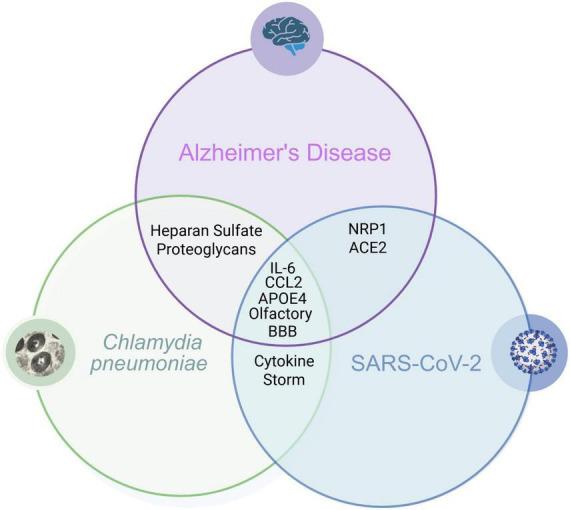
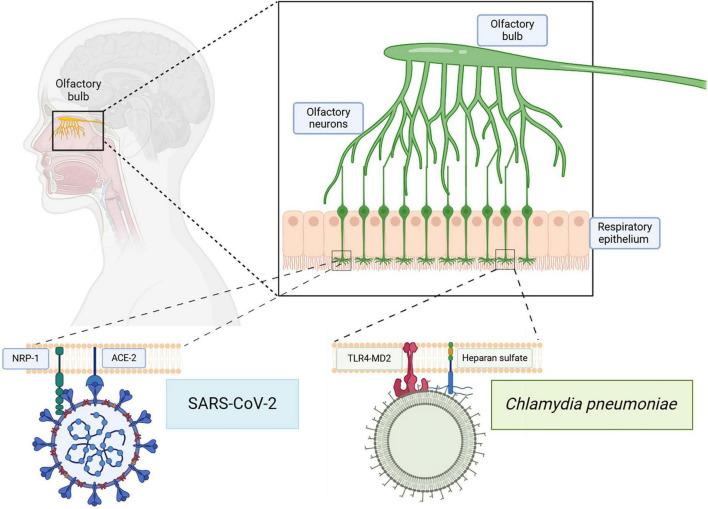
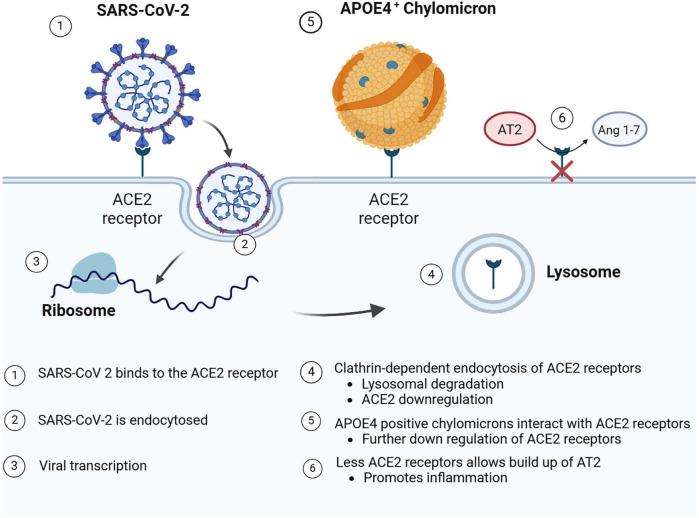
Both Cpn and SARS-CoV-2 may infect the neuroepithelium of the olfactory system to enter the brain. Cpn binds to heparan sulfate proteoglycans for entry into mucosal cells. SARS-CoV-2 infects epithelia after binding to ACE2 receptors. Once inside the neuroepithelium, the pathogens may traffic to the olfactory bulbs. NRP1, an abundant receptor in AD, also potentiates SARS-CoV-2 infection. Furthermore, both pathogens may enter the systemic circulation for eventual entry through the blood brain barrier. The SARS-CoV-2 spike protein, in conjunction with CCL2, co-stimulates macrophages, resulting in IL-6 cytokine release. Likewise, Cpn infection leads to an increase of CCL2 and IL-6 cytokine release. The primary infection of either organism may lead to chronically elevated levels of IL-6 and secondary infection(s). Additionally, host APOEε4 expression appears to increase susceptibility to Cpn and SARS-CoV-2 infections.
DISCUSSION
Cpn and SARS-CoV-2 may enter the brain through olfactory neuroepithelial cells and/or through the blood brain barrier. SARS-CoV-2 utilizes specific receptors for infection, while Cpn utilizes binding of proteoglycans. Neuroinflammation may be an outcome of infection with one or both organisms as observed by increased levels of CCL2 and IL-6 leading to AD pathogenesis. Genetic risk is noted for infection with both organisms with expression of APOEε4. Ongoing and future studies will further dissect mechanisms of infection with SARS-CoV-2 and Cpn as they may inform on causation and diagnostic factors for AD.
引言
阿尔茨海默病(AD)是世界上最常见的神经退行性疾病,但我们对其病因仍缺乏了解。目前基于证据的一种假说提出,某些感染因子引发了与AD一致的神经退行性变。两种与AD发病机制相关的感染因子是嗜肺军团菌(Cpn),一种呼吸道专性胞内细菌,以及严重急性呼吸综合征冠状病毒2(SARS-CoV-2),即引发新冠疫情的冠状病毒。这两种病原体都可能使易感人群易出现诸如AD等疾病表现。
方法
本综述聚焦于经同行评审的原创研究以及评估Cpn和SARS-CoV-2与AD潜在关联的综述文章。我们关注的内容包括:APOEε4表达以及其他AD常见生物标志物(包括白细胞介素-6(IL-6)、趋化因子配体2(CCL2)、神经纤毛蛋白-1(NRP1))的遗传风险,以及感染过程和由此产生的神经炎症的结构/功能方面。
结果
Cpn和SARS-CoV-2都可能感染嗅觉系统的神经上皮细胞从而进入大脑髓质。Cpn与硫酸乙酰肝素蛋白聚糖结合以进入黏膜细胞。SARS-CoV-2在与血管紧张素转换酶2(ACE2)受体结合后感染上皮细胞。一旦进入神经上皮细胞,病原体可能会转移至嗅球。NRP1是AD中一种丰富的受体,它也会增强SARS-CoV-2的感染。此外,这两种病原体都可能进入体循环,最终通过血脑屏障进入大脑。SARS-CoV-2刺突蛋白与CCL2共同刺激巨噬细胞,导致IL-6细胞因子释放。同样,Cpn感染会导致CCL2和IL-6细胞因子释放增加。任何一种病原体的初次感染都可能导致IL-6水平长期升高以及继发感染。此外,宿主APOEε4表达似乎会增加对Cpn和SARS-CoV-2感染的易感性。
讨论
Cpn和SARS-CoV-2可能通过嗅神经上皮细胞和/或通过血脑屏障进入大脑。SARS-CoV-2利用特定受体进行感染,而Cpn利用蛋白聚糖结合。如CCL2和IL-6水平升高所观察到的,神经炎症可能是感染一种或两种病原体的结果,进而导致AD发病机制。两种病原体感染时若有APOEε4表达,则存在遗传风险。正在进行的和未来的研究将进一步剖析SARS-CoV-2和Cpn的感染机制,因为它们可能为AD的病因和诊断因素提供信息。


 Zotero 插件