
推动KMT2A重排的儿童B细胞急性淋巴细胞白血病治疗进展:新型药物与创新方法
Moving the Needle in KMT2A Rearranged Pediatric B-Cell Acute Lymphoblastic Leukemia: Newer agents and novel approaches.
作者信息
Ray Anwesha, Jain Aditi, Vijayaran Mona, Thomas Steve, Senapati Jayastu, Aggarwal Mukul
机构信息
Lady Hardinge Medical College, New Delhi, India.
Dept. of Haematology, Safdarjung Hospital, Vardhaman Mahavir Medical College, New Delhi, India.
出版信息
Clin Hematol Int. 2025 Jun 27;7(2):65-73. doi: 10.46989/001c.141198. eCollection 2025.
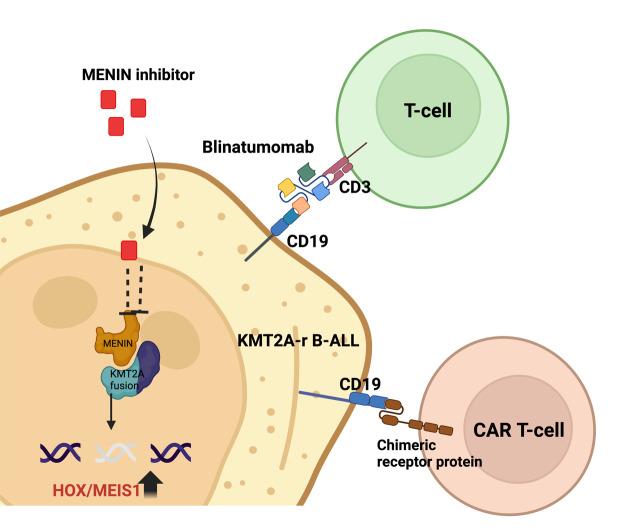
Pediatric B-cell acute lymphoblastic leukemia (B-ALL) has been the poster child of progressive success in the development of leukemia therapy. Among the genomically defined high-risk subtypes of B-ALL are those with -rearrangement (r) which are associated with inferior outcomes with chemotherapy-based approaches. -r ALL is most common in the infantile period but can be seen beyond it and has remained a therapeutic challenge. Recent clinical trials have shown a significant improvement in response rates and survival outcomes in infantile and pediatric non-infant patients with -r B-ALL when treated with blinatumomab-containing regimens. A single course of sequential blinatumomab added to Interfant-06 chemotherapy led to an exceptional improvement in 2-year disease free survival to 82% compared to 49% from historical chemotherapy only approach. In the salvage settings the use of tisagenlecleucel chimeric antigen receptor (CAR) T-cell therapy has led to high response rates and durable remissions in pediatric -r B-ALL. Recently, inotuzumab ozogamicin was approved in pediatric (>1 year) relapsed/refractory B-ALL, widening immunotherapy-based salvage options. However, the efficacy of inotuzumab in -r B-ALL remains questionable, given lower CD22 expression in this ALL genotype. Additionally, the approval of menin inhibitors like revumenib in -r pediatric acute leukemias provides another treatment option in the salvage setting for this high-risk pediatric B-ALL subtype. These targeted agents are positively altering the treatment approaches and outcomes in pediatric -r B-ALL, and the use of better residual disease monitoring with next generation sequencing might further help to refine treatment approaches in such high-risk pediatric ALL.
小儿B细胞急性淋巴细胞白血病(B-ALL)一直是白血病治疗取得不断进展的成功典范。在基因组定义的B-ALL高危亚型中,存在那些伴有重排(r)的亚型,它们与基于化疗的治疗方法疗效较差相关。r型ALL在婴儿期最为常见,但在婴儿期之后也可见到,并且仍然是一个治疗挑战。最近的临床试验表明,使用含博纳吐单抗的方案治疗婴儿期和小儿非婴儿期r型B-ALL患者时,缓解率和生存结果有显著改善。在Interfant-06化疗基础上加用一个疗程的序贯博纳吐单抗,使2年无病生存率显著提高至82%,而仅采用历史化疗方法时为49%。在挽救治疗中,使用替沙格尼定嵌合抗原受体(CAR)T细胞疗法已在小儿r型B-ALL中产生了高缓解率和持久缓解。最近,因诺妥珠单抗在小儿(>1岁)复发/难治性B-ALL中获得批准,拓宽了基于免疫疗法的挽救治疗选择。然而,鉴于该ALL基因型中CD22表达较低,因诺妥珠单抗在r型B-ALL中的疗效仍存在疑问。此外,像瑞武单抗这样的Menin抑制剂在小儿r型急性白血病中的获批,为这种高危小儿B-ALL亚型的挽救治疗提供了另一种治疗选择。这些靶向药物正在积极改变小儿r型B-ALL的治疗方法和结果,并且使用下一代测序进行更好的残留疾病监测可能会进一步有助于优化这种高危小儿ALL的治疗方法。
 Zotero 插件