
氧化铜纳米颗粒、[植物名称]乙醇提取物及其组合对多重耐药细菌的抗菌活性 。 注:原文中“Ethanolic Extract of ”后面缺少具体植物名称。
Antibacterial Activity of CuO Nanoparticles, Ethanolic Extract of , and Their Combination Against Multidrug-Resistant Bacteria.
作者信息
Ruvalcaba-Ontiveros Rosa I, Esparza-Ponce Hilda E, Reyes-Martínez Reyna, Manjarrez-Nevárez Laura A, Gómez-Benítez Valente, Piñon-Castillo Hilda A
机构信息
Facultad de Ciencias Químicas, Universidad Autónoma de Chihuahua, Circuito Universitario S/N Campus II, Chihuahua, 31125, Mexico.
Centro de Investigación en Materiales Avanzados, S.C., Complejo Industrial Chihuahua, Chihuahua, 31136, Mexico.
出版信息
Int J Nanomedicine. 2025 Jun 23;20:8003-8022. doi: 10.2147/IJN.S517465. eCollection 2025.
INTRODUCTION
This study investigated the incorporation of ethanolic extract into the synthesis of copper oxide nanoparticles (CuO+Aa) and evaluates their antibacterial activity against methicillin-resistant (MRSA) and carbapenem-resistant (CRAB). To assess the impact of the extract, chemically synthesized CuO nanoparticles (CuO-NPs) and the extract alone were also tested. Both CuO-NPs and are known for their antimicrobial properties.
METHODS
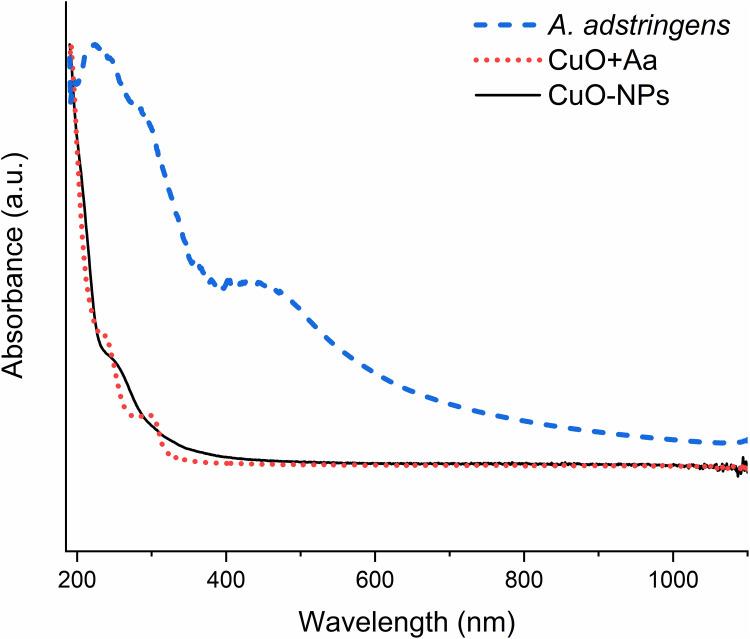
CuO+Aa nanoparticles were synthesized using extract and characterized through Transmission Electron Microscopy (TEM), Dynamic Light Scattering (DLS), Zeta Potential, Thermogravimetric Analysis (TGA), and X-ray Diffraction (XRD), and compared to CuO-NPs. The influence of the extract was analyzed using Inductively Coupled Plasma Mass Spectroscopy (ICP-MS), UV-Vis, FTIR, Raman, and Nuclear Magnetic Resonance Spectroscopy (NMR). Antibacterial effects were tested using the microdrop technique and biofilm inhibition. Bacterial structural changes were observed via Scanning Electron Microscopy (SEM), and cytotoxicity was measured through hemolysis assays.
RESULTS
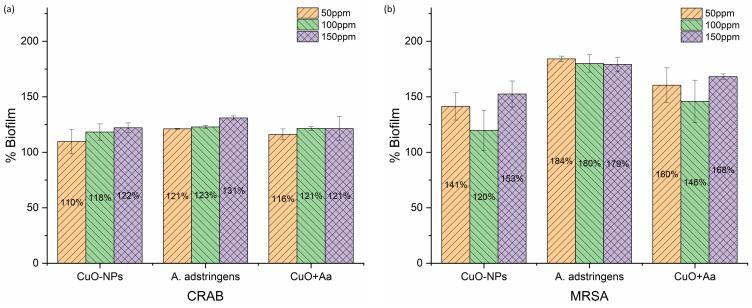
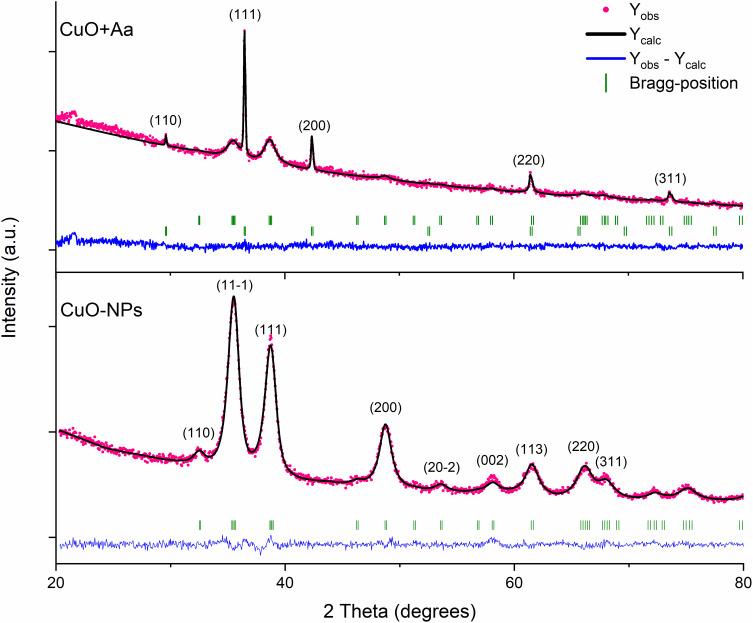
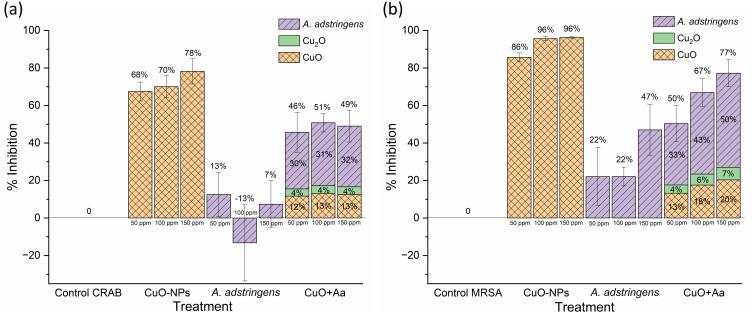
CuO+Aa nanoparticles were smaller (3.46 nm) than CuO-NPs (5.32 nm). TGA indicated improved thermal degradation in CuO+Aa, suggesting incorporation of organic compounds. XRD revealed a shift from CuO to a mixed CuO-CuO phase (75.15%-24.84%) in CuO+Aa due to the functional groups present in the extract. Antibacterial assays showed that CuO+Aa inhibited MRSA and CRAB by 77% and 49%, respectively, using only 17.5 ppm of copper oxides-significantly lower than CuO-NPs, which required 150 ppm to achieve 96% and 78% inhibition. SEM revealed bacterial surface damage, including roughness, perforations, and cell wall collapse. All treatments showed low cytotoxicity (<2% hemolysis). Biofilm formation increased by 180% in MRSA and 131% in CRAB.
CONCLUSION
ethanolic extract enhances CuO nanoparticle synthesis, reducing size and maintaining strong antibacterial activity with low toxicity. CuO+Aa represents a promising candidate for future biomedical applications against resistant pathogens.
引言
本研究调查了乙醇提取物在氧化铜纳米颗粒(CuO+Aa)合成中的掺入情况,并评估了它们对耐甲氧西林金黄色葡萄球菌(MRSA)和耐碳青霉烯类鲍曼不动杆菌(CRAB)的抗菌活性。为了评估提取物的影响,还测试了化学合成的氧化铜纳米颗粒(CuO-NPs)和单独的提取物。CuO-NPs和提取物均以其抗菌特性而闻名。
方法
使用提取物合成CuO+Aa纳米颗粒,并通过透射电子显微镜(TEM)、动态光散射(DLS)、zeta电位、热重分析(TGA)和X射线衍射(XRD)对其进行表征,并与CuO-NPs进行比较。使用电感耦合等离子体质谱(ICP-MS)、紫外可见光谱、傅里叶变换红外光谱(FTIR)、拉曼光谱和核磁共振光谱(NMR)分析提取物的影响。使用微滴技术和生物膜抑制测试抗菌效果。通过扫描电子显微镜(SEM)观察细菌结构变化,并通过溶血试验测量细胞毒性。
结果
CuO+Aa纳米颗粒(3.46纳米)比CuO-NPs(5.32纳米)更小。TGA表明CuO+Aa的热降解有所改善,表明有有机化合物掺入。XRD显示,由于提取物中存在的官能团,CuO+Aa中从CuO相转变为混合的CuO-CuO相(75.15%-24.84%)。抗菌试验表明,CuO+Aa仅使用17.5 ppm的氧化铜就能分别抑制MRSA和CRAB达77%和49%,显著低于CuO-NPs,后者需要150 ppm才能达到96%和78%的抑制率。SEM显示细菌表面受损,包括粗糙度增加、穿孔和细胞壁塌陷。所有处理均显示出低细胞毒性(<2%溶血)。MRSA中的生物膜形成增加了180%,CRAB中的生物膜形成增加了131%。
结论
乙醇提取物增强了CuO纳米颗粒的合成,减小了尺寸,并保持了低毒性的强抗菌活性。CuO+Aa是未来针对耐药病原体的生物医学应用的有前途的候选物。






 Zotero 插件