
蛋白质组学特征作为动脉粥样硬化负担的生物标志物
Proteomic Signatures as Biomarkers of Atherosclerosis Burden.
作者信息
Zhang Lanyue, Omarov Murad, Xu LingLing, Das Barnali, Luo Hong, Hauck Stefanie M, Petrera Agnese, Yu Zhi, Goonewardena Sascha N, Zeggini Eleftheria, Peters Annette, Dichgans Martin, Murthy Venkatesh L, Thorand Barbara, Georgakis Marios K
机构信息
Institute for Stroke and Dementia Research (ISD), LMU University Hospital, LMU Munich, Munich, Germany.
Urological Diseases Research Center, Boston Children's Hospital, Boston, MA, USA.
出版信息
Res Sq. 2025 Jun 10:rs.3.rs-6837440. doi: 10.21203/rs.3.rs-6837440/v1.
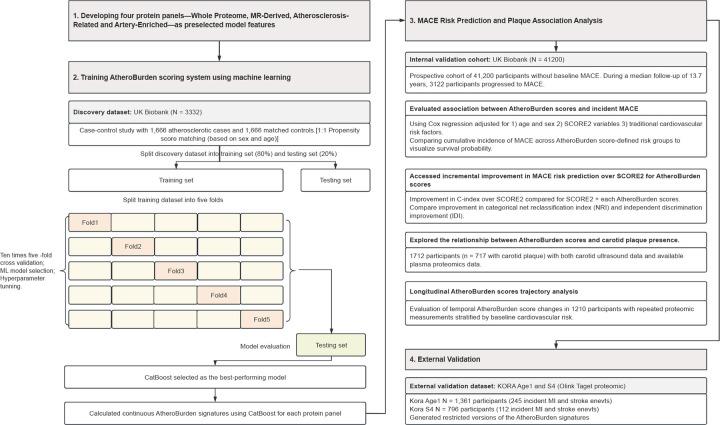
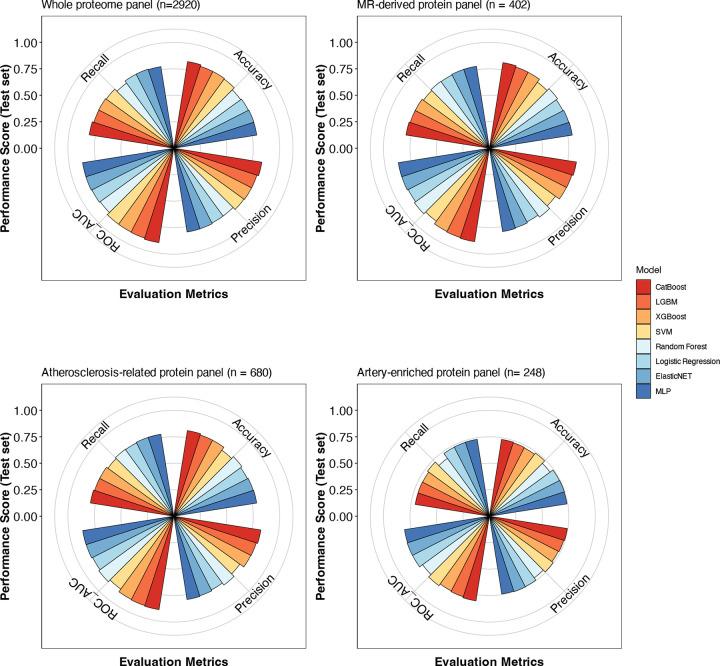
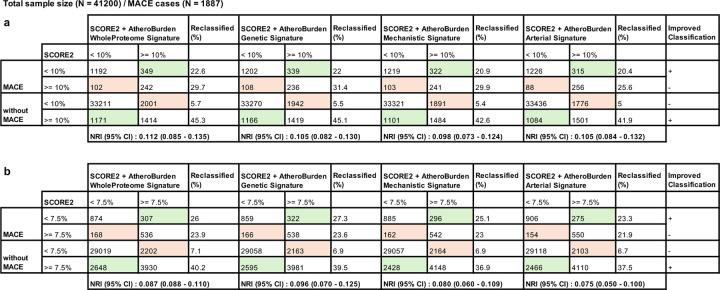
Atherosclerosis progresses silently over decades before manifesting clinically as myocardial infarction or stroke. Currently, no circulating biomarker reliably quantifies the burden of atherosclerosis beyond imaging techniques. Here, we sought to define plasma proteomic signatures that reflect the systemic burden of atherosclerosis. Using CatBoost machine learning applied to plasma proteomes (Olink Explore 3072; 2,920 proteins) from 44,788 UK Biobank participants, we derived four proteomic signatures which robustly discriminated individuals with known atherosclerotic disease from propensity score-matched controls (ROC-AUC up to 0.92, 95% CI: 0.90-0.94 in the test set). Each signature was based on distinct protein sets: the whole proteome (WholeProteome; n = 2920), proteins associated with genetic predisposition to atherosclerosis (Genetic; n = 402), those implicated in atherogenesis (Mechanistic; n = 680), and proteins enriched in arterial tissue (Arterial; n = 248). Among 41,200 individuals without atherosclerosis at baseline, all four signatures were strongly associated with future major adverse cardiovascular events over a median follow-up of 13.7 years (HR per SD increase in WholeProteome signature: 1.70, 95% CI: 1.64-1.77), providing significant improvements in risk discrimination (ΔC-index: +0.036; p <0.0001) and reclassification (Net Reclassification Index: 0.085-0.135 at a 10% risk threshold) beyond SCORE2. Signature levels increased with the number of clinically affected vascular beds, correlated with carotid ultrasound-measured plaque burden, and predicted future myocardial infarction and stroke in the external KORA S4 (n=1,361) and KORA-Age1 (n=796) cohorts with a median follow-up period of 15.1 and 6.8 years, respectively. Longitudinal analyses across three serial assessments showed that all signatures followed distinct trajectories, with significantly steeper annual increases among individuals with a higher burden of vascular risk factors. These findings demonstrate that proteomic signatures effectively capture atherosclerotic burden and improve cardiovascular risk prediction in asymptomatic individuals. Plasma proteomics may serve as a scalable and accessible alternative to imaging for identifying subclinical atherosclerosis, thereby supporting prevention strategies for cardiovascular disease.
动脉粥样硬化在临床上表现为心肌梗死或中风之前,会在数十年间悄然发展。目前,除了成像技术外,没有循环生物标志物能够可靠地量化动脉粥样硬化的负担。在此,我们试图定义反映动脉粥样硬化全身负担的血浆蛋白质组学特征。我们将CatBoost机器学习应用于来自44788名英国生物银行参与者的血浆蛋白质组(Olink Explore 3072;2920种蛋白质),得出了四种蛋白质组学特征,这些特征能够有力地区分已知患有动脉粥样硬化疾病的个体与倾向评分匹配的对照组(测试集中的ROC-AUC高达0.92,95%CI:0.90-0.94)。每个特征都基于不同的蛋白质集:全蛋白质组(WholeProteome;n = 2920)、与动脉粥样硬化遗传易感性相关的蛋白质(Genetic;n = 402)、参与动脉粥样硬化形成的蛋白质(Mechanistic;n = 680)以及在动脉组织中富集的蛋白质(Arterial;n = 248)。在基线时无动脉粥样硬化的41200名个体中,在中位随访13.7年期间,所有这四种特征都与未来的主要不良心血管事件密切相关(全蛋白质组特征每增加一个标准差的HR:1.70,95%CI:1.64-1.77),在风险区分(ΔC指数:+0.036;p <0.0001)和重新分类(在10%风险阈值下的净重新分类指数:0.085-0.135)方面比SCORE2有显著改善。特征水平随着临床受累血管床的数量增加而升高,与颈动脉超声测量的斑块负担相关,并在外部KORA S4(n = 1361)和KORA-Age1(n = 796)队列中分别中位随访15.1年和6.8年时预测未来的心肌梗死和中风。对三次连续评估进行的纵向分析表明,所有特征都遵循不同的轨迹,在血管危险因素负担较高的个体中,年增长率明显更陡。这些发现表明,蛋白质组学特征能够有效捕捉动脉粥样硬化负担,并改善无症状个体的心血管风险预测。血浆蛋白质组学可作为一种可扩展且易于获取的替代成像方法,用于识别亚临床动脉粥样硬化,从而支持心血管疾病的预防策略。





 Zotero 插件