
艰难梭菌感染中的粪便微生物群移植(FMT):胃肠道微生物组调节的范式转变
Fecal Microbiota Transplantation (FMT) in Clostridium difficile Infection: A Paradigm Shift in Gastrointestinal Microbiome Modulation.
作者信息
Hamza Saeed Muhammad, Qamar Sundas, Ishtiaq Ayesha, Umaira Khan Qudsia, Atta Asma, Atta Maryam, Ishtiaq Hifza, Khan Marriam, Saeed Muhammad Rawal, Iqbal Ayesha
机构信息
Internal Medicine, Russells Hall Hospital, Dudley, GBR.
Geriatrics, Russells Hall Hospital, Dudley, GBR.
出版信息
Cureus. 2025 May 29;17(5):e85054. doi: 10.7759/cureus.85054. eCollection 2025 May.
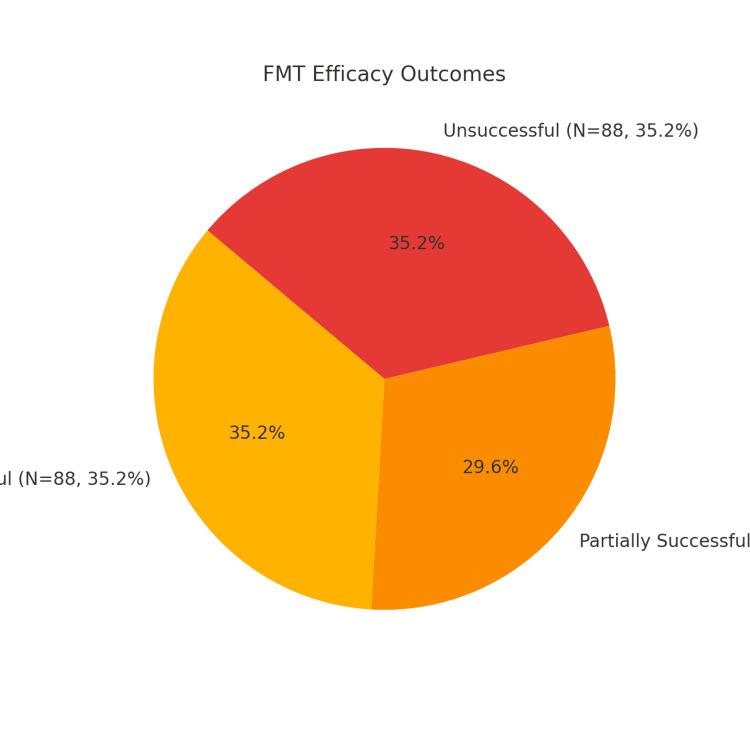
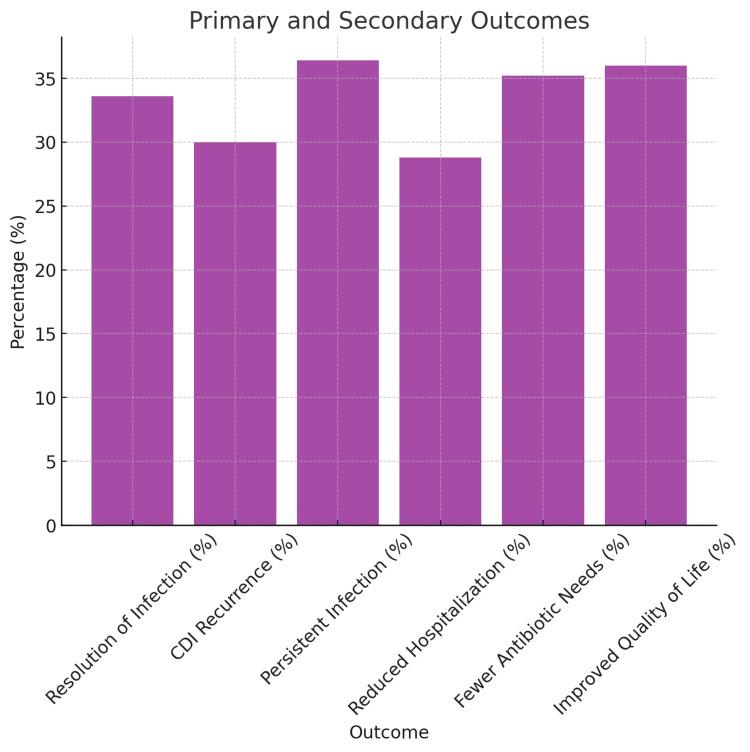
() infection (CDI) poses a tremendous clinical challenge, especially in patients with recurrent disease and antibiotic resistance. Fecal microbiota transplantation (FMT) has become a new therapeutic strategy for restoring gut microbiota and decreasing CDI recurrence. The study aims to assess the clinical effectiveness of FMT in adult subjects with recurrent or refractory CDI, determine its effect on gut microbiome diversity, and track safety outcomes and rates of recurrence post-treatment. FMT was compared against standard antibiotic treatments to establish its efficacy in decreasing infection persistence and improving patients' quality of life. This study examines the efficacy, safety, and modulation of microbiota by FMT in an ensemble of 250 patients diagnosed with CDI, with equal gender distribution and a mean age of 55.61. Among the study participants, 131 (52.4%) underwent FMT by various routes of administration, including 66 (25.2%) through colonoscopy, 73 (29.2%) via a nasogastric tube, 60 (24.0%) via enema, and 54 (21.6%) through oral capsule administration. The success rate for FMT was reported as 88 (35.2%), partial success at 74 (29.6%), and treatment failure at 88 (35.2%). CDI recurrence was reported in 130 (52.0%) of patients after FMT. The gut microbiome enhanced diversity, measured in terms of the Shannon Diversity Index, increased significantly from 3.96 before FMT to 5.88 after FMT, thus indicating a favorable impact on gut microbial composition. Furthermore, 132 (52.8%) converted from polymerase chain reaction (PCR) toxin positive to negative, corroborating successful pathogen clearance. On secondary outcomes, the quality of life in patients improved in 90 (36%), antibiotic dependence was reduced in 88 (35.2%), and hospitalization was lessened in 72 (28.8%). Inflammatory markers, such as white blood cell (WBC) counts and C-reactive protein (CRP), went downward but did not reach statistical significance. Logistic regression analysis identified age, severity of CDI, and prior exposure to antibiotics as the main predictors for the efficacy of FMT (p < 0.05). It is concluded that FMT is a promising alternative treatment for recurrent CDI through modulation of gut microbiota and decreasing the severity of infection. Future work is, however, required to establish treatment protocols with optimized results for long-term effectiveness and minimized recurrence risks.
艰难梭菌感染(CDI)带来了巨大的临床挑战,尤其是在复发性疾病和抗生素耐药的患者中。粪便微生物群移植(FMT)已成为恢复肠道微生物群和降低CDI复发率的一种新的治疗策略。本研究旨在评估FMT对复发性或难治性CDI成年患者的临床疗效,确定其对肠道微生物群多样性的影响,并追踪治疗后的安全性结果和复发率。将FMT与标准抗生素治疗进行比较,以确定其在降低感染持续性和改善患者生活质量方面的疗效。本研究考察了FMT对250例诊断为CDI患者的疗效、安全性及微生物群调节作用,这些患者性别分布均匀,平均年龄为55.61岁。在研究参与者中,131例(52.4%)通过各种给药途径接受了FMT,包括66例(25.2%)通过结肠镜检查、73例(29.2%)通过鼻胃管、60例(24.0%)通过灌肠以及54例(21.6%)通过口服胶囊给药。FMT的成功率报告为88例(35.2%),部分成功为74例(29.6%),治疗失败为88例(35.2%)。FMT后130例(52.0%)患者报告有CDI复发。以香农多样性指数衡量的肠道微生物群多样性增强,从FMT前的3.96显著增加到FMT后的5.88,这表明对肠道微生物组成有有利影响。此外,132例(52.8%)从聚合酶链反应(PCR)毒素阳性转为阴性,证实病原体清除成功。在次要结果方面,90例(36%)患者的生活质量得到改善,88例(35.2%)患者的抗生素依赖性降低,72例(28.8%)患者的住院时间缩短。炎症标志物,如白细胞(WBC)计数和C反应蛋白(CRP)有所下降,但未达到统计学意义。逻辑回归分析确定年龄、CDI严重程度和既往抗生素暴露是FMT疗效的主要预测因素(p<0.05)。结论是,FMT通过调节肠道微生物群和降低感染严重程度,是复发性CDI一种有前景的替代治疗方法。然而,未来需要开展工作以建立具有优化结果的治疗方案,实现长期有效性并将复发风险降至最低。


 Zotero 插件