
从巴西梅亚蓬特河及其污水中分离出耐甲氧西林金黄色葡萄球菌(MRSA)的首次记录:对1198株分离菌的分析。
First record of methicillin-resistant (MRSA) isolated from the Meia Ponte River and effluent in Brazil: an analysis of 1198 isolates.
作者信息
Dos Santos Igor Romeiro, de Lima Leandro Fonseca, de Souza Marcelino Benvindo, da Silva Isabela Náthaly Machado, de Sousa Adriano Roberto Vieira, Bailão Alexandre Melo, do Amaral Cátia Lira, Bailão Elisa Flávia Luiz Cardoso
机构信息
Laboratório de Biotecnologia, Câmpus Central, Universidade Estadual de Goiás, Anápolis, GO, Brazil.
Laboratório de Biologia Molecular, Câmpus Samambaia, Universidade Federal de Goiás, Goiânia, GO, Brazil.
出版信息
New Microbes New Infect. 2025 Jun 4;66:101603. doi: 10.1016/j.nmni.2025.101603. eCollection 2025 Aug.
OBJECTIVE
This study aimed to detect environmental reservoirs of multidrug-resistant and methicillin-resistant (MRSA) in Central Brazil.
METHODS
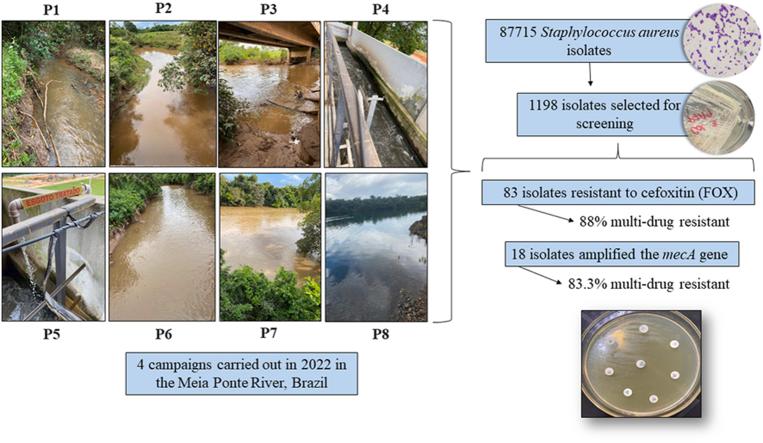
Membrane filtration with growth on Baird-Parker agar base was used to recover and MRSA from the effluents of a sewage treatment plant (STP) and surface water from an important Cerrado river. Effluent samples were collected at two points in the STP (pre- and post-treatment). Surface water was collected at six points along the Meia Ponte River, from its source to the mouth. Air samples were collected at all these collection points in 2022, totaling four campaigns between the dry and rainy seasons.
RESULTS
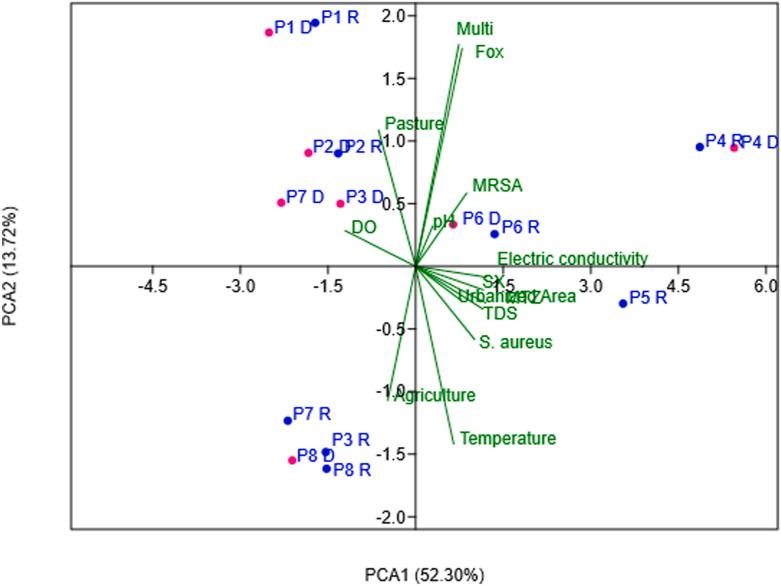
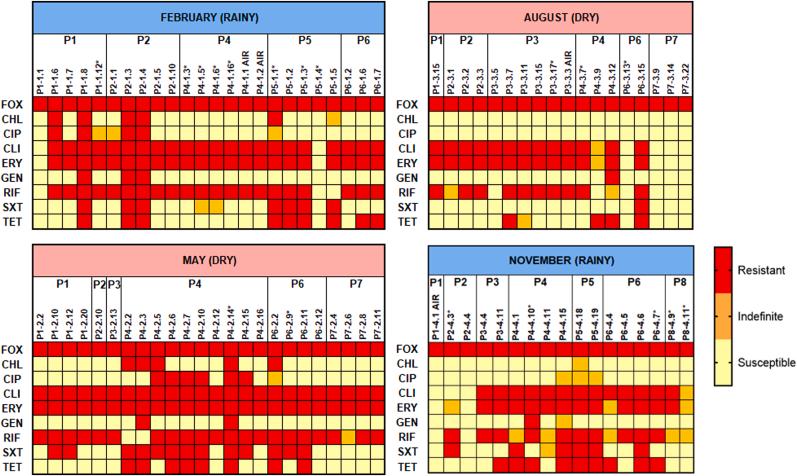
was isolated at all collection points in all campaigns, totaling 87715 isolates. Of the 1198 selected isolates, 83 were cefoxitin (FOX)-resistant, indicating a methicillin-resistance phenotype. The antimicrobial profiles of the 83 FOX-resistant isolates were investigated, and 88 % could be considered multidrug-resistant . Of the 83 FOX-resistant isolates, more than 70 % were resistant to clindamycin, erythromycin, and rifampicin. The presence of the gene was confirmed in 18 isolates collected along the Meia Ponte River and inside the STP, with 15 exhibiting multidrug-resistant phenotypes. The results of the principal component analysis (PCA) revealed an association between isolates and the urbanized environment/STP, as well as the presence of antimicrobials.
CONCLUSION
This study is a pioneer in identifying the presence of MRSA in Brazilian water bodies, highlighting the urgent need for monitoring antimicrobial resistance in urban rivers.
目的
本研究旨在检测巴西中部耐多药和耐甲氧西林金黄色葡萄球菌(MRSA)的环境储存库。
方法
采用在贝尔德-帕克琼脂基础上生长的膜过滤法,从污水处理厂(STP)的废水和一条重要的塞拉多河流的地表水样本中分离出金黄色葡萄球菌和MRSA。废水样本在STP的两个点(处理前和处理后)采集。地表水在梅亚蓬特河沿线从源头到河口的六个点采集。2022年在所有这些采集点采集空气样本,在旱季和雨季之间共进行了四次采样活动。
结果
在所有采样活动的所有采集点均分离出金黄色葡萄球菌,共分离出87715株菌株。在1198株选定的菌株中,83株对头孢西丁(FOX)耐药,表明具有耐甲氧西林表型。对这83株FOX耐药菌株的抗菌谱进行了研究,88%可被认为是耐多药的。在83株FOX耐药菌株中,超过70%对克林霉素、红霉素和利福平耐药。在沿梅亚蓬特河和STP内部采集的18株菌株中证实了mecA基因的存在,其中15株表现出耐多药表型。主成分分析(PCA)结果显示,金黄色葡萄球菌菌株与城市化环境/STP以及抗菌药物的存在之间存在关联。
结论
本研究是在巴西水体中鉴定MRSA存在情况的开创性研究,突出了监测城市河流中抗菌药物耐药性的迫切需求。

 Zotero 插件