
苯扎氯铵烷基链长度与病毒灭活之间关系的研究
Study on the relationship between viral inactivation and alkyl chain length of benzalkonium chloride.
作者信息
Takada Ikumi, Miyazaki Atsushi, Igarashi Chisato, Yamawaki Yukiko, Hayase Atsuko, Mori Takuya, Sakai Takaya
机构信息
Biological Material Science Research Laboratory, Kao Corporation, Tochigi, Japan.
Biological Material Science Research Laboratory, Kao Corporation, Tokyo, Japan.
出版信息
PLoS One. 2025 Jun 30;20(6):e0325981. doi: 10.1371/journal.pone.0325981. eCollection 2025.
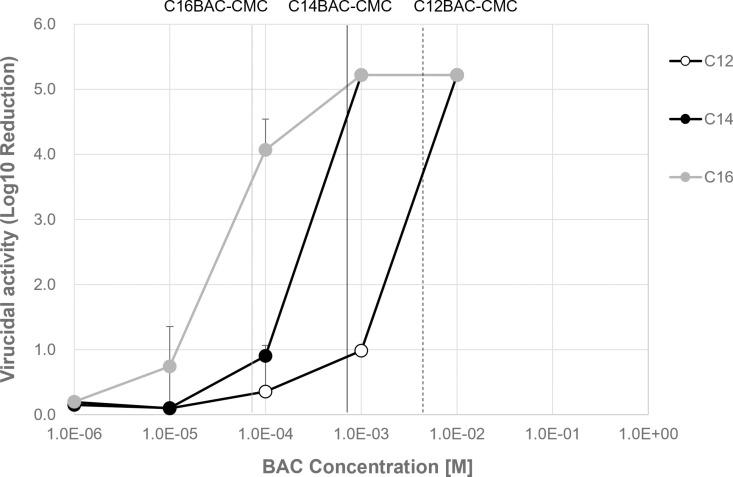
Alkyldimethylbenzylammonium chloride (BAC), a quaternary ammonium salt surfactant, is commonly utilized as a sanitizer and disinfectant. Concerns have emerged regarding the increasing global exposure to BAC, emphasizing the need for strategies to maximize its efficacy while minimizing its usage. Therefore, it is crucial to understand BAC's effects on bacteria and viruses, and its mechanism of action. Our previous research demonstrated that BAC micelles solubilizes the lipid bilayer of viruses, significantly enhancing virus inactivation efficacy at concentrations exceeding the critical micelle concentration (CMC). We focused on the alkyl chain length of BAC to elucidate how variations in CMC, driven by differences in alkyl chain length, influence virus inactivation activity. We measured CMC and assessed influenza virus inactivation for benzyldodecyldimethylammonium chloride (C12BAC), benzyltetradecyldimethylammonium chloride (C14BAC), benzylhexadecyldimethylammonium chloride (C16BAC), and their mixtures. The results showed that both BACs with a single alkyl chain length and mixed BACs exhibited significantly enhanced inactivation activity at concentrations of the CMC or above. Notably, BAC mixtures with comparable CMC values showed similar virucidal activity, suggesting that CMC can serve as a useful indicator in designing BAC mixtures aimed at virus inactivation, leading to the development of compositions with enhanced virus inactivation at lower doses. However, when the bactericidal activity of each BAC mixture against E. coli was tested under the same conditions, a significant bactericidal effect, of at least 3 Log10, was observed even at concentrations below CMC. This suggests that the bactericidal activity of BAC is not due to the micellization at CMC, but rather to the contribution of BAC monomers, indicating a distinct difference in the mechanism of action of BAC against viruses and bacteria. Therefore, when formulating BAC-based disinfectants, it is essential to assess the inactivation efficacy against both bacteria and viruses to ensure sufficient virus inactivation.
烷基二甲基苄基氯化铵(BAC)是一种季铵盐表面活性剂,通常用作消毒剂。随着全球范围内接触BAC的情况日益增加,人们开始担忧,这凸显了制定策略以在尽量减少其使用量的同时最大化其功效的必要性。因此,了解BAC对细菌和病毒的影响及其作用机制至关重要。我们之前的研究表明,BAC胶束可溶解病毒的脂质双层,在浓度超过临界胶束浓度(CMC)时显著提高病毒灭活效果。我们聚焦于BAC的烷基链长度,以阐明由烷基链长度差异驱动的CMC变化如何影响病毒灭活活性。我们测量了苄基十二烷基二甲基氯化铵(C12BAC)、苄基十四烷基二甲基氯化铵(C14BAC)、苄基十六烷基二甲基氯化铵(C16BAC)及其混合物的CMC,并评估了它们对流感病毒的灭活效果。结果表明,具有单一烷基链长度的BAC和混合BAC在CMC及以上浓度时均表现出显著增强的灭活活性。值得注意的是,具有可比CMC值的BAC混合物表现出相似的杀病毒活性,这表明CMC可作为设计旨在灭活病毒的BAC混合物的有用指标,从而开发出在较低剂量下具有增强病毒灭活效果的组合物。然而,当在相同条件下测试每种BAC混合物对大肠杆菌的杀菌活性时,即使在低于CMC的浓度下也观察到了至少3个对数10的显著杀菌效果。这表明BAC的杀菌活性并非源于CMC时的胶束化,而是由于BAC单体的作用,这表明BAC对病毒和细菌的作用机制存在明显差异。因此,在配制基于BAC的消毒剂时,必须评估其对细菌和病毒的灭活效果,以确保充分的病毒灭活。


 Zotero 插件