
丝氨酸/苏氨酸/酪氨酸激酶1通过糖原合成酶激酶3β隔离介导的Wnt/β-连环蛋白信号通路过度激活驱动胰腺癌发生。
Serine/threonine/tyrosine kinase 1 drives pancreatic carcinogenesis via GSK3β sequestration-mediated Wnt/β-catenin pathway hyperactivation.
作者信息
Zhou Cefan, Dong Xueying, Li Shi, Xi Yue, Liu Yuan, Qian Xuehong, Song Ziyan, Zhou Li, Zhang Rui, Lyu Hao, Xiao Shuai, Guo Dong, Zhang Qi, Liu Weiyong, Xiong Yan, Wang Zhentian, Yan Chaojun, Zhang Zijian, Zhu Haichuan, Chen Xing-Zhen, Song Zhiyin, Tang Jingfeng
机构信息
National "111" Center for Cellular Regulation and Molecular Pharmaceutics, Key Laboratory of Fermentation Engineering (Ministry of Education), Hubei University of Technology, Wuhan, China.
Membrane Protein Disease Research Group, Department of Physiology, Faculty of Medicine and Dentistry, University of Alberta, Edmonton, AB, Canada.
出版信息
Signal Transduct Target Ther. 2025 Jun 30;10(1):205. doi: 10.1038/s41392-025-02292-x.
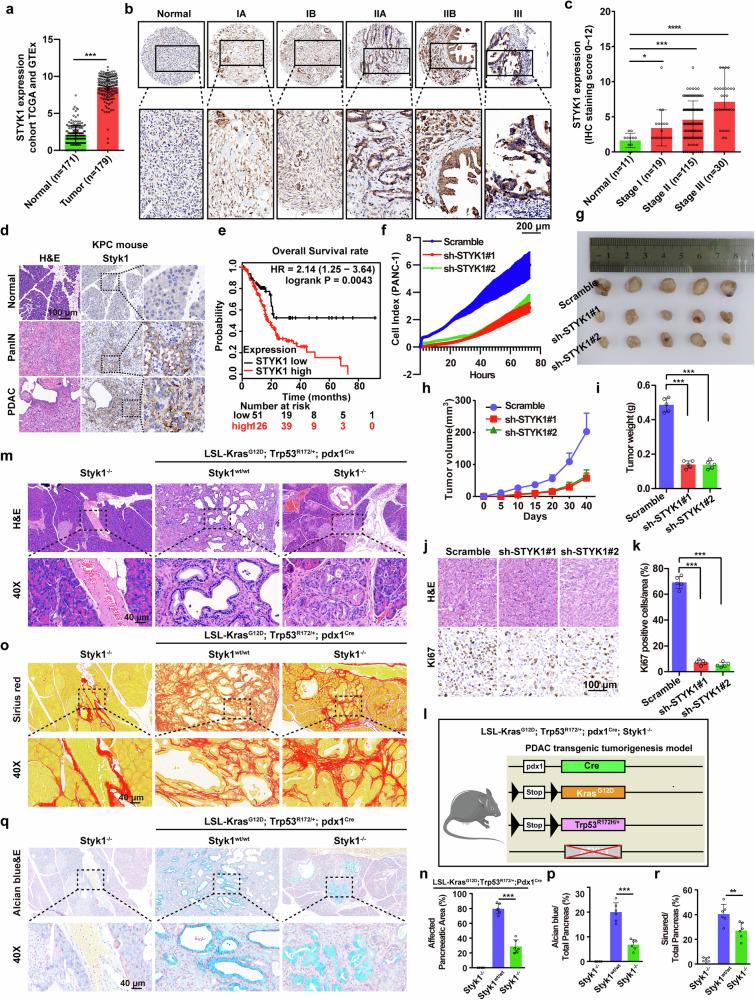
The Wnt/β-catenin pathway is strongly relevant to pancreatic cancer progression, poor prognostic outcomes, and elevated cancer-related mortality. However, the mechanism underlying continuously activated Wnt/β-catenin signaling in pancreatic cancer, a context in which adenomatous polyposis coli (APC) mutations are rarely observed, remains poorly understood. In this study, we investigated the role of STYK1 in regulating canonical Wnt/β-catenin signaling and pancreatic cancer tumorigenesis using the LSL-Kras; Trp53; Pdx1 mouse model. Our findings demonstrate that STYK1 directly binds to β-catenin and GSK3β, inhibiting GSK3β activity by increasing the level of its kinase-inactive form, which is phosphorylated at S9, and promoting its sequestration into MVBs. We further showed that STYK1-mediated GSK3β sequestration is impaired by autophagy inhibitors or in ATG7 knockout cells, linking this process to autophagic regulation. Structural analysis identified conserved tyrosine-based (Y191QRL194) and dileucine-based (GDLL203-204) sorting motifs in STYK1, which facilitate clathrin/AP2-dependent internalization essential for GSK3β sequestration. The phosphorylation of STYK1 at Y191 by BLK kinase enhances its interaction with AP2, thereby accelerating GSK3β sequestration and subsequent Wnt/β-catenin pathway activation. Notably, inhibitory peptides targeting either the STYK1-β-catenin or the STYK1-GSK3β interface significantly suppressed pancreatic cancer development in vitro and in vivo, underscoring their therapeutic potential. Collectively, these results elucidate a novel STYK1-driven mechanism for Wnt/β-catenin activation in APC-independent pancreatic cancer and provide preclinical evidence for targeting STYK1-mediated signaling as a therapeutic strategy.
Wnt/β-连环蛋白信号通路与胰腺癌进展、不良预后结果以及癌症相关死亡率升高密切相关。然而,在胰腺癌中,Wnt/β-连环蛋白信号持续激活的机制仍知之甚少,在这种情况下很少观察到腺瘤性息肉病 coli(APC)突变。在本研究中,我们使用 LSL-Kras;Trp53;Pdx1 小鼠模型研究了 STYK1 在调节经典 Wnt/β-连环蛋白信号和胰腺癌肿瘤发生中的作用。我们的研究结果表明,STYK1 直接与β-连环蛋白和 GSK3β结合,通过增加其在 S9 位点磷酸化的激酶非活性形式的水平来抑制 GSK3β活性,并促进其被隔离到多泡体中。我们进一步表明,自噬抑制剂或 ATG7 基因敲除细胞会损害 STYK1 介导的 GSK3β隔离,将这一过程与自噬调节联系起来。结构分析在 STYK1 中鉴定出保守的基于酪氨酸的(Y191QRL194)和基于双亮氨酸的(GDLL203 - 204)分选基序,这些基序促进了网格蛋白/AP2 依赖性内化,这对于 GSK3β隔离至关重要。BLK 激酶在 Y191 位点对 STYK1 的磷酸化增强了其与 AP2 的相互作用,从而加速 GSK3β隔离和随后的 Wnt/β-连环蛋白信号通路激活。值得注意的是,靶向 STYK1-β-连环蛋白或 STYK1-GSK3β界面的抑制性肽在体外和体内均显著抑制了胰腺癌的发展,突出了它们的治疗潜力。总体而言,这些结果阐明了一种在 APC 非依赖性胰腺癌中由 STYK1 驱动的 Wnt/β-连环蛋白激活新机制,并为将靶向 STYK1 介导的信号作为一种治疗策略提供了临床前证据。



 Zotero 插件